Overview
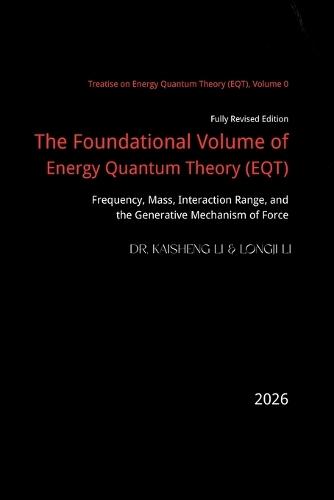
The Foundational Volume of Energy Quantum Theory is the opening volume of the Energy Quantum Theory (EQT) series. It does not retell the history of the Planck formula, but reconsiders the theoretical status of (E=h\nu). The central question is whether this relation should be treated only as a formula for photon energy and quantum transitions, or whether frequency can serve as a structural variable linking energy, mass, interaction range, field dynamics, and the generative mechanism of force. The book begins with the Planck relation and combines it with Einstein's mass-energy relation to obtain ( \nu = mc^2/h ). This mass-frequency relation is not used merely as a conversion formula. It provides a theoretical entrance through which massive objects can also be described in frequency terms. On this basis, the book develops a frequency spectrum in which propagation modes, stable massive modes, transitional modes, and possible higher- or lower-frequency structures can be compared along a common spectral coordinate. Frequency is then connected to wavelength, Compton scale, and effective range of action. The core object of EQT is the frequency-resolved energy quantum density field, ( \rho_f(x, t) ). This field is not ordinary matter density, not wave-function probability density, and not an auxiliary tool added after particles and forces are assumed. It is introduced as the foundational bearer of EQT. Particles are interpreted as stable or transient density-field modes formed under specific frequency bands, boundary conditions, and stabilization mechanisms. Forces are not primitive entities; they appear as effective actions generated by spatial density gradients, cross-frequency coupling, and the dynamical evolution of the density field. EQT is developed through four minimal postulates and one meta-norm. These define the basic ontology of the energy quantum density field, the universal spectral relation between frequency and energy, the master equation governing field evolution, and a Lorentzian resonance kernel constraining cross-frequency coupling. The meta-norm requires mechanism priority, derivational discipline, and falsifiability. Mass, force, particles, spacetime, and the frequency stratification of interactions are therefore not initial postulates, but must appear as inferences, limits, or open extensions. The volume also provides a foundational interface for the four forces. Gravity is treated as a low-frequency, long-scale, accumulative density-gradient limit; electromagnetism as a mid-frequency, low-dissipation propagation interface; the strong force as a high-frequency resonant-condensation interface; and the weak force as an ultra-high-frequency trans-frequency and short-lived mediation interface. The book does not claim to complete the full theory of each force. Its task is to establish the common postulates, terminology, formulas, and failure conditions required for later EQT volumes. A distinctive feature of this volume is its methodological restraint. It distinguishes postulates, definitions, inferences, extensions, and failure conditions, and insists that philosophical or cosmological interpretations must follow mechanism rather than precede it. Falsifiability is treated as an internal requirement: if mass-frequencyization cannot yield structural consequences, if the frequency spectrum cannot explain differences in range or stability, if the master equation cannot produce calculable limits, or if gradient-force relations cannot connect with known mechanical behavior, the corresponding module fails. This volume is therefore both a theoretical foundation and a constraint document for the EQT series. It seeks to transform the Planck formula from a familiar quantum energy relation into the entrance of a frequency-density-field mechanism, while maintaining clear boundaries among derivation, conjecture, correspondence with existing physics, and future research.
Full Product Details
Author: Longji Li ,
Kaisheng Li
Publisher: Independently Published
Imprint: Independently Published
Dimensions:
Width: 15.20cm
, Height: 2.60cm
, Length: 22.90cm
Weight: 0.676kg
ISBN: 9798196874215
Pages: 512
Publication Date: 14 May 2026
Audience:
General/trade
,
General
Format: Paperback
Publisher's Status: Active
Availability: Available To Order

We have confirmation that this item is in stock with the supplier. It will be ordered in for you and dispatched immediately.