Overview
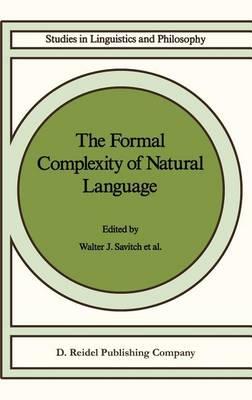
Ever since Chomsky laid the framework for a mathematically formal theory of syntax, two classes of formal models have held wide appeal. The finite state model offered simplicity. At the opposite extreme numerous very powerful models, most notable transformational grammar, offered generality. As soon as this mathematical framework was laid, devastating arguments were given by Chomsky and others indicating that the finite state model was woefully inadequate for the syntax of natural language. In response, the completely general transformational grammar model was advanced as a suitable vehicle for capturing the description of natural language syntax. While transformational grammar seems likely to be adequate to the task, many researchers have advanced the argument that it is ""too adequate. "" A now classic result of Peters and Ritchie shows that the model of transformational grammar given in Chomsky's Aspects [IJ is powerful indeed. So powerful as to allow it to describe any recursively enumerable set. In other words it can describe the syntax of any language that is describable by any algorithmic process whatsoever. This situation led many researchers to reasses the claim that natural languages are included in the class of transformational grammar languages. The conclu sion that many reached is that the claim is void of content, since, in their view, it says little more than that natural language syntax is doable algo rithmically and, in the framework of modern linguistics, psychology or neuroscience, that is axiomatic.
Full Product Details
Author: W.J. Savitch ,
E. Bach ,
W.E. Marsh ,
Gila Safran-Naveh
Publisher: Kluwer Academic Publishers Group
Imprint: Kluwer Academic Publishers
Edition: 1987 ed.
Volume: 33
Dimensions:
Width: 15.50cm
, Height: 2.60cm
, Length: 23.50cm
Weight: 1.860kg
ISBN: 9781556080463
ISBN 10: 1556080468
Pages: 452
Publication Date: 31 October 1987
Audience:
College/higher education
,
Professional and scholarly
,
Postgraduate, Research & Scholarly
,
Professional & Vocational
Format: Hardback
Publisher's Status: Active
Availability: In Print

This item will be ordered in for you from one of our suppliers. Upon receipt, we will promptly dispatch it out to you. For in store availability, please contact us.
Reviews
' .. Savitch et al. have done an excellent job, both in their selections and in their commentaries, of giving a solid introduction to a sparsely cultivated but already complex field. They have also done much to foster the dissemination and the comprehension of formal complexity results in liguistics and to encourage accuracy and lucidity in the formulation, presentation, and interpretation of such results.' A. Manaster-Ramer in Computational Linguistics, 14:4 (December 1988)
.. Savitch et al. have done an excellent job, both in their selections and in their commentaries, of giving a solid introduction to a sparsely cultivated but already complex field. They have also done much to foster the dissemination and the comprehension of formal complexity results in liguistics and to encourage accuracy and lucidity in the formulation, presentation, and interpretation of such results.' A. Manaster-Ramer in Computational Linguistics, 14: 4 (December 1988)
' .. Savitch et al. have done an excellent job, both in their selections and in their commentaries, of giving a solid introduction to a sparsely cultivated but already complex field. They have also done much to foster the dissemination and the comprehension of formal complexity results in liguistics and to encourage accuracy and lucidity in the formulation, presentation, and interpretation of such results.' A. Manaster-Ramer in Computational Linguistics, 14:4 (December 1988)