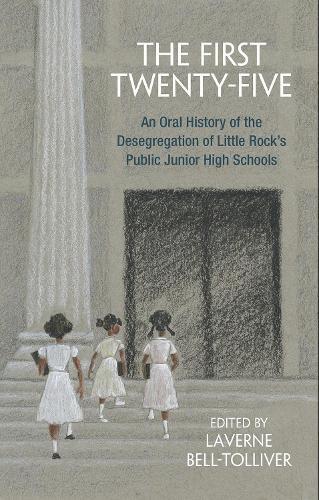
Full Product Details
Author: LaVerne Bell-Tolliver
Publisher: University of Arkansas Press
Imprint: University of Arkansas Press
Dimensions:
Width: 15.40cm
, Height: 3.00cm
, Length: 23.10cm
Weight: 0.615kg
ISBN: 9781682260470
ISBN 10: 168226047
Pages: 300
Publication Date: 28 February 2018
Audience:
Professional and scholarly
,
Professional & Vocational
Format: Hardback
Publisher's Status: Active
Availability: In Print

This item will be ordered in for you from one of our suppliers. Upon receipt, we will promptly dispatch it out to you. For in store availability, please contact us.
Reviews
The collection extends our understanding of school desegregation in Little Rock beyond the iconic events of 1957-1959. It places emphasis on the next generation of firsts at the junior high school level, but many of the participants also went on to attend Central High in the mid-1960s, and the interviews provide valuable insight into the ongoing process of desegregation there as well. The First Twenty-Five calls attention to the evolution of school desegregation policy in Little Rock at the crucial juncture when massive resistance gave way to a focus on pupil placement procedures that were designed to keep the number of black students attending the city's white schools as small as possible. ... The First Twenty-Five assembles a useful set of interviews that will afford readers access to multiple and divergent perspectives. It may be a particularly useful tool for middle and junior high school teachers because it will enable young people to sec this history through the eyes of students like themselves. --Erin Krutko Devlin, Arkansas Historical Quarterly, Spring 2018 It might seem redundant to remind ourselves that the people featured in video footage of news stories -- the black-and-white images capturing a precise moment in our shared past -- are actual human beings, not simply a visual complement. We forget this, though; the images today move too quickly. The impressions are too fleeting, and there's a future-seeking urgency to click or swipe to the next thing before we even have a chance to fully grasp what we're seeing. Often, it takes a book like Dr. LaVerne Bell-Tolliver's The First Twenty-Five: An Oral History of the Desegregation of Little Rock's Public Junior High Schools to cut through the Hollywood sheen of made-for-television history and punctuate the lives of those who shaped and changed our world. --Matt Baker, Arkansas Times, February 2015 LaVerne Bell-Tolliver's work is a critical benchmark for American ethnographies; her narrative is deeply revealing, accessible, sensitive, and insightful. This is an illuminating text for all scholars interested in how ethnic groups undergo and experience social change through key moments in American history. As such, this work will likely inspire generations of scholarship in cultural history and social ecology in Arkansas, the American South, and beyond. --Justin M. Nolan, associate professor and chair, Department of Anthropology, University of Arkansas LaVerne Bell-Tolliver focuses on stories that haven't been told before, which automatically makes them important for just about any community. I almost think those stories could be about anything--childhood games, ghost stories, eccentric relatives--and she could have written a version of this book. But her work has special power because it concerns the entry of some brave people into the previously forbidden world of the white schools. This is an important book. --David Stricklin, Director, Butler Center for Arkansas Studies
LaVerne Bell-Tolliver's work is a critical benchmark for American ethnographies; her narrative is deeply revealing, accessible, sensitive, and insightful. This is an illuminating text for all scholars interested in how ethnic groups undergo and experience social change through key moments in American history. As such, this work will likely inspire generations of scholarship in cultural history and social ecology in Arkansas, the American South, and beyond. --Justin M. Nolan, associate professor and chair, Department of Anthropology, University of Arkansas LaVerne Bell-Tolliver focuses on stories that haven't been told before, which automatically makes them important for just about any community. I almost think those stories could be about anything--childhood games, ghost stories, eccentric relatives--and she could have written a version of this book. But her work has special power because it concerns the entry of some brave people into the previously forbidden world of the white schools. This is an important book. --David Stricklin, Director, Butler Center for Arkansas Studies
It might seem redundant to remind ourselves that the people featured in video footage of news stories -- the black-and-white images capturing a precise moment in our shared past -- are actual human beings, not simply a visual complement. We forget this, though; the images today move too quickly. The impressions are too fleeting, and there's a future-seeking urgency to click or swipe to the next thing before we even have a chance to fully grasp what we're seeing. Often, it takes a book like Dr. LaVerne Bell-Tolliver's The First Twenty-Five: An Oral History of the Desegregation of Little Rock's Public Junior High Schools to cut through the Hollywood sheen of made-for-television history and punctuate the lives of those who shaped and changed our world. --Matt Baker, Arkansas Times, February 2015 LaVerne Bell-Tolliver's work is a critical benchmark for American ethnographies; her narrative is deeply revealing, accessible, sensitive, and insightful. This is an illuminating text for all scholars interested in how ethnic groups undergo and experience social change through key moments in American history. As such, this work will likely inspire generations of scholarship in cultural history and social ecology in Arkansas, the American South, and beyond. --Justin M. Nolan, associate professor and chair, Department of Anthropology, University of Arkansas LaVerne Bell-Tolliver focuses on stories that haven't been told before, which automatically makes them important for just about any community. I almost think those stories could be about anything--childhood games, ghost stories, eccentric relatives--and she could have written a version of this book. But her work has special power because it concerns the entry of some brave people into the previously forbidden world of the white schools. This is an important book. --David Stricklin, Director, Butler Center for Arkansas Studies
LaVerne Bell-Tolliver's work is a critical benchmark for American ethnographies; her narrative is deeply revealing, accessible, sensitive, and insightful. This is an illuminating text for all scholars interested in how ethnic groups undergo and experience social change through key moments in American history. As such, this work will likely inspire generations of scholarship in cultural history and social ecology in Arkansas, the American South, and beyond. --Justin M. Nolan, associate professor and chair, Department of Anthropology, University of Arkansas LaVerne Bell-Tolliver focuses on stories that haven't been told before, which automatically makes them important for just about any community. I almost think those stories could be about anything--childhood games, ghost stories, eccentric relatives--and she could have written a version of this book. But her work has special power because it concerns the entry of some brave people into the previously forbidden world of the white schools. This is an important book. --David Stricklin, Director, Butler Center for Arkansas Studies
Author Information
LaVerne Bell-Tolliver, herself one of the ""first twenty-five,"" is an associate professor at the University of Arkansas at Little Rock School of Social Work. She has worked in the fields of mental health and child protective services and is senior pastor of Bullock Temple Christian Methodist Episcopal Church in Little Rock.