Overview
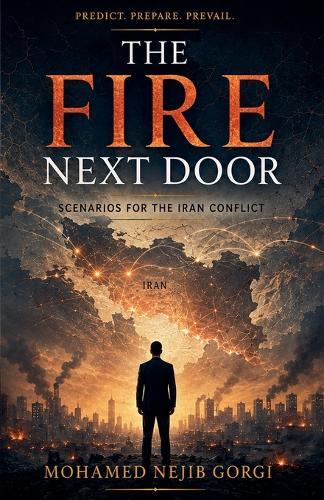
The Fire Next Door: Future Scenarios of the Iran Conflict is not a prediction. It is a map. In late February 2026, after years of shadow war and a devastating twelve-day exchange the previous summer, the United States and Israel launched Operation Epic Fury-the largest coordinated military campaign against a sovereign Middle Eastern state since the 2003 invasion of Iraq. Within seventy-two hours, Iran's declared nuclear infrastructure lay in ruins, Supreme Leader Ali Khamenei was dead, and the Strait of Hormuz was closed. The world watched as oil prices spiked to $160 a barrel, Hezbollah fired its largest rocket barrage in history, and the region teetered on the edge of nuclear use. Yet even as the bombs fell, veteran Tunisian diplomat and political scientist Mohamed Nejib Gorgi was writing a different kind of war book: one that refuses to predict the future but instead maps its plausible trajectories. Drawing on two decades of diplomatic service across Europe and Australasia, a doctorate in political science, and deep regional knowledge, Gorgi offers a rigorous, scenario-based analysis of the Iran-Israel conflict. He strips away the rhetoric and examines the raw machinery of each player's strategic logic-their wants, their fears, their capabilities, and, critically, their limitations. The Fire Next Door explores five distinct futures: the fragile stalemate of a frozen conflict, the grinding attrition of a long war, the catastrophic speed of a regional conflagration, the chaotic opportunity of an internal Iranian collapse, and the fragile hope of a diplomatic off-ramp. Each scenario is grounded in the physical realities of the Middle East-the chokepoints of Hormuz and Bab el-Mandeb, the geology of Fordow's mountain bunkers, the karstic tunnels of southern Lebanon, the flight time of hypersonic missiles, and the invisible geography of cyber and undersea cables. But this is not an abstract exercise. The book also profiles the key actors-Israel, Iran, the United States, the Gulf monarchies, Hezbollah, the Houthis, Turkey, Russia, China, and Europe-and examines their shifting interests in real time. It dissects the economic dimensions of the war: energy markets, financial systems, supply chains, and the human cost of sanctions and blockade. It exposes the information war that has poisoned public discourse and made compromise nearly impossible. And it offers ten pragmatic principles for de-escalation, drawn from the hard lessons of the Cuban Missile Crisis, the JCPOA, and the ceasefire that finally took effect in April 2026. What makes this book unique is its vantage point. Gorgi is neither an Israeli nor an Iranian nor a Western partisan. He is an Arab diplomat from Tunisia-a country that has navigated its own revolution, democratic transition, and return to authoritarianism. He brings the restraint of someone who has sat across negotiating tables and the urgency of someone who believes that clarity about plausible futures is the only responsible response to uncertainty. He writes with empathy for all sides, but with a cold eye for the structural forces-historical trauma, technological acceleration, proxy entanglement, and great-power rivalry-that have already made the Middle East more dangerous than at any time since 1979. The ceasefire of April 2026 is a pause, not a peace. The fire next door is not out; it is smouldering. This book is a warning, a tool, and an invitation to choose a different path. Essential reading for policymakers, analysts, students, and citizens who refuse to let the future be written only by missiles. ""The future is not a prediction. It is a choice. And the time to make it is now.""
Full Product Details
Author: Mohamed Nejib Gorgi
Publisher: Mohamed Nejib Gorgi
Imprint: Mohamed Nejib Gorgi
Dimensions:
Width: 14.00cm
, Height: 2.00cm
, Length: 21.60cm
Weight: 0.408kg
ISBN: 9798235876156
Pages: 354
Publication Date: 09 April 2026
Audience:
General/trade
,
General
Format: Paperback
Publisher's Status: Active
Availability: Available To Order

We have confirmation that this item is in stock with the supplier. It will be ordered in for you and dispatched immediately.
Author Information
Mohamed Nejib Gorgi is a senior career diplomat and political scientist whose work bridges the worlds of democratic theory, particularly democratic transition, resilience and consolidation, and those of governance and citicenship. With a PhD in Political Science and a distinguished record of service in international politics, he now channels his expertise into thought leadership on democratic resilience and citizenship maturity. Gorgi's scholarly excellence has been recognized with two of La Trobe University's most prestigious honors: The Rhys Isaac Prize (2022) - awarded annually to the most outstanding graduate thesis in the humanities and social sciences. His thesis, Ideological Polarisation as an Impediment to Democratic Consolidation in Tunisia, was distinguished for its originality and impact. The Nancy Millis Medal (2022) - presented to exceptional PhD candidates for the highest quality of doctoral research, underscoring his contribution to political science and democratic studies. As the author of Citizens' People, Gorgi offers a rare fusion of scholarly depth and mass-market clarity. His writing reflects years of diplomatic engagement, comparative analysis, and institutional reform - all grounded in Tunisia's lived experience and universal democratic aspirations. Fluent in multiple languages and formats, he adapts his voice to speak to policymakers, students, and engaged citizens alike.