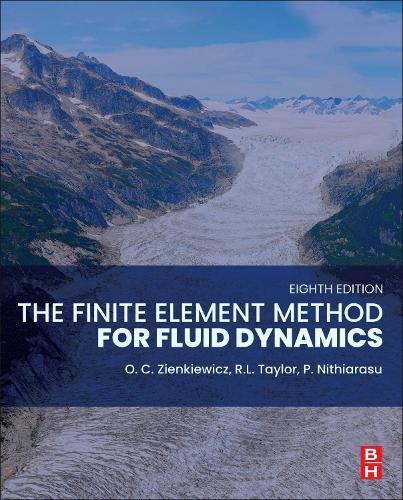
Overview
The Finite Element Method for Fluid Dynamics provides a comprehensive introduction to the application of the finite element method in fluid dynamics. The book begins with a useful summary of all relevant partial differential equations, progressing to the discussion of convection stabilization procedures, steady and transient state equations, and numerical solution of fluid dynamic equations. In this expanded eighth edition, the book starts by explaining the character-based split (CBS) scheme, followed by an exploration of various other methods, including SUPG/PSPG, space-time, and VMS methods. Emphasising the fundamental knowledge, mathematical, and analytical tools necessary for successful implementation of computational fluid dynamics (CFD), The Finite Element Method for Fluid Dynamics stands as the authoritative introduction of choice for graduate level students, researchers, and professional engineers.
Full Product Details
Author: R. L. Taylor (Emeritus Professor of Engineering, University of California, Berkeley, USA) ,
P. Nithiarasu (Professor, Zienkiewicz Institute for Modelling, Data and AI and Associate Dean for Research, Innovation and Impact, Faculty of Science and Engineering, Swansea University) ,
P. Nithiarasu (Professor, College of Engineering, University of Wales, Swansea, UK) ,
Alberto Coccarelli
Publisher: Elsevier - Health Sciences Division
Imprint: Butterworth-Heinemann Inc
Edition: 8th edition
Weight: 1.000kg
ISBN: 9780323958868
ISBN 10: 0323958869
Pages: 596
Publication Date: 27 November 2024
Audience:
Professional and scholarly
,
College/higher education
,
Professional & Vocational
,
Postgraduate, Research & Scholarly
Format: Hardback
Publisher's Status: Active
Availability: Manufactured on demand

We will order this item for you from a manufactured on demand supplier.
Author Information
Professor R.L. Taylor has more than 60 years of experience in the modelling and simulation of structures and solid continua including eighteen years in industry. He is Professor of the Graduate School and the Emeritus T.Y. and Margaret Lin Professor of Engineering at the University of California, Berkeley and also Corporate Fellow at Dassault Systèmes Americas Corp. in Johnston, Rhode Island. In 1991 he was elected to membership in the US National Academy of Engineering in recognition of his educational and research contributions to the field of computational mechanics. Professor Taylor is a Fellow of the US Association for Computational Mechanics – USACM (1996) and a Fellow of the International Association of Computational Mechanics – IACM (1998). He has received numerous awards including the Berkeley Citation, the highest honour awarded by the University of California, Berkeley, the USACM John von Neumann Medal, the IACM Gauss–Newton Congress Medal and a Dr.-Ingenieur ehrenhalber awarded by the Technical University of Hannover, Germany. Professor Taylor has written several computer programs for finite element analysis of structural and non-structural systems, one of which, FEAP, is used world-wide in education and research environments. A personal version, FEAPpv, available on GitHub, is incorporated into this book. P. Nithiarasu is Professor at Zienkiewicz Institute for Modelling, Data and AI and Associate Dean for Research, Innovation and Impact, Faculty of Science and Engineering, Swansea University. Previously he has served as the Head of Zienkiewicz Centre for Computational Engineering, Deputy Head of College of Engineering and Dean of Academic Leadership. He was awarded the Zienkiewicz silver medal from the ICE London in 2002, the ECCOMAS Young Investigator award in 2004, and the prestigious EPSRC Advanced Fellowship in 2006.