Overview
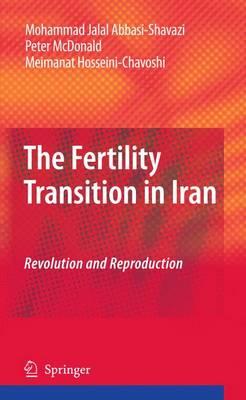
Confounding all conventional wisdom, the fertility rate in the Islamic Republic of Iran fell from around 7.0 births per woman in the early 1980s to 1.9 births per woman in 2006. That this, the largest and fastest fall in fertility ever recorded, should have occurred in one of the world’s few Islamic Republics demands explanation. This book, based upon a decade of research is the first to attempt such an explanation. The book documents the progress of the fertility decline and displays its association with social and economic characteristics. It addresses an explanation of the phenomenal fall of fertility in this Islamic context by considering the relevance of standard theories of fertility transition. The book is rich in data as well as the application of different demographic methods to interpret the data. All the available national demographic data are used in addition to two major surveys conducted by the authors. Demographic description is preceded by a socio-political history of Iran in recent decades, providing a context for the demographic changes. The authors conclude with their views on the importance of specific socio-economic and political changes to the demographic transition. Their concluding arguments suggest continued low fertility in Iran. The book is recommended to not only demographers, social scientists, and gender specialists, but also to policy makers and those who are interested in social and demographic changes in Iran and other Islamic countries in the Middle East. It is also a useful reference for demography students and researchers who are interested in applying fertility theories in designing surveys and analysing data.
Full Product Details
Author: Mohammad Jalal Abbasi-Shavazi ,
Peter McDonald ,
Meimanat Hosseini-Chavoshi
Publisher: Springer
Imprint: Springer
Edition: 2009 ed.
Dimensions:
Width: 15.50cm
, Height: 1.10cm
, Length: 23.50cm
Weight: 0.343kg
ISBN: 9789400718258
ISBN 10: 940071825
Pages: 195
Publication Date: 21 May 2011
Audience:
Professional and scholarly
,
Professional & Vocational
Format: Paperback
Publisher's Status: Active
Availability: Out of print, replaced by POD

We will order this item for you from a manufatured on demand supplier.
Reviews
From the reviews: The book is easy to read, and each chapter is written concisely with a clear organization ... . this is the first book in the field describing the astonishing fertility transition of Iran. I strongly recommend ... to researchers, policy makers, and senior undergraduate and graduate students who are interested in population changes in Iran, Muslim countries, and the Middle East. ... a book for those who are interested in knowing about the past, present, and future of fertility in Iran. (Amir Erfani, Canadian Studies in Population, Vol. 38 (1-2), Spring/Summer, 2011) In The Fertility Transition in Iran the authors provide a thorough analysis of the components of fertility behaviour, with particular attention to provincial differentials and broad coverage of as many census and survey data sets as they could access. The result is a definitive study of one of the most fascinating societies of the Middle East region. ... each institution should have a copy of this book in their library, and many of the English-speaking teachers of social sciences should have copies on their shelves. (Terence H. Hull, Journal of Population Research, Vol. 27, 2010)
<p>From the reviews: The book is easy to read, and each chapter is written concisely with a clear organization . this is the first book in the field describing the astonishing fertility transition of Iran. I strongly recommend to researchers, policy makers, and senior undergraduate and graduate students who are interested in population changes in Iran, Muslim countries, and the Middle East. a book for those who are interested in knowing about the past, present, and future of fertility in Iran. (Amir Erfani, Canadian Studies in Population, Vol. 38 (1-2), Spring/Summer, 2011)
From the reviews: The book is easy to read, and each chapter is written concisely with a clear organization ! . this is the first book in the field describing the astonishing fertility transition of Iran. I strongly recommend ! to researchers, policy makers, and senior undergraduate and graduate students who are interested in population changes in Iran, Muslim countries, and the Middle East. ! a book for those who are interested in knowing about the past, present, and future of fertility in Iran. (Amir Erfani, Canadian Studies in Population, Vol. 38 (1-2), Spring/Summer, 2011) In The Fertility Transition in Iran the authors provide a thorough analysis of the components of fertility behaviour, with particular attention to provincial differentials and broad coverage of as many census and survey data sets as they could access. The result is a definitive study of one of the most fascinating societies of the Middle East region. ! each institution should have a copy of this book in their library, and many of the English-speaking teachers of social sciences should have copies on their shelves. (Terence H. Hull, Journal of Population Research, Vol. 27, 2010)