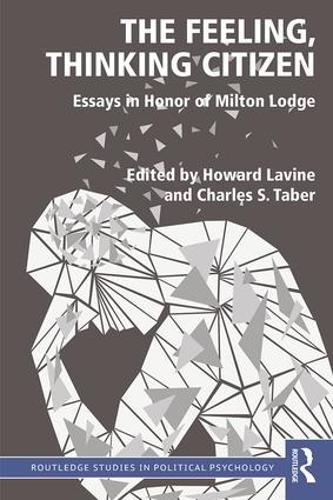
Full Product Details
Author: Howard Lavine (University of Minnesota, USA) ,
Charles S. Taber (Stony Brook University, USA)
Publisher: Taylor & Francis Inc
Imprint: Routledge
Weight: 0.400kg
ISBN: 9780815379409
ISBN 10: 0815379404
Pages: 256
Publication Date: 19 March 2018
Audience:
General/trade
,
College/higher education
,
General
,
Tertiary & Higher Education
Format: Paperback
Publisher's Status: Active
Availability: In Print

This item will be ordered in for you from one of our suppliers. Upon receipt, we will promptly dispatch it out to you. For in store availability, please contact us.
Reviews
'The depth and range of Milton Lodge's contributions to political psychology are highlighted by the distinction of the authors contributing to this volume. Its broad focus encompasses motivated reasoning, transfer of affect, and the problem of wobbly citizen civic expertise, among other topics.' - David O. Sears, Distinguished Professor of Psychology and Political Science, UCLA 'This is an important book. It demonstrates the powerful and far reaching influence that Milton Lodge has had on the development of political psychology. Not only has his personal research had a singular influence on the field but his example has demonstrated how political psychologists should conduct their work to meet the highest academic and scholarly standards.' - Edward G. Carmines, Distinguished Professor, Warner O. Chapman Professor of Political Science, and Rudy Professor, Indiana Universityã
'The depth and range of Milton Lodge's contributions to political psychology are highlighted by the distinction of the authors contributing to this volume. Its broad focus encompasses motivated reasoning, transfer of affect, and the problem of wobbly citizen civic expertise, among other topics.' - David O. Sears, Distinguished Professor of Psychology and Political Science, UCLA 'This is an important book. It demonstrates the powerful and far reaching influence that Milton Lodge has had on the development of political psychology. Not only has his personal research had a singular influence on the field but his example has demonstrated how political psychologists should conduct their work to meet the highest academic and scholarly standards.' - Edward G. Carmines, Distinguished Professor, Warner O. Chapman Professor of Political Science, and Rudy Professor, Indiana Universityã 'This is a book to prize. It is above all a book of ideas -- most centrally, the ideas of the preeminent researcher in the field, Milton Lodge, but additionally, as a bonus, the ideas of many who have had the good fortune of learning from him by working along side of him.' - Paul M. Sniderman, Stanford University
'The depth and range of Milton Lodge's contributions to political psychology are highlighted by the distinction of the authors contributing to this volume. Its broad focus encompasses motivated reasoning, transfer of affect, and the problem of wobbly citizen civic expertise, among other topics.' - David O. Sears, Distinguished Professor of Psychology and Political Science, UCLA 'This is an important book. It demonstrates the powerful and far reaching influence that Milton Lodge has had on the development of political psychology. Not only has his personal research had a singular influence on the field but his example has demonstrated how political psychologists should conduct their work to meet the highest academic and scholarly standards.' - Edward G. Carmines, Indiana University Bloomington
Author Information
Howard Lavine is Arleen C. Carlson Professor of Political Science and Psychology at the University of Minnesota and Director of the Center for the Study of Political Psychology. He is author of Open versus Closed: Personality, Identity and the Politics of Redistribution (2017) and The Ambivalent Partisan: How Critical Loyalty Promotes Democracy (2012), which won the Robert E. Lane and David O. Sears Book Awards. He is editor of Advances in Political Psychology. Charles S. Taber is Professor of Political Science and Dean of the Graduate School at Stony Brook University. He received his PhD from the University of Illinois, Urbana-Champaign in 1991, and works in the fields of political psychology and computational modeling. Taber has contributed to the growing literature on the psychological mechanisms that drive public opinion, and his 2013 book, The Rationalizing Voter, coauthored with Milton Lodge, won the Robert E. Lane Book Award and the Book of the Year Awards from the Experimental Politics and Migration and Citizenship Sections of the American Political Science Association.