Overview
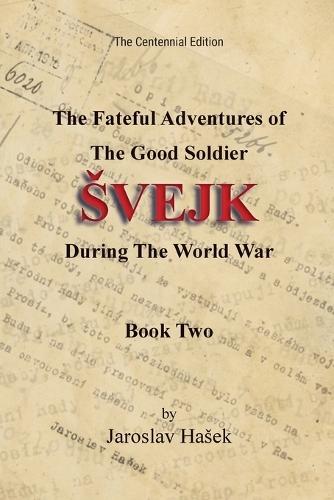
In Book Two of The Fateful Adventures of the Good Soldier Svejk, the reader boards a military train bound for the front-or so it appears. What follows is not a march toward battle but a prolonged detour through mishap, misidentification, and the self-consuming logic of military bureaucracy. At every stop-railway stations, police offices, infirmaries, barracks-Svejk is examined, interrogated, classified, misplaced, and examined again. Each authority must determine who he is, where he belongs, and whether he is an idiot, a criminal, or a spy. Rather than advancing the plot through decisive action, Hasek responds to this diagnostic frenzy with episodes: monologues, cross-examinations, false conclusions, and comical reversals. The novel begins to test itself, submitting its protagonist to trial after trial without ever reaching judgment. Identity exists only as something provisional-what can be written down, stamped, transferred, or revoked. This volume is the second of the two commonly regarded as the ""easier"" parts of the novel-praised for their narrative coherence, episodic clarity, and accessibility-yet it is here that Hasek's method fully crystallizes. The story becomes centrifugal rather than linear, throwing Svejk outward through institutions that cannot contain him. Along the way, the book accumulates reports, testimonies, dossiers, and tales within tales, revealing a world governed less by intention than by paperwork. What begins as a journey toward war widens into an inquiry into obedience, responsibility, and command. Svejk obeys every order, misunderstands nothing essential, and steadily disarms authority by exposing its contradictions. Book Two stands at the threshold of the novel's deeper structural logic, where comedy, bureaucracy, and moral inquiry converge-without resolution, and without appeal.
Full Product Details
Author: Jaroslav Hasek , Zdeněk Zenny K Sadloň , Lucille Sadlon
Publisher: Keenan, Sadlon & Lord, Inc.
Imprint: Keenan, Sadlon & Lord, Inc.
Dimensions:
Width: 15.20cm
, Height: 1.90cm
, Length: 22.90cm
Weight: 0.449kg
ISBN: 9798994308424
Pages: 334
Publication Date: 14 February 2026
Audience:
General/trade
,
General
Format: Paperback
Publisher's Status: Active
Availability: In Print 
This item will be ordered in for you from one of our suppliers. Upon receipt, we will promptly dispatch it out to you. For in store availability, please contact us.
Table of Contents
Reviews
Readers familiar with Hasek's satirical Czech novel of war and survival only from earlier English translations will likely be jolted by Sadlon's version, first published in 2000 and here updated in a new edition to mark the centennial of Hasek's 1923 death, which left the serialized novel unfinished. Often printed in the west with an emphasis, in both translation and critical assessment, on protagonist Svejk's good humor even as he gets impressed into becoming cannon fodder in the first World War, Hasek's masterpiece is revealed, in Sadlon's handling, as a book of greater bite, heft, and complexity. The broad strokes of this first book (of three) have not changed: After the assassination of Archduke Franz Ferdinand in 1914, the soldier Svejk finds himself interrogated and institutionalized in response to rambling remarks made about the Austrian emperor over a pub feast of ""five beers and one roll with a sausage."" Upon his release, Svejk receives a summons to a medical examination to determine his fitness to fight in the coming war. He demands his cleaning woman push him there in a wheelchair, declaring ""at a time when it is so grim for Austria, every cripple must be at his post."" As always, this first book of Hasek's sprawling novel centers on soldiers' talk, including scabrous monologues about latrines and what maladies will help get one out of service (""I got a dislocated foot for a tenner""), plus hilarious accounts of card games, training mishaps, and soldiers' certainty that they face death. Here, though, the laughs are more pained, the scatology more pointed, that good humor laced with mustard gas. Rather than a bumbling Pangloss, this Svejk resists readers' efforts to see him as sympathetic. He's often cruel and oafish, animated by no clear philosophy, quite unlike the pacifist teacher Hasek describes in the prison passages. The result is challenging and provocative, a century on. Prefatory material addressing translation issues is academic but illuminating. Takeaway: Illuminating translation of the human complexity of a Czech classic. - BookLife (Publishers Weekly), September 21, 2024
Author Information
Jaroslav Hasek (30 April 1883 - 3 January 1923), an author and satirist from Prague, he lived a short and extremely turbulent life. He is best known for his famous satirical novel The Fateful Adventures of the Good Soldier Svejk During the World War, but also wrote more than 1,200 short stories/feuilletons/articles, numerous poems, and co-authored some cabaret plays. Even before writing The Good Soldier Svejk (1921-22), Jaroslav Hasek had a reputation as a prominent satirist, but was also viewed as controversial, due to a period as an active anarchist. Hasek was also known for his many pranks. Hasek had repeated conflicts with the police, mostly due to drunkenness and public disorder. He was also under surveillance due to his involvement in the Anarchist movement. He was jailed several times, the most serious case was in 1907 when he was sentenced for inciting violence against the police during a demonstration on 1 May 1907. In 1911 Hasek had thought up Svejk. Five stories about the soldier were published, although very different from the later novel in style and content. On 17 February 1915 he was drafted into Austro-Hungarian Army, sent to the front in early July, and was captured by the Russians on 24 September 1915. In Russian POW camp Hasek contracted typhus. In the spring of 1916, he volunteered for the Czechoslovak Brigade (later a.k.a Legions), recruiting among prisoners of war. He also worked as a journalist for weekly Čechoslovan in Kiev. Sent to the front in May 1917, on 2 July 1917, Hasek took part in the battle of Zborów. After the Russian October Revolution in 1917 and the peace treaty between the new Soviet state and the Central Powers, the Legions were placed under French command to be transferred to the western front via Vladivostok. Jaroslav Hasek preferred that his countrymen remain in Russia, in the hope that the front against the Central Powers would be reopened. Many left-wing groups disapproved of Lenin's Brest-Litovsk peace treaty, and it would have been natural for Hasek to align with those. In March 1918, fleeing from the advancing Germans, he reported to the Czech social democrats (Communists) in Moscow. In April he left the Czech Corps disagreeing with their transfer to France. In the spring of 1918, the relationship between the Czechs and the Bolsheviks deteriorated, and an armed rebellion broke out. This led Hasek into direct conflict with his former comrades. He and other Czech Communists were branded as traitors, and arrest orders were issued, with an emphasis on Hasek (Omsk 25 July 1918). By now all bridges had been burnt and from October he worked directly for the Bolshevik's 5th Army. Hasek was mainly responsible for propaganda and recruitment among the foreign prisoners of war. In the summer of 1920 the Bolsheviks had in effect won the Russian Civil War, and the many foreigners were deemed more useful as agitators in their home countries. On 26 August 1920 Hasek was ordered to report to the leadership of the Czech Communist Party. He arrived in Prague on 19 December, and spent a week in quarantine in Pardubice. By then the communist uprising had failed and the organizers had been arrested. If Hasek was controversial in pre-war Prague, he was even more so now; there was the threat of legal proceedings because of bigamy and he was widely unpopular due to his Bolshevik past. Around February/March 1921 he started to write The Good Soldier Svejk, planned to have six parts. The first part and the first chapter of the second were completed in Zizkov and was initially sold in instalments. Before the novel's November 1921 breakthrough, Hasek had moved to Lipnice (on 25 August 1921) where he completed part two, wrote part three, and started on the fourth part of The Good Soldier Svejk. Unfortunately, his health took a downturn; the hard life had taken its toll. Jaroslav Hasek never managed to complete the fourth part of his epic novel and died on 3 January 1923. Zenny K. Sadlon was born and raised in Czechoslovakia. In 1972 he escaped via Cyprus. Following a period as a refugee in Beirut, Lebanon, he arrived in the United States in 1973 with the right to permanent residence and work. Trained in electrical engineering, he worked as an electrician before studying political science and philosophy, and again while studying business management. He later served for 15 years with the Voice of America's Czechoslovak Service as an international radio broadcaster, and has worked extensively as a freelance translator and interpreter, as well as for U.S. Department of State Language Services. He served eight years in the United States Navy Reserve, attached to units supporting the Dwight D. Eisenhower (CVN-69) aircraft carrier, and was honorably discharged. He later worked for the U.S. Environmental Protection Agency, first in public affairs and community involvement and then as a program analyst, focusing on web-based systems that support public participation and decision-making on environmental and public health impacts.
Tab Content 6
Author Website:
Countries Available
All regions
|