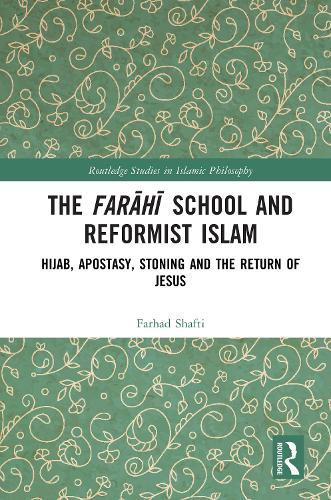
Overview
Examining the emergence and development of the Farāhī school of thought and its methodology, this book explores the four case studies of stoning, apostasy, hijab, and the return of Jesus. It demonstrates the reforming Farāhī approach and divergence from traditional Islamic thought, tracing Farāhī scholarship through the years, from Hamiduddin Farahi to Amin Ahsan Islahi and Javed Ahmad Ghamidi. Through the case studies the author analyses Farāhī approach to the Qur’an, the Sunnah, and religion. For each case study, he looks at contested areas and critically reviews traditional approaches, evaluating various sources, including the Qur’an, Tafsīrs from both Sunni and Shia scholars, Ḥadīths, and where applies Fiqh, before moving on to discussing the Farāhī approach, including interviews with Javed Ahmad Ghamidi, the present academic leader of the approach. Each case study ends with comparative analysis, leading to extracting the methodological features of the Farāhī school of thought at the end of the book. The book closes with a critical discussion of the methodology of the Farāhī school of thought and a summary. The Farahi School and Reformist Islam is the first academic work to go beyond the Farāhī school’s theory of Qur’anic coherence, aiming to derive its methodological features through original analysis and a case study approach. It will appeal to advanced students and scholars of Islam, particularly those interested in Qur’anic exegesis and Islamic jurisprudence. It will be invaluable for those exploring new or reformist methodologies in deriving rules and concepts from the text, especially the approach of the Farāhī school of thought. It will also be of considerable interest to general readers seeking insight into the background and evolving perspectives on any of the case study subjects addressed in the book.
Full Product Details
Author: Farhad Shafti (University of Glasgow, UK)
Publisher: Taylor & Francis Ltd
Imprint: Routledge
Weight: 0.630kg
ISBN: 9781032813509
ISBN 10: 1032813504
Pages: 238
Publication Date: 09 February 2026
Audience:
College/higher education
,
Tertiary & Higher Education
Format: Hardback
Publisher's Status: Active
Availability: Manufactured on demand

We will order this item for you from a manufactured on demand supplier.
Reviews
“Scholars who are engaged in researching modern interpretations of Islam and the Qur'an should not miss this remarkable work which deals with the Farāhī school. Focusing on their distinctive method of Quranic interpretation the author presents an intriguing depiction of Farāhīs who offer a unique response to controversial issues such as stoning, apostasy, the hijab, and the death of Jesus. In short, the Farāhīs reach conclusions on such issues that dovetail neatly with concepts of modern human rights. Based on meticulous textual study and also on extensive meetings with Farāhīs, Dr Shafti has produced a work that is essential reading for students and researchers of modern Islamic thought.” Professor Lloyd Ridgeon, University of Tokyo, Japan “This groundbreaking study offers a lucid and intellectually rigorous analysis of the Farāhī school of thought, a significant yet under-examined movement in modern Qur'an-centred Islamic theology. In what stands as the first systematic exposition of the school's methodology, the author masterfully derives its key features through an analysis of some of the most contentious issues in Islamic law and theology, including apostasy, stoning, the ḥijāb, and the return of Jesus, offering compelling, Qur'an-centric resolutions. The work is uniquely enriched by the author's intimate, face-to-face engagement with the school's leading contemporary figures, particularly Javed Ahmed Ghamidi, providing unparalleled insight into the living and evolving nature of this intellectual tradition. This book is an indispensable resource for scholars of Islamic studies, scriptural hermeneutics, and comparative theology.” Dr. Yaser Mirdamadi, The Institute of Isma‘ili Studies, UK
Author Information
Farhad Shafti is Senior Lecturer at the Adam Smith Business School at the University of Glasgow, UK, holds a PhD in Islamic Studies, and is the founder of the Exploring Islam website.