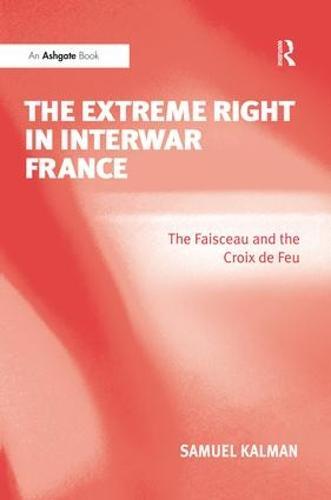
Full Product Details
Author: Samuel Kalman
Publisher: Taylor & Francis Ltd
Imprint: Routledge
Edition: New edition
Dimensions:
Width: 15.60cm
, Height: 1.80cm
, Length: 23.40cm
Weight: 0.453kg
ISBN: 9780754662402
ISBN 10: 0754662403
Pages: 278
Publication Date: 21 August 2008
Audience:
College/higher education
,
General/trade
,
Tertiary & Higher Education
,
General
Format: Hardback
Publisher's Status: Active
Availability: In Print

This item will be ordered in for you from one of our suppliers. Upon receipt, we will promptly dispatch it out to you. For in store availability, please contact us.
Reviews
’Samuel Kalman's new book is a welcome change from most studies of the French nationalist movements in the first decades of the 20th century. The reason is simple: while the majority of scholars focus on the history and organisation of those groups to determine whether they fit into the controversial Fascist category, Kalman takes an empirical approach and looks at their programmes and ideology without confining his research to the never-ending debate on the elusive Fascist label... All in all, this book is innovative and helps us understand how these two movements, although they ultimately failed, helped shape the doctrines of the Vichy regime and, one may add, that of the French extreme right up to the days of the Front National.’ Searchlight ’Thoroughly researched and gracefully written, this book makes a distinct and valuable contribution to the historiography of the French far right.’ Canadian Journal of History ’Kalman’s new, well-researched monograph complements previous analyses of the extreme Right in interwar French politics by focussing on the largest and most influential of such groups in the 1920s and 1930s, the Faisceau and the Croix de Feu.’ American Historical Review ’Kalman’s comparative study is well-researched, detailed and informative. It successfully demonstrates how two of the largest extreme-rightist movements in interwar France had clear plans for the renovation of the state and how opposing ideologies co-existed within them. It is sound and well thought-out and offers an original contribution which both scholars and students will wish to read.’ French History '... Kalman's work is a stimulating account, which skilfully traces the lines of continuity between earlier thinkers and incarnations of the extreme right and their hugely successful interwar descendants, while exposing a complex and factionalized nature. It moves the study of the French interwar extreme right away from the debate on fascism and there
'Samuel Kalman's new book is a welcome change from most studies of the French nationalist movements in the first decades of the 20th century. The reason is simple: while the majority of scholars focus on the history and organisation of those groups to determine whether they fit into the controversial Fascist category, Kalman takes an empirical approach and looks at their programmes and ideology without confining his research to the never-ending debate on the elusive Fascist label... All in all, this book is innovative and helps us understand how these two movements, although they ultimately failed, helped shape the doctrines of the Vichy regime and, one may add, that of the French extreme right up to the days of the Front National.' Searchlight 'Thoroughly researched and gracefully written, this book makes a distinct and valuable contribution to the historiography of the French far right.' Canadian Journal of History 'Kalman's new, well-researched monograph complements previous analyses of the extreme Right in interwar French politics by focussing on the largest and most influential of such groups in the 1920s and 1930s, the Faisceau and the Croix de Feu.' American Historical Review 'Kalman's comparative study is well-researched, detailed and informative. It successfully demonstrates how two of the largest extreme-rightist movements in interwar France had clear plans for the renovation of the state and how opposing ideologies co-existed within them. It is sound and well thought-out and offers an original contribution which both scholars and students will wish to read.' French History '... Kalman's work is a stimulating account, which skilfully traces the lines of continuity between earlier thinkers and incarnations of the extreme right and their hugely successful interwar descendants, while exposing a complex and factionalized nature. It moves the study of the French interwar extreme right away from the debate on fascism and therefore in the right direction; it is a welcome addition to the field.' European History Quarterly
Author Information
Dr Samuel Kalman is based in the Department of History at St Francis Xavier University, Canada