Overview
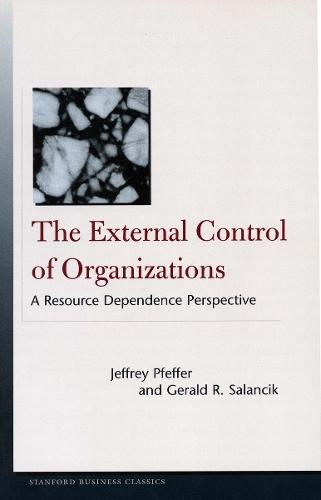
This work explores how external constraints affect organizations and provides insights for designing and managing organizations to mitigate these constraints. All organizations are dependent on the environment for their survival. It contends that it is the fact of the organization's dependence on the environment that makes the external constraint and control of organizational behaviour both possible and almost inevitable. Organizations can either try to change their environments through political means or form interorganizational relationships to control or absorb uncertainty.
Full Product Details
Author: Jeffrey Pfeffer ,
Gerald R. Salancik
Publisher: Stanford University Press
Imprint: Stanford Business Books,US
Edition: New edition
Dimensions:
Width: 15.20cm
, Height: 1.90cm
, Length: 23.20cm
Weight: 0.449kg
ISBN: 9780804747899
ISBN 10: 080474789
Pages: 336
Publication Date: 26 March 2003
Audience:
College/higher education
,
Professional and scholarly
,
Undergraduate
,
Postgraduate, Research & Scholarly
Format: Paperback
Publisher's Status: Active
Availability: In Print

This item will be ordered in for you from one of our suppliers. Upon receipt, we will promptly dispatch it out to you. For in store availability, please contact us.
Reviews
Two of the best minds in the business, Pfeffer and Salancik crafted this powerful argument that remains timely and timeless. That's the true test of a classic. The External Control of Organizations is a trusted, durable, evocative work. --Karl E. Weick,Rensis Likert Distinguished University Professor of Organizational Behavior and Psychology, University of Michigan Business School Launching the resource dependence theory of organizations, this influential work was the first to recognize the power of the wider social-political environment as a force shaping organizational structure and behavior. Recognizing that all organizations must acquire resources from the environment as a condition of their survival, Pfeffer and Salancik demonstrate how resource dependence gives rise to power problems and, potentially, to political solutions. --W. Richard Scott,Stanford University Pfeffer and Salancik have produced a good, persuasive statement of the resource dependence view... Their book is a welcome effort to formulate the perspective more completely, weigh the relevant empirical evidence, and develop implications for organizational design. --Administrative Science Quarterly
Two of the best minds in the business, Pfeffer and Salancik crafted this powerful argument that remains timely and timeless. That,s the true test of a classic. The External Control of Organizations is a trusted, durable, evocative work. - Karl E. Weick, Rensis Likert Distinguished University Professor of Organizational Behavior and Psychology, University of Michigan Business School; Pfeffer and Salancik have produced a good, persuasive statement of the resource dependence view.... Their book is a welcome effort to formulate the perspective more completely, weigh the relevant empirical evidence, and develop implications for organizational design. - Administrative Science Quarterly
Author Information
Jeffrey Pfeffer is the Thomas D. Dee II Professor of Organizational Behavior at the Stanford Graduate School of Business. His recent publications include The Knowing-Doing Gap: How Smart Companies Turn Knowledge into Action and Hidden Value: How Great Companies Achieve Extraordinary Results with Ordinary People. The late Gerald R. Salancik was the [title] at the Graduate School of Industrial Administration at Carnegie Mellon University at the time of his death in [year].