Overview
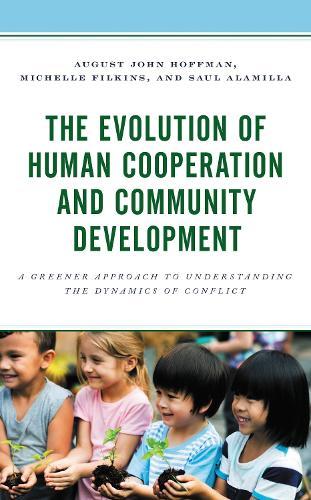
Communities today face unprecedented racial tension, conflict, and turmoil. Social unrest, political rhetoric, authoritarian rulers, and economic disparities contribute to unprecedented levels of community violence and extremism. The Evolution of Human Cooperation and Community Development: A Greener Approach to Understanding the Dynamics of Conflict proposes a more comprehensive and community-oriented approach to address conflict through the development of community resources and ecologically sustainable green space programs, such as community gardening programs. The authors draw on empirical research to identify how resources may be utilized to promote increased positive intergroup contact and provide greater collaboration among community residents. This book provides the essential interpersonal mechanisms to achieve a more resilient, empowered, and peaceful community.
Full Product Details
Author: August John Hoffman ,
Michelle Filkins ,
Saul Alamilla ,
Taylor Kruger
Publisher: Bloomsbury Publishing Plc
Imprint: Lexington Books
Dimensions:
Width: 16.20cm
, Height: 1.70cm
, Length: 22.90cm
Weight: 0.458kg
ISBN: 9781793601094
ISBN 10: 1793601097
Pages: 180
Publication Date: 12 February 2021
Audience:
Professional and scholarly
,
Professional & Vocational
Format: Hardback
Publisher's Status: Active
Availability: Manufactured on demand

We will order this item for you from a manufactured on demand supplier.
Reviews
This book champions the positive outcomes that communal green zone environments can have in communities, examining how they can help build connectedness and reduce social conflicts. Authors Hoffman, Filkins, and Alamilla explain the dire social and physical consequences of living in a dysfunctional society, highlighting phenomena that continue to affect communities (e.g., violence, bullying, lone-wolf syndrome, authoritarian rulers), and they explore why minorities too often bear the brunt of these consequences. Examples of some successful green zone communities are provided. The work of thinkers such as Jean-Jacques Rousseau and Stanley Milgram are brought to bear, and the authors periodically clarify their own concepts through diagrams. They also provide numerous citations to empirical research supporting their points. There is one chapter on the significant role that public libraries play in their communities (through, e.g., literacy, shelter, and outreach programs). The final chapter, an extended discussion by Alamilla, tackles the conundrum of multiculturalism. This book should be useful to undergraduates enrolled in community or social psychology courses and to those wanting to learn how to work on a small practical solution to decrease the turmoil. Recommended. Lower- and upper-division undergraduates. General readers.-- Choice Hoffman, Filkins, and Alamilla ask how can we achieve a healthy multicultural society? This book is a useful tool to help answer that question. The authors outline the critical need to address the hate and violence that exists in modern North American society. But they also provide potential strategies that can begin to reduce or eliminate that hate and violence. Drawing on classic work from social psychology and elsewhere, the authors build a case for the possibilities of collaboration, compassion, and connectedness that can develop out of community activities that center around 'green space' and 'green environments.' They make a strong case for meeting conflict head on by addressing the challenges--and value--of a multicultural society, with a concluding chapter that thoroughly reviews intergroup relations and the promise of a diverse society. I was energized and optimistic by the time I was done reading.--Stephen P. Stelzner, College of St. Benedict & St. John's University The authors identify how the socio-structural development of specific types of inclusive community environments, like green spaces and outdoor environments, may enhance a broad range of positive social behaviors (i.e., cooperative behaviors) as well as influence a greater sense of community connectedness and psychological well-being. This book examines the unique benefits of 'green space' environments and natural outdoor areas, such as community gardens and fruit tree orchards that have been identified through empirical research as effective in promoting both physical and psychological health, which in turn can reduce social conflict. The authors conclude that social conflicts can be addressed through community interventions and by providing greater opportunities of engagement within natural 'green space' environments.--Fabricio E. Balcazar, University of Illinois at Chicago The Evolution of Human Cooperation and Community Development is a masterpiece, an integrative and original contribution that will be appreciated by those in the fields of community psychology, environmental psychology, applied social psychology, applied anthropology, and social work. This book provides readers with a conceptual model to help change the world in innovative and substantive ways.--Leonard Jason, DePaul University We need this book--we need to look at the green in our lives and how we can together create a community with our planet. This is an easy and engaging read for scholars and others committed to our planet and each other. The authors help us understand that we are in this together and must include in our togetherness our planet and green spaces.--Joseph Ferrari, DePaul University
The Evolution of Human Cooperation and Community Development is a masterpiece, an integrative and original contribution that will be appreciated by those in the fields of community psychology, environmental psychology, applied social psychology, applied anthropology, and social work. This book provides readers with a conceptual model to help change the world in innovative and substantive ways.--Leonard Jason, DePaul University We need this book--we need to look at the green in our lives and how we can together create a community with our planet. This is an easy and engaging read for scholars and others committed to our planet and each other. The authors help us understand that we are in this together and must include in our togetherness our planet and green spaces.--Joseph Ferrari, DePaul University
Author Information
August John Hoffman is professor of psychology at Metropolitan State University. Michelle Filkins is professor and reference and instruction librarian at Metropolitan State University. Saul Alamilla is associate professor in the Department of Psychological Science at Kennesaw State University.