Overview
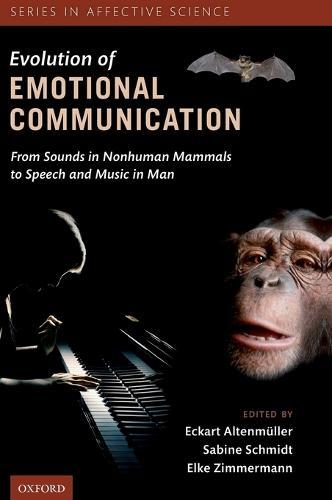
Why do we think that we can understand animal voices - such as the aggressive barking of a pet dog, and the longing meows of the family cat? Why do we think of deep voices as dominant and high voices as submissive. Are there universal principles governing our own communication system? Can we even see how close animals are related to us by constructing an evolutionary tree based on similarities and dissimilarities in acoustic signaling?Research on the role of emotions in acoustic communication and its evolution has often been neglected, despite its obvious role in our daily life. When we infect others with our laugh, soothe a crying baby with a lullaby, or get goose bumps listening to classical music, we are barely aware of the complex processes upon which this behavior is based. It is not facial expressions or body language that are affecting us, but sound. They are present in music and speech as ""emotional prosody"" and allow us to communicate not only verbally but also emotionally. This groundbreaking book presents a thorough exploration into how acoustically conveyed emotions are generated and processed in both animals and man. It is the first volume to bridge the gap between research in the acoustic communication of emotions in humans with those in animals, using a comparative approach. With the communication of emotions being an important research topic for a range of scientific fields, this book is valuable for those in the fields of animal behaviour, anthropology, evolutionary biology, human psychology, linguistics, musicology, and neurology.
Full Product Details
Author: Eckart Altenmüller (, Full Professor, University of Music, Drama and Media, Germany) , Sabine Schmidt (, Hochschuldozentin, Institute of Zoology, University of Veterinary Medicine and Center for Systems Neuroscience, Germany) , Elke Zimmermann (, Professor, Institute of Zoology, University of Veterinary Medicine and Center for Systems Neuroscience, Germany)
Publisher: Oxford University Press
Imprint: Oxford University Press
Dimensions:
Width: 18.50cm
, Height: 2.60cm
, Length: 24.60cm
Weight: 0.824kg
ISBN: 9780199583560
ISBN 10: 0199583560
Pages: 392
Publication Date: 24 January 2013
Audience:
College/higher education
,
Postgraduate, Research & Scholarly
Format: Hardback
Publisher's Status: Active
Availability: To order 
Stock availability from the supplier is unknown. We will order it for you and ship this item to you once it is received by us.
Table of Contents
Part A: Introductory Section 1: M. Mortillaru, M. Mehu and K.R. Scherer: The evolutionary origin of multimodal synchronisation and emotional expression 2: W.T. Fitch and K. Zuberbühler: Primate precursors to human language: Beyond discontinuity 3: J.P. Rauschecker: Brain networks for the encoding of emotions in communication sounds of human and nonhuman primates Part B: Different mammalian taxa 4: G. Ehret: Sound communication in house mice: Emotions in their voices and ears? 5: S. Brudzynks: Vocalizations as indicators of emotional states in rats and cats 6: S. Schmidt: Beyond echolocation: Emotional acoustic communication in bats 7: J. Soltis: Emotional communication in African Elephants 8: E. Zimmermann, L. Leliveld, and S. Schehka: Toward the evolutionary roots of affective prosody in human acoustic communication: A comparative approach to mammalian voices 9: C.T. Snowdon and D. Teie: Emotional communication in monkeys: Music to their ears? Part C: Non-speech Human vocalizations 10: P. Zeskind: Infant crying and the synchrony of arousal 11: M. J. Owren, M. Philipp, E. Vanman, N. Trivedi, A. Schulman, and J.A. Bachorowski: Understanding spontaneous human laughter: The role of voicing in inducing positive emotion 12: D. Szameitat, D. Wildgruber, and K. Alter: Vocal expression of emotions in laughter Part D: Human Prosody 13: D. Grandjean and S. Frühholz: An integrative model of brain processes for the decoding of emotional prosody 14: S.A. Kotz, A.S. Hasting, and S. Paulmann: On the orbito-striatal interface in (acoustic) emotional processing 15: C. Schroeder and R. Dengler: The role of dopamine in perception and expression of emotional communication in Parkinson's disease 16: P.N. Juslin: Vocal affect expression: Problems and promises Part E: Music 17: I. Peretz, W. Aube, and J. Armony: Towards a neurobiology of musical emotions 18: T. Fritz and S. Koelsch: Acoustically mediated emotional contagion as an across-species homology underlying music processing 19: E. Altenmüller R. Kopiez, and O. Grewe: A contribution to the evolutionary basis of music: Lessons from the chill-response Part F: Summary: Where to go? 20: 1. E. Altenmüller, S. Schmidt, and E. Zimmermann: A cross-taxa concept of emotion in acoustic communication: An ethological perspective
Reviews
Readers will quickly be immersed into this highly transdisciplinary literature that includes neuroscientists and musicians with a few evolutionary biologists and animal communication experts thrown into the mix. ... [I]t will appeal to a broad audience interested in emotional communication and why (and how) we respond emotionally to music, as well as anyone broadly interested in neuroscience of emotions. --The Quarterly Review of Biology
Author Information
Prof. Dr. med. Eckart Altenmüller (b. 1955) holds a Masters degree in classical flute, and is a Medical Doctor. After clinical training as a neurologist and habilitation, he became in 1994 chairman and director of the Institute of Music Physiology and Musicians' Medicine at the University of Music, Drama, and Media in Hannover. He continues research into the neurobiology of emotions and into movement disorders in musicians as well as motor, auditory and sensory learning. Since 2005 he is President of the German Society of Music Physiology and Musicians' Medicine and Member of the Göttingen Academy of Sciences. Privatdozent Dr. rer nat. Sabine Schmidt is an experimental behavioural and sensory biologist and Head of the Sensory Biology group of the Institute of Zoology at the University of Veterinary Medicine and the Centre for Systems Neuroscience in Hannover, Germany. Her main research interests cover behavioural ecology and psychoacoustics, with special emphasis on echolocation and acoustic communication in bats. Prof. Dr. rer nat. Elke Zimmermann is an experimental behavioural and evolutionary biologist and Director of the Institute of Zoology and Professor at the University of Veterinary Medicine and the Center for Systems Neuroscience in Hannover, Germany. Her main research interests cover patterns, processes and mechanisms of primate adaptation, speciation and evolution, with special emphasis to the evolution of communication and cognition. She is spokesperson of the DFG-funded interdisciplinary Research Unit Acoustic communication of emotions in humans and nonhuman mammals.
Tab Content 6
Author Website:
Countries Available
All regions
|