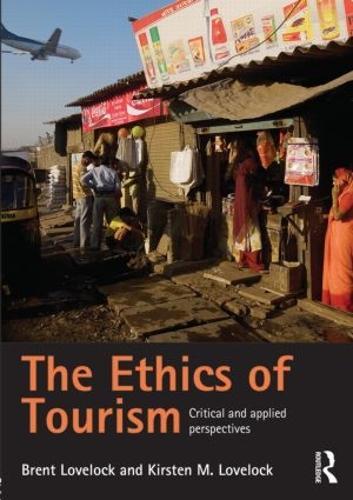
Full Product Details
Author: Brent Lovelock (University of Otago, New Zealand) ,
Kirsten Lovelock (University of Otago, New Zealand)
Publisher: Taylor & Francis Ltd
Imprint: Routledge
Dimensions:
Width: 17.40cm
, Height: 1.80cm
, Length: 24.60cm
Weight: 0.748kg
ISBN: 9780415575584
ISBN 10: 0415575583
Pages: 368
Publication Date: 10 June 2013
Audience:
College/higher education
,
Tertiary & Higher Education
Format: Paperback
Publisher's Status: Active
Availability: In Print

This item will be ordered in for you from one of our suppliers. Upon receipt, we will promptly dispatch it out to you. For in store availability, please contact us.
Reviews
'The Ethics of Tourism is a significant contribution to the tourism literature. It provides the first comprehensive review of ethics across the breadth of travel and tourism experiences, and presents this in a clear and accessible manner for both students and tourism professionals. The Lovelocks demonstrate the importance of ethical considerations in tourism development, management and behaviour, making this fundamental reading for all tourism professionals.' - Alan A. Lew, Department of Geography, Planning and Recreation, Northern Arizona University 'This is the comprehensive book on tourism and ethics that students and staff have been waiting for. Written in a friendly and engaging manner, it is sure to become a 'must have' and sets a new benchmark in tourism studies' - Kevin Hannam, School of Events, Tourism and Hospitality, Leeds Metropolitan University
'The Ethics of Tourism is a significant contribution to the tourism literature. It provides the first comprehensive review of ethics across the breadth of travel and tourism experiences, and presents this in a clear and accessible manner for both students and tourism professionals. The Lovelocks demonstrate the importance of ethical considerations in tourism development, management and behaviour, making this fundamental reading for all tourism professionals.' - Alan A. Lew, Department of Geography, Planning and Recreation, Northern Arizona University 'This is the comprehensive book on tourism and ethics that students and staff have been waiting for. Written in a friendly and engaging manner, it is sure to become a 'must have' and sets a new benchmark in tourism studies' - Kevin Hannam, School of Events, Tourism and Hospitality, Leeds Metropolitan University 'The Ethics of Tourism is an important addition towards tourism sustainability theory... [It] has an inner structure that is easy to follow combined with novelty approach and practical application. It is enjoyable to read and could be appreciated by both academics and more general audience.' - Miroslava Dimitrova, European Journal of Tourism Research 'I do recommend this book wholeheartedly. Quite simply, it is excellent: it is extremely well-written; is very clearly laid out; includes a fine overview of the theory and practice of ethics both in general and as they apply to tourism; and has excellent case studies, discussion points, chapter reviews, and extensive bibliographies.' - Paul F. Wilkinson, Tourism Management
Author Information
Dr Brent Lovelock is Senior Lecturer in the Department of Tourism at the eUniversity of Otago, New Zealand. Brent's research interests in sustainable and ethical tourism. His ethical tourism research relates to consumptive wildlife tourism, to the ethical aspects of travel to destinations with human rights issues, and to tourism and access for persons with disabilities. He has over thirty publications addressing the social and environmental aspects of sustainable and ethical tourism Dr Kirsten M. Lovelock is a research fellos at the Department of Preventive and Social Medicine, University of Otago, New Zealand. Kirsten is a social anthropologist whose general research interests pivot on issues surrounding social justice and social equity. Specific research projects have focused on local use of human reproductive technologies and the cultural practices that ensure engagement with global processes linked to assisting human conception, the anthropology of health - in particular occupational health in agriculture, how economically marginal communities reinvent themselves , and the political economy of permanent and temporary migration, most recently, the use of temporary seasonal migration schemes to address inter and intra regional rural poverty.