Overview
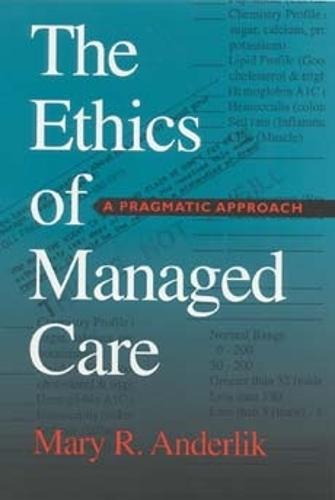
Discussions of managed care frequently begin and end with an opposition between the Hippocratic ethic of dedication to patient welfare and a business ethic of self-interest in the service of efficiency. Mary R. Anderlik approaches managed care as a problem of organizations. Rejecting a simple ""medicine vs. business"" analysis, she directs attention to management as manipulation, the neglect of such personal goods as satisfaction in professional accomplishment, and organizational moral myopia. In this account, ""pragmatic"" suggests practical idealism, not the jettisoning of principle in the interests of expediency. In The Ethics of Managed Care, Anderlik favors a broad empiricism and a moral vision centered on values of democracy and community. She describes how organizations can nourish or destroy openness, creativity, cooperation, and faithfulness-and display ""virtues"" such as justice, integrity, responsiveness, and efficiency, rightly understood. She uses community care clinics, asthma outreach programs, and new contexts for participatory decision-making to show the promise of managed care. She also explains the complexities of financial arrangements, arguing for an end to schemes that reward clinicians for providing less care and profiting from avoiding people who need a lot of it. The book concludes with a look at the future of managed care, proposing a program for reform.
Full Product Details
Author: Mary R. Majumder
Publisher: Indiana University Press
Imprint: Indiana University Press
Dimensions:
Width: 15.60cm
, Height: 2.90cm
, Length: 23.50cm
Weight: 0.653kg
ISBN: 9780253338488
ISBN 10: 0253338484
Pages: 312
Publication Date: 27 July 2001
Audience:
Professional and scholarly
,
Professional & Vocational
Format: Hardback
Publisher's Status: Active
Availability: In Print

This item will be ordered in for you from one of our suppliers. Upon receipt, we will promptly dispatch it out to you. For in store availability, please contact us.
Reviews
<p>Anderlik (Univ. of Houston Law Center) argues that managed care has bydefault become society's medical care rationing agent. She decries this role andpoints to Kaiser Permanente as a managed care organization that has both socialconscience and genuine concern for its enrollees. Anderlik posits that organizationscan and should nourish human personalities and display virtues such as justice, integrity, responsiveness, and efficiency. The pervasiveness of financial incentivesto save health care money is, the author believes, at the center of the problem.This work is an exploration of the care giving in today's managed care setting, fromthe perspective of an ethical position that managed care organizations are notmeeting ethical obligations to their enrollees. The book is well footnoted and wellreasoned, but readers will have to accept the ethical assertions made by the author.All levels.J. E. Allen, University of North Carolina at Chapel Hill, 2002aprCHOICE.
Anderlik (Univ. of Houston Law Center) argues that managed care has by default become society's medical care rationing agent. She decries this role and points to Kaiser Permanente as a managed care organization that has both social conscience and genuine concern for its enrollees. Anderlik posits that organizations can and should nourish human personalities and display virtues such as justice, integrity, responsiveness, and efficiency. The pervasiveness of financial incentives to save health care money is, the author believes, at the center of the problem. This work is an exploration of the care giving in today's managed care setting, from the perspective of an ethical position that managed care organizations are not meeting ethical obligations to their enrollees. The book is well footnoted and well reasoned, but readers will have to accept the ethical assertions made by the author. All levels.J. E. Allen, University of North Carolina at Chapel Hill, 2002apr CHOICE. The book is well footnoted and well reasoned... -Choice
The book is well footnoted and well reasoned . . . * Choice * Anderlik (Univ. of Houston Law Center) argues that managed care has by default become society's medical care rationing agent. She decries this role and points to Kaiser Permanente as a managed care organization that has both social conscience and genuine concern for its enrollees. Anderlik posits that organizations can and should nourish human personalities and display virtues such as justice, integrity, responsiveness, and efficiency. The pervasiveness of financial incentives to save health care money is, the author believes, at the center of the problem. This work is an exploration of the care giving in today's managed care setting, from the perspective of an ethical position that managed care organizations are not meeting ethical obligations to their enrollees. The book is well footnoted and well reasoned, but readers will have to accept the ethical assertions made by the author. All levels. -- J. E. Allen, University of North Carolina at Chapel Hill , 2002apr CHOICE.
Anderlik (Univ. of Houston Law Center) argues that managed care has by default become society's medical care rationing agent. She decries this role and points to Kaiser Permanente as a managed care organization that has both social conscience and genuine concern for its enrollees. Anderlik posits that organizations can and should nourish human personalities and display virtues such as justice, integrity, responsiveness, and efficiency. The pervasiveness of financial incentives to save health care money is, the author believes, at the center of the problem. This work is an exploration of the care giving in today's managed care setting, from the perspective of an ethical position that managed care organizations are not meeting ethical obligations to their enrollees. The book is well footnoted and well reasoned, but readers will have to accept the ethical assertions made by the author. All levels.J. E. Allen, University of North Carolina at Chapel Hill, 2002apr CHOICE.
Author Information
Mary R. Anderlik, Research Professor, Health Law and Policy Institute, University of Houston Law Center, has an A.B from Bryn Mawr College, a J.D. from Yale Law School, and a Ph.D. from Rice University. She spent a number of years as an associate in the Banking and Commercial Transactions group at Sidley & Austin. Immediately prior to joining the Institute, she held a postdoctoral fellowship in Clinical Ethics at the University of Texas M.D. Anderson Cancer Center. At the Institute, Dr. Anderlik works on projects in the areas of managed care, disability, genetics, and privacy.