|
|
|||
|
||||
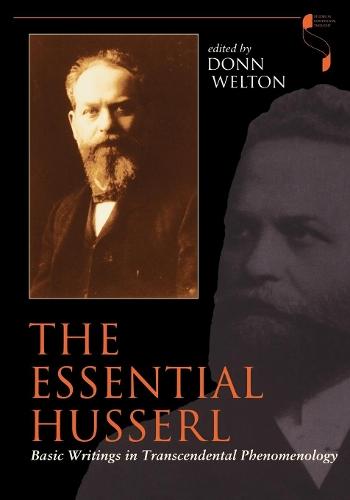
OverviewThe Essential Husserl, the first anthology in English of Edmund Husserl's major writings, provides access to the scope of his philosophical studies, including selections from his key works: Logical Investigations, Ideas I and II, Formal and Transcendental Logic, Experience and Judgment, Cartesian Meditations, The Crisis of European Sciences and Transcendental Phenomenology, and On the Phenomenology of the Consciousness of Internal Time. The collection is an indispensable resource for anyone interested in twentieth-century philosophy. Full Product DetailsAuthor: Donn Welton , Donn Welton , Donn WeltonPublisher: Indiana University Press Imprint: Indiana University Press Dimensions: Width: 17.80cm , Height: 2.40cm , Length: 25.40cm Weight: 0.771kg ISBN: 9780253212733ISBN 10: 0253212731 Pages: 408 Publication Date: 22 May 1999 Audience: Professional and scholarly , Professional & Vocational Format: Paperback Publisher's Status: Active Availability: In Print This item will be ordered in for you from one of our suppliers. Upon receipt, we will promptly dispatch it out to you. For in store availability, please contact us. Table of ContentsAcknowledgments Introduction: The Development of Husserl's Phenomenology Abbreviations Part One: Contours of a Transcendental Phenomenology I. Antitheses 1. The Critique of Psychologism Normative and Theoretical Disciplines The Arguments of Psychologism The Prejudices of Psychologism 2. The Critique of Historicism II. Phenomenological Clues 3. Expression and Meaning Essential Distinctions Fluctuation in Meaning and the Ideality of Unities of Meaning The Phenomenological and Ideal Content of the Experiences of Meaning 4. Meaning-Intention and Meaning-Fulfillment III. Phenomenology as Transcendental Philosophy 5. The Basic Approach of Phenomenology The Natural Attitude and Its Exclusion Consciousness as Transcendental The Region of Pure Consciousness IV. The Structure of Intentionality 6. The Noetic and Noematic Structure of Consciousness Noesis and Noema The Question of Levels Expressive Acts Noema and Object Horizons V. The Question of Evidence 7. Varieties of Evidence 8. Sensuous and Categorial Intuition VI. From Subjectivity to Intersubjectivity 9. Empathy and the Constitution of the Other Primordial Abstraction The Appresentation of the Other Part Two: Transcendental Phenomenology and the Problem of the Life-World VII. Transcendental Aesthetics 10. Perception, Spatiality and the Body Objective Reality, Spatial Orientation, and the Body The Self-Constitution of the Body 11. A Phenomenology of the Consciousness of Internal Time Analysis of the Consciousness of Time Levels of Constitution of Time and Temporal Objects 12. Horizons and the Genesis of Perception VIII. Transcendental Analytics 13. Formal and Transcendental Logic The Discipline of Formal Logic Formal Logic as Apophantic Analysis The Transcendental Grounds of Logic 14. Individuals and Sets Explication of Individuals Constituting Sets 15. Universals The Constitution of Empirical Universals Eidetic Variation and the Acquisition of Pure Universals 16. The Genesis of Judgment IX. Static and Genetic Phenomenology 17. Time and the Self-Constitution of the Ego 18. Static and Genetic Phenomenological Method X. Transcendental Phenomenology and the Way through the Science of Phenomenological Psychology 19. Phenomenological Psychology and Transcendental Phenomenology XI. Transcendental Phenomenology and the Way through the Life-World 20. The Mathematization of Nature 21. Elements of a Science of the Life-World Bibliography IndexReviewsAuthor InformationDonn Welton is Professor of Philosophy at the State University of New York at Stony Brook. Tab Content 6Author Website:Countries AvailableAll regions |
||||