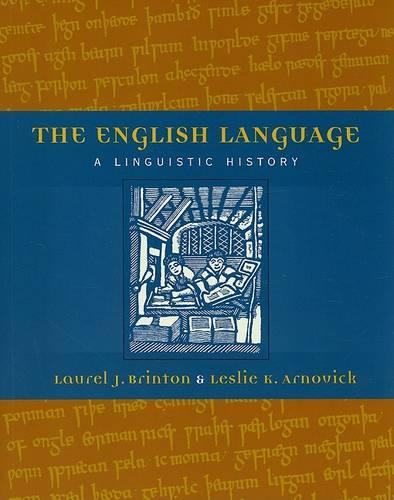
The English Language: A Linguistic History

Author:   Brinton
Publisher:   Oxford University Press, Canada
ISBN:  

9780195422054


Pages:   542
Publication Date:   September 2005
Replaced By:   9780195431575
Format:   Paperback
Availability:   Out of stock   Availability explained


Our Price $290.37 Quantity:  
Add to Cart

Share |

The English Language: A Linguistic History


Overview

The English Language: A Linguistic History is designed as a core text for classes in the history of the English language, offered through the English or linguistics department. Beginning with a discussion of how language changes, the book examines historical change in English from its Indo-European past through its major periods (Old English, Middle English, Early Modern English, and Modern English). This is an introductory text: it does not assume any background in language or linguistics. Self-testing exercises are integrated throughout the text, and students are required to learn to use the International Phonetic Alphabet. Additional pedagogical material, such as lists of related books and Web sites, are also integrated.

Full Product Details

Author:   Brinton
Publisher:   Oxford University Press, Canada
Imprint:   Oxford University Press, Canada
Dimensions:   Width: 17.90cm , Height: 2.80cm , Length: 22.90cm
Weight:   0.847kg
ISBN:  

9780195422054


ISBN 10:   0195422058
Pages:   542
Publication Date:   September 2005
Audience:   General/trade ,  College/higher education ,  Professional and scholarly ,  General ,  Postgraduate, Research & Scholarly
Replaced By:   9780195431575
Format:   Paperback
Publisher's Status:   Out of Print
Availability:   Out of stock   Availability explained

Table of Contents

List of Tables; List of Figures; List of Sample Texts; Acknowledgements ; Preface; Introduction; Text Overview; Note on Punctuation; Abbreviations ; Chapter 1: Studying the History of English; Reasons for Studying the History of English; A Definition of Language; The Components of Language; Linguistic Change in English; The Periods of English; An Example of Linguistic Change; The Nature of Linguistic Change; The Inevitability of Change; The Arbitrary Nature of the Linguistic Sign; The Origin of Language; Attitudes Toward Linguistic Change; Linguistic Corruption; Prescriptivism vs. Descriptivism; Resources for Studying the History of English ; Chapter 2: The Sounds and Writing of English; The Sounds of English; The Phonetic Alphabet; The Phoneme; The Production of Speech; Consonants; The Consonants of English; Vowels; The Vowels of English; Stress; The Writing of English; The History of Writing; The Origin of the Alphabet ; Chapter 3: Causes and Mechanisms of Language Change; Causes of Change; Internal; External; Mechanisms of Change; Phonological Change; Determining Sounds from Written Records; The Nature of Sound Change; Types of Sound Change; Morphological and Syntactic Change; Analogy; Grammaticalization; Conservative and Innovative Changes; Semantic Change; Types of Semantic Change; Some Generalizations About Semantic Change ; Chapter 4: Indo-European; Classification of Languages; Typological Classification; Genealogical Classification; Language Families; The Indo-European Language Family; The Discovery of Indo-European; The Branches of Indo-European; Proto-Language; Reconstruction; Proto-Indo-European; Linguistic Features; Society; Homeland; Nostratic Theory ; Chapter 5: Germanic and the Development of Old English; Proto-Germanic; Grammatical and Lexical Changes from PIE to Germanic; Phonological Changes from PIE to Germanic; First Sound Shift; Accent Shift and Ordering of Changes; Vowel Changes; Second Sound Shift and Mechanisms of Change; A Brief History of Anglo-Saxon England; The Germanic Settlement of England; The Christianization of the Anglo-Saxons; The Scandinavian Invasions of England; The Records of the Anglo-Saxons; The Dialects of Old English; The Written Records of Old English ; Chapter 6: The Sounds and Words of Old English; The Orthographic System of Old English; The Phonological System of Old English; Consonants; Vowels; Sound Changes; The Word Stock of the Anglo-Saxons; Core Germanic Vocabulary; Borrowing in Old English; Word Formation in Old English; Stress ; Chapter 7: The Grammar of Old English; The Nominal System; The Grammatical Categories of the Noun; Pronouns; Nouns; Demonstratives, Adjectives, and Adverbs; Agreement; Case Usage; The Verbal System; Verb Classes; The Grammatical Categories of the Verb; Inflectional Endings of the Verb; Syntax; Verbal Periphrases; Word Order ; Chapter 8: The Rise of the Middle English: Words and Sounds; French and English in Medieval England; The Norman Conquest; The Establishment of French; The Re-establishment of English; The Word Stock of Middle English; French Influence; Latin Influence; The Written Records of Middle English; Middle English Dialects; Middle English Literature; Orthographic Changes; Consonant Changes; Vowel Changes; Qualitative Changes; Quantitative Changes ; Chapter 9: The Grammar of Middle English and Rise of a Written Standard; Vowel Reduction and its Effects; Grammatical Developments in Middle English; Adjectives and Nouns; Pronouns; Loss of Grammatical Gender; Verbs; Syntax; Change from Synthetic to Analytic; Middle English as a Creole?; The Rise of a Standard Dialect ; Chapter 10: The Sounds and Inflections of Early Modern English; The Great Vowel Shift; Nature of the Shift; Details of the Shift; Changes in the Short Vowels and Diphthongs; Changes in Consonants; Renaissance Respellings; Changes in Nominal Inflected Forms; Nouns; Pronouns; Case Usage; Changes in Verbal Inflected Forms; Verb Classes; Inflectional Endings ; Chapter 11: Early Modern English Verbal Constructions and 18th Century Prescriptivism; Early Modern English Syntax; Reflexive and Impersonal Verbs; The Subjunctive and the Modal Auxiliaries; Verbal Periphrases; Do; Word Order; The Rise of Prescriptivism; Renaissance Concerns About the Language; Social, Linguistic, and Philosophical Reasons for Prescriptivism; Important Prescriptive Grammarians of the 18th Century; Aims of the 18th Century Grammarians; Ascertainment; An Academy; Methods of the 18th Century Grammarians; Authority; Model of Latin; Etymology; Reason; The Question of Usage; Dictionaries ; Chapter 12: Modern English; Grammatical Changes Since Early Modern English; Modern Borrowings; The Oxford English Dictionary; The Development of National Varieties; British versus North American English; Canadian English; Australian and New Zealand English; African English; Caribbean English; Important Regional Varieties; English in the British Isles; English in the United States; Changes in Progress; Neologisms; Grammatical Changes ; Glossary of Linguistic Terms; References

Reviews

Author Information

Tab Content 6

Author Website:  

Countries Available

All regions
Latest Reading Guide

NOV RG 20252


Shopping Cart
Your cart is empty
Shopping cart
Mailing List