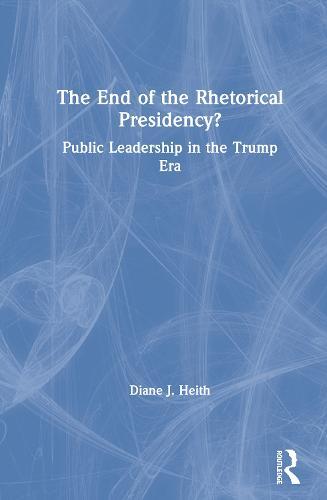
Full Product Details
Author: Diane Heith
Publisher: Taylor & Francis Ltd
Imprint: Routledge
Weight: 0.362kg
ISBN: 9780367522544
ISBN 10: 0367522543
Pages: 154
Publication Date: 31 July 2020
Audience:
General/trade
,
College/higher education
,
General
,
Tertiary & Higher Education
Format: Hardback
Publisher's Status: Active
Availability: In Print

This item will be ordered in for you from one of our suppliers. Upon receipt, we will promptly dispatch it out to you. For in store availability, please contact us.
Reviews
This enjoyable and fascinating book provides a good glimpse of the recent past, and perhaps of things to come. Heith's findings regarding Trump's rhetoric are important and informative as we cast our eyes on the potential 2024 field of presidential candidates. -Presidential Studies Quarterly In The End of the Rhetorical Presidency, Diane Heith has written a well-crated and entirely readable discussion of the Trump presidency as understood through his efforts at rhetorical leadership. It is useful for anyone interested in understanding Donald Trump's relationship to the history and practices of presidential rhetoric. Heith notes that much of what Trump has done and is doing as president is consistent with broad patterns of that leadership, but also finds that his presidency reveals an important struggle between the hyper-individualized and importantly institutional valences of the office. Trump's tendency to favor individual over institutional aspects has damaged his ability to govern even while concentrating attention on his rhetorical style. - Mary E. Stuckey, Pennsylvania State University Diane Heith's new study of presidential communication examines how and why President Trump has barreled through one executive branch norm after another on his way to dominating Washington policy-making and the never-ending news cycle. This vital work, sure to be a winner with students and scholars, offers an effective and accessible analysis of White House self-marketing during a roller coaster presidency like no other. - Stephen Farnsworth, University of Mary Washington Donald Trump has forever altered the rhetorical presidency and Diane Heith's absorbing work demonstrates exactly how he did so. Anyone interested in the narrowing of the public presidency because of the splintering of partisans -- and the future of presidential communication -- will want to read this topical book. - Brandon Rottinghaus, University of Houston For those struggling with whether Trump is an anomaly or a glimpse of things to come for the institution of the presidency, Diane Heith offers important and much-needed insight. She captures the struggle within the Trump presidency between the institutional and the individual, and shows how the individual is winning. Students of the presidency will benefit enormously from Heith's situating Trump's rhetoric in the larger context of recent presidents, clearly showing where Trump is well within institutional structures, and where his devolved approach to rhetorical leadership is truly unprecedented. - Donna R. Hoffman, University of Northern Iowa
In The End of the Rhetorical Presidency, Diane Heith has written a well-crated and entirely readable discussion of the Trump presidency as understood through his efforts at rhetorical leadership. It is useful for anyone interested in understanding Donald Trump's relationship to the history and practices of presidential rhetoric. Heith notes that much of what Trump has done and is doing as president is consistent with broad patterns of that leadership, but also finds that his presidency reveals an important struggle between the hyper-individualized and importantly institutional valences of the office. Trump's tendency to favor individual over institutional aspects has damaged his ability to govern even while concentrating attention on his rhetorical style. - Mary E. Stuckey, Pennsylvania State University Diane Heith's new study of presidential communication examines how and why President Trump has barreled through one executive branch norm after another on his way to dominating Washington policy-making and the never-ending news cycle. This vital work, sure to be a winner with students and scholars, offers an effective and accessible analysis of White House self-marketing during a roller coaster presidency like no other. - Stephen Farnsworth, University of Mary Washington Donald Trump has forever altered the rhetorical presidency and Diane Heith's absorbing work demonstrates exactly how he did so. Anyone interested in the narrowing of the public presidency because of the splintering of partisans -- and the future of presidential communication -- will want to read this topical book. - Brandon Rottinghaus, University of Houston
Author Information
Diane J. Heith is Professor of Government and Politics at St. John’s University. She is the author of several works on the presidency, public opinion, campaigns and elections, and the media including, The Presidential Road Show: Public Leadership in an Era of Party Polarization and Media Fragmentation (2013), and Polling to Govern: Public Opinion and Presidential Leadership (2004). She is co-author of Presidents and the American Presidency (2018) and the 2016 Presidential Election Guide (2016) and co-editor of In the Public Domain: Presidents and the Challenges of Public Leadership (2005). Her work has appeared in The New York Times, Public Opinion Quarterly, Presidential Studies Quarterly, Political Science Quarterly, The Journal of Health Politics, Policy and Law, The Journal of Women, Politics and Policy, White House Studies and Congress and the Presidency.