Full Product Details
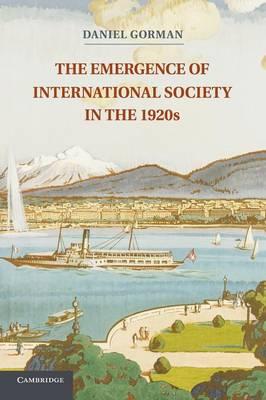
Author: Daniel Gorman
Publisher: Cambridge University Press
Imprint: Cambridge University Press
Dimensions:
Width: 15.20cm
, Height: 2.20cm
, Length: 22.90cm
Weight: 0.570kg
ISBN: 9781107640948
ISBN 10: 1107640946
Pages: 390
Publication Date: 06 March 2014
Audience:
Professional and scholarly
,
Professional & Vocational
Format: Paperback
Publisher's Status: Active
Availability: Manufactured on demand

We will order this item for you from a manufactured on demand supplier.
Reviews
'Daniel Gorman's argument, that international society during the 1920s developed out of the interaction of imperialism and internationalism, is an arresting one. His stage is peopled with private citizens and public officials, nations and foundations, interest groups and interested individuals, all trying to remake the world into a safer place. Beginnings were made and seeds were sown, but there was not enough time. This important book details the philosophies, the aspirations, the successes, and the failures of his well-intentioned actors.' Kathleen Burk, University College London 'After ... World War I there was a rush of activism, creating a new kind of international society. Gorman's rich and engaging new book recounts how internationalists came to grips with a host of critical issues ... He shows that in the Anglo-American sphere internationalism was a spectrum of varied hues. His textured tale shows that this internationalism often could work at cross purposes - it could challenge norms even as it reinforced existing imperial relationships. What Gorman makes clear is that a shopworn view that dismisses internationalists of the era as wooly idealists is well out of date. While the internationalists' prescriptions were not always the perfect medicine for what ailed the world, within them there was often a remarkable grasp of the problems besetting the global body politic. Their efforts laid important foundations on which the international community still stands today.' David Ekbladh, Tufts University 'Daniel Gorman offers an illuminating study of the evolution of international society in the 1920s, with a special focus on how new international norms reshaped the British Empire and on how Anglo-American individuals and organizations promoted numerous internationalist initiatives during this period. He highlights neglected episodes in this history, such as the League of Nations' campaigns against the transnational drug and sex trades, and he also sheds new light on well-known ones, such as the Kellogg-Briand pact. This book makes an important contribution to the history of interwar internationalism and, more broadly, to our understanding of the origins of contemporary global governance.' Erez Manela, author of The Wilsonian Moment (2007) 'This is an innovative and instructive approach to the development of an 'international society' in the 1920s based on a series of wide-ranging case studies; it will be welcomed by readers interested in international and transnational history.' Zara Steiner, University of Cambridge '... this is an impressive piece of scholarship. Its chief value lies in deepening our understanding of the social, cultural and political dynamics of interwar Anglo-American internationalism, and in particular the role of empire within it. It is well written, clearly argued and exhaustively researched, and serves as an example of how to write historically about the intersection of political ideas and institutions.' Duncan Bell, International Affairs 'This ambitious study ... offers a number of stimulating case studies that will be of interest to scholars of interwar internationalism, particularly those seeking to explore its imperial dimension.' H-Soz-u-Kult
'Daniel Gorman's argument, that international society during the 1920s developed out of the interaction of imperialism and internationalism, is an arresting one. His stage is peopled with private citizens and public officials, nations and foundations, interest groups and interested individuals, all trying to remake the world into a safer place. Beginnings were made and seeds were sown, but there was not enough time. This important book details the philosophies, the aspirations, the successes, and the failures of his well-intentioned actors.' Kathleen Burk, University College London 'After ... World War I there was a rush of activism, creating a new kind of international society. Gorman's rich and engaging new book recounts how internationalists came to grips with a host of critical issues ... He shows that in the Anglo-American sphere internationalism was a spectrum of varied hues. His textured tale shows that this internationalism often could work at cross purposes - it could challenge norms even as it reinforced existing imperial relationships. What Gorman makes clear is that a shopworn view that dismisses internationalists of the era as wooly idealists is well out of date. While the internationalists' prescriptions were not always the perfect medicine for what ailed the world, within them there was often a remarkable grasp of the problems besetting the global body politic. Their efforts laid important foundations on which the international community still stands today.' David Ekbladh, Tufts University 'Daniel Gorman offers an illuminating study of the evolution of international society in the 1920s, with a special focus on how new international norms reshaped the British Empire and on how Anglo-American individuals and organizations promoted numerous internationalist initiatives during this period. He highlights neglected episodes in this history, such as the League of Nations' campaigns against the transnational drug and sex trades, and he also sheds new light on well-known ones, such as the Kellogg-Briand pact. This book makes an important contribution to the history of interwar internationalism and, more broadly, to our understanding of the origins of contemporary global governance.' Erez Manela, author of The Wilsonian Moment (2007) 'This is an innovative and instructive approach to the development of an 'international society' in the 1920s based on a series of wide-ranging case studies; it will be welcomed by readers interested in international and transnational history.' Zara Steiner, University of Cambridge '... this is an impressive piece of scholarship. Its chief value lies in deepening our understanding of the social, cultural and political dynamics of interwar Anglo-American internationalism, and in particular the role of empire within it. It is well written, clearly argued and exhaustively researched, and serves as an example of how to write historically about the intersection of political ideas and institutions.' Duncan Bell, International Affairs 'This ambitious study ... offers a number of stimulating case studies that will be of interest to scholars of interwar internationalism, particularly those seeking to explore its imperial dimension.' H-Soz-u-Kult 'Apart from encouraging historians to concentrate more upon the nature and historical significance of the 1920s rather than to rush on from the 1919 Peace Treaties to the breakdown of international order in the 1930s, Gorman's book should prompt serious thought also about both the extent and the manner of imperialism's interaction with the 'transition' affecting internationalism.' Diplomacy and Statecraft
Author Information
Daniel Gorman is Associate Professor of History and Political Science at the University of Waterloo and the Balsillie School of International Affairs. He is the author of Imperial Citizenship: Empire and the Question of Belonging (2007). He has contributed essays on aspects of the history of globalization to several books: Mobilities, Knowledge and Social Justice (2012), edited by Suzan Ilcan; Property, Territory, Globalization: Struggles over Autonomy (2011), edited by William Coleman; and Empires and Autonomy: Moments in the History of Globalization (2010), edited by Steven Streeter, John Weaver and William Coleman.