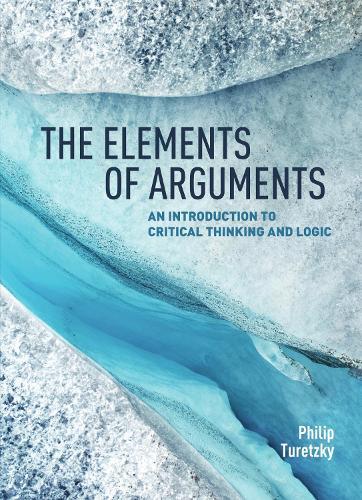
Full Product Details
Author: Philip Turetzky
Publisher: Broadview Press Ltd
Imprint: Broadview Press Ltd
Dimensions:
Width: 16.50cm
, Height: 1.60cm
, Length: 22.90cm
Weight: 0.489kg
ISBN: 9781554814077
ISBN 10: 1554814073
Pages: 336
Publication Date: 11 April 2019
Audience:
College/higher education
,
Tertiary & Higher Education
Format: Paperback
Publisher's Status: Active
Availability: Available To Order

We have confirmation that this item is in stock with the supplier. It will be ordered in for you and dispatched immediately.
Reviews
Compared to other books in this area I find The Elements of Arguments to be near the top in quality. In terms of teaching to a diverse group of students from varying backgrounds and with different abilities, I find it to be exceptional. The author is extremely sensitive to traditional problems and confusions that surround the subject making it a challenge to teach. He has given the higher education community a standard of the highest caliber with admirable benefit to the students we serve. -- Dennis Brandon, California State University, Northridge In a crowded field of introductory texts, The Elements of Arguments stands out. Turetzky has achieved in one volume an admirably clear presentation of both 'critical thinking' and 'logic' as distinct but overlapping disciplines. Instructors will benefit greatly from the book's lucid definitions, careful distinctions, and abundant exercises. Students will find their reading rewarded with varied and accessible examples as well as insightful sections relating logic to other fields such as psychology, rhetoric, and the philosophy of language. Using this text, students will be well prepared to handle reasoning and arguments in any subject. -- Tyler Will, Colorado State University
“Compared to other books in this area I find The Elements of Arguments to be near the top in quality. In terms of teaching to a diverse group of students from varying backgrounds and with different abilities, I find it to be exceptional. The author is extremely sensitive to traditional problems and confusions that surround the subject making it a challenge to teach. He has given the higher education community a standard of the highest caliber with admirable benefit to the students we serve.” — Dennis Brandon, California State University, Northridge “In a crowded field of introductory texts, The Elements of Arguments stands out. Turetzky has achieved in one volume an admirably clear presentation of both ‘critical thinking’ and ‘logic’ as distinct but overlapping disciplines. Instructors will benefit greatly from the book’s lucid definitions, careful distinctions, and abundant exercises. Students will find their reading rewarded with varied and accessible examples as well as insightful sections relating logic to other fields such as psychology, rhetoric, and the philosophy of language. Using this text, students will be well prepared to handle reasoning and arguments in any subject.” — Tyler Will, Colorado State University
Compared to other books in this area I find The Elements of Arguments to be near the top in quality. In terms of teaching to a diverse group of students from varying backgrounds and with different abilities, I find it to be exceptional. The author is extremely sensitive to traditional problems and confusions that surround the subject making it a challenge to teach. He has given the higher education community a standard of the highest caliber with admirable benefit to the students we serve. - Dennis Brandon, California State University, Northridge In a crowded field of introductory texts, The Elements of Arguments stands out. Turetzky has achieved in one volume an admirably clear presentation of both 'critical thinking' and 'logic' as distinct but overlapping disciplines. Instructors will benefit greatly from the book's lucid definitions, careful distinctions, and abundant exercises. Students will find their reading rewarded with varied and accessible examples as well as insightful sections relating logic to other fields such as psychology, rhetoric, and the philosophy of language. Using this text, students will be well prepared to handle reasoning and arguments in any subject. - Tyler Will, Colorado State University
Compared to other books in this area I find The Elements of Arguments to be near the top in quality. In terms of teaching to a diverse group of students from varying backgrounds and with different abilities, I find it to be exceptional. The author is extremely sensitive to traditional problems and confusions that surround the subject making it a challenge to teach. He has given the higher education community a standard of the highest caliber with admirable benefit to the students we serve. -- Dennis Brandon, California State University, Northridge
Author Information
Philip Turetzky taught philosophy at Colorado State University, the University of South Dakota, Ripon College, and other post-secondary institutions. He is the author of Time (Routledge, 1998) and numerous academic articles.