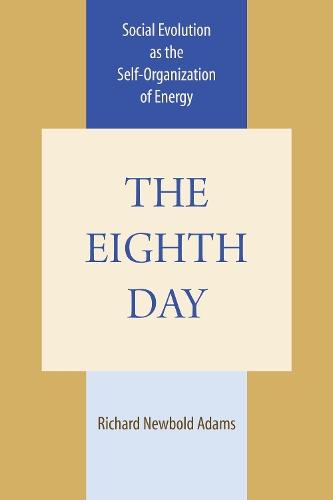
The Eighth Day: Social Evolution As the Self-Organization of Energy

Author:   Richard Newbold Adams
Publisher:   University of Texas Press
ISBN:  

9780292720619


Pages:   312
Publication Date:   01 March 1988
Format:   Paperback
Availability:   In Print   Availability explained
This item will be ordered in for you from one of our suppliers. Upon receipt, we will promptly dispatch it out to you. For in store availability, please contact us.

Our Price $47.95 Quantity:  
Add to Cart

Share |

The Eighth Day: Social Evolution As the Self-Organization of Energy


Overview

Can human social evolution be described in terms common to other sciences, most specifically, as an energy process? The Eighth Day reflects a conviction that the human trajectory, for all its uniqueness and indeterminism, will never be satisfactorily understood until it is framed in dynamics that are common to all of nature. The problem in doing this, however, lies in ourselves. The major social theories have failed to treat human social evolution as a component of broader natural processes. The Eighth Day argues that the energy process provides a basis for explaining, comparing, and measuring complex social evolution. Using traditional ecological energy flow studies as background, society is conceived as a self-organization of energy. This perspective enables Adams to analyze society in term of the natural selection of self-organizing energy forms and the trigger processes basic to it. Domestication, civilization, socioeconomic development, and the regulation of contemporary industrial nation-states serve to illustrate the approach. A principal aim is to explore the limitation that energy process imposes on human social evolution as well as to clarify the alternatives that it allows. Richly informed by contemporary anthropological historicism, sociobiology, and Marxism, The Eighth Day avoids simple reductionism and denies facile ideological categorization. Adams builds on work in nonequilibrium thermodynamics and theoretical biology and brings three decades of his own work to an analysis of human society that demands an extreme materialism in which human thought and action find a central place.

Full Product Details

Author:   Richard Newbold Adams
Publisher:   University of Texas Press
Imprint:   University of Texas Press
Dimensions:   Width: 15.20cm , Height: 2.30cm , Length: 22.90cm
Weight:   0.454kg
ISBN:  

9780292720619


ISBN 10:   0292720610
Pages:   312
Publication Date:   01 March 1988
Audience:   Professional and scholarly ,  Professional & Vocational
Format:   Paperback
Publisher's Status:   Active
Availability:   In Print   Availability explained
This item will be ordered in for you from one of our suppliers. Upon receipt, we will promptly dispatch it out to you. For in store availability, please contact us.

Table of Contents

Contents Preface Introduction 1. Preliminaries Principles and Explanations Anthropological Antecedents Monism and Materialism Studies of Energy and Society 2. Energy Process Energy Forms Equilibrium Equilibrium and Dissipative Structures Stability and Steady States Appendix: Note on Odum’s “Energy Quality” 3. Energy Dynamics The Laws of Thermodynamics Lotka’s Principle Minimum Dissipation Principle Trigger-Flow Mechanisms and Principles 4. Self-Organization Introduction Equilibrium Bases of Self-Organization Autopoiesis Perturbations Self-Triggering Appendix: Order and Functional Organization 5. Culture Mental Self-Organization Informational Dynamics Cultural Process Appendix: Energy and Values 6. Domestication Domestication? Why Bother? Ecological and Human Controls Human Dominance, Culture, and Power Indigenous California Society The Emergence of Social Hierarchies Political and Ideological Implications Notes 7. Natural Selection The Broader Issue In Equilibrium Structures Self-Organization of Dissipative Structures Selection and Epistemology 8. Boundary Dynamics Social Boundaries Energetic Boundaries Environments and Closure 9. Civilization The Meaning of “Civilization” Civilization as a Trigger The Origins and Future of Civilization Notes 10. Humanities The Classics Free-Floating Triggers 11. Expansion In Social Hierarchy: A Model Social Survival Vehicles and Coaxal Structures Novel and Secondary Constructions The Emergence of Hierarchy: Work and Regulation 12. Energy and Industrialization Modeling Industrialization Expansion The Energy Sector Model Interactive Changes among Sectors Expansion of the Regulatory Sector Regulation in Subnational Units Notes Postscript: Development and Contemporary Social Evolution References Index

Reviews

Author Information

Richard Newbold Adams is Rapoport Centennial Professor Emeritus of Liberal Arts at the University of Texas at Austin.

Tab Content 6

Author Website:  

Countries Available

All regions
Latest Reading Guide

NOV RG 20252


Shopping Cart
Your cart is empty
Shopping cart
Mailing List