|
|
|||
|
||||
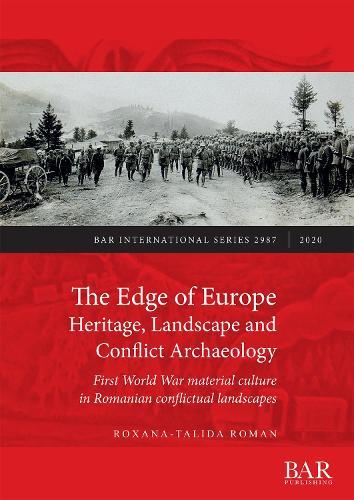
OverviewThe Edge of Europe addresses the significance of Romanian WWI sites as places of remembrance and heritage. By measuring the case of Maramures against national and international heritage standards the work demonstrates that the Prislop Pass places of war hold heritage value both in terms of physical preservation and in terms of mapping the memorial-historical record. As well as providing the first ever gazetteer and survey of WWI sites on the Eastern Front, Roman's research suggests a model of conflictual landscape for approaching aspects of previously unexplored material culture of war and a tool kit for the assessment of unrecognised heritage. Full Product DetailsAuthor: Roxana-Talida RomanPublisher: BAR Publishing Imprint: BAR Publishing Weight: 0.969kg ISBN: 9781407356853ISBN 10: 1407356852 Pages: 243 Publication Date: 29 June 2020 Audience: Professional and scholarly , Professional & Vocational Format: Paperback Publisher's Status: Active Availability: Available To Order We have confirmation that this item is in stock with the supplier. It will be ordered in for you and dispatched immediately. Table of ContentsList of Figures List of Tables Abbreviations 1. Introduction 1.1. Preamble 1.2. Research context and broader themes 1.3. Research outline 2. Background 2.1. Introduction 2.2. Archaeology as link between heritage and history/memory 2.3. Approaches to WWI research - First World War archaeology 2.4. WWI and remembrance 2.5. Memory, remembrance and its links to heritage 2.6. Heritage 2.6.1. International heritage stakeholders 2.6.2. AHD & UHD 2.6.3. Laws and their place in heritage 2.6.4. Value ascription in heritage management and conservation practice, internationally 2.7. Conclusion 3. Methodology 3.1. Introduction 3.2. Rationale 3.3. The First World War and Romania 3.4. Research area 3.5. Methodology 3.5.1. First Objective 3.5.2. Second objective 3.5.3. Third objective 3.6. Conclusion 4. Historical Review 4.1. Introduction 4.2. The Romanian Kingdom in WWI 4.3. The 1916 Romanian Campaign 4.4. The 1917 Romanian campaign 4.4.1. The Mara?ti Battle 4.4.2. The Oituz Battle 4.4.3. The Mara?e?ti Battle 4.5. The 1918 Romanian campaign 4.6. The Union of the Romanian historical provinces with the Romanian Kingdom 4.7. WWI in the Romanian historical provinces appendant to the Austro-Hungarian Empire 4.8. Maramure? 4.9. The Prislop Pass - the link between Maramure? and Bukovina 4.10. The Maramure?-Bukovina front 4.11. The imperial transport systems in Maramure? and Bukovina 4.12. The human dimension of the war - civilians and war prisoners 4.13. WWI in literature and folklore 4.14. Conclusion 5. Assessment of the Material Culture of War in the Prislop Pass Area/the Prislop Pass Conflictual Landscape 5.1. Introduction 5.2. Research sector 1 5.3. Research sector 2 5.4. Research sector 3 5.5. The material culture of war in Maramure? - The Prislop Pass conflictual landscape 5.6. Conclusion 6. Heritage by Law, Nationally 6.1. Introduction 6.2. The evolution of heritage legislation in Romania 6.3. The formation of contemporary heritage legislation 6.4. The List of Historic Monuments 6.5. Romania and the heritage arena/The Romanian Territorial Development Strategy 6.6. Assessment of WWI remains as instances of heritage at national level 6.7. Conclusion 7. Heritage by Law, Internationally 7.1. Introduction 7.2. The link between national and international heritage legislation 7.3. International heritage legislation 7.4. The European Year of Cultural Heritage 7.5. The World Heritage ranking process and criteria 7.6. The Wooden Churches of Maramure? 7.7 Assessment of WWI remains as instances of heritage at international level 7.8. Conclusion 8. Research Outcomes 8.1. Introduction 8.2. Main findings 8.3. Implications 8.4. Future research 8.5. Conclusion Appendix 1. Cultural tourism as highlighter of the versatility of heritage value Appendix 2. King Ferdinand's proclamation to all Romanians Appendix 3. The offensive in Transylvania Appendix 4. The defence of the South Front Appendix 5. The defence of the Carpathian Mountains' passages Appendix 6. The defence of the Muntenia territory Appendix 7. The declaration of self-determination presented by Alexandru Vaida-Voevod to the Hungarian Parliament of Austria-Hungary Appendix 8. The New York Times article describing the National Assembly of Alba Iulia that decided the Great Union on 1st December 1918 Appendix 9. Iuliu Maniu's speech at the National Assembly of Alba Iulia - Great Union 1st December 1918 Appendix 10. The resolution of the National Assembly of Alba Iulia 1st December 1918 Appendix 11. The Union of Basarabia, Bukovina and Banat with Romania Appendix 12. The Union of Maramure? with Romania Appendix 13. Between two front lines, 1914-1918 BibliographyReviews{\rtf1\ansi\ansicpg1252\deff0\deflang2057{\fonttbl{\f0\fswiss\fprq2\fcharset0 Calibri;}{\f1\fnil\fcharset0 Verdana;}} \viewkind4\uc1\pard\sa160\sl252\slmult1\f0\fs22\lquote This is a critically important contribution to conflict archaeology and First World War studies.\rquote Professor Nicholas Saunders, University of Bristol\par \lquote The quality of this research is of great significance archaeologically in examining the Eastern Front during the Great War.\rquote Peer reviewer\par \pard\f1\fs17\par } 'This is a critically important contribution to conflict archaeology and First World War studies.' Professor Nicholas Saunders, University of Bristol 'The quality of this research is of great significance archaeologically in examining the Eastern Front during the Great War.' Peer reviewer {\rtf1\ansi\ansicpg1252\deff0\deflang2057{\fonttbl{\f0\fswiss\fprq2\fcharset0 Calibri;}{\f1\fnil\fcharset0 Verdana;}} \viewkind4\uc1\pard\sa160\sl252\slmult1\f0\fs22\lquote This is a critically important contribution to conflict archaeology and First World War studies.\rquote Professor Nicholas Saunders, University of Bristol\par \lquote The quality of this research is of great significance archaeologically in examining the Eastern Front during the Great War.\rquote Peer reviewer\par \pard\f1\fs17\par } Author InformationRoxana-Talida Roman completed her PhD in Classics, Ancient History and Archaeology at the University of Birmingham in 2019. She specialises in conflict/landscape archaeology, heritage and material culture. Previously she conducted research on memory and remembrance in relation to military ethos and the rhetoric of death in the post-heroic age. Tab Content 6Author Website:Countries AvailableAll regions |
||||