Overview
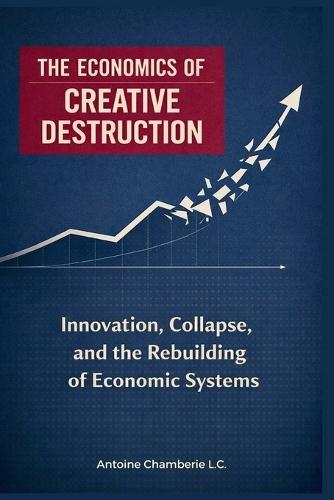
Why does growth so often arrive through collapse? Factories close, industries vanish, regions hollow out-yet productivity rises, new firms appear, and entire technologies emerge from the wreckage. To anyone living through disruption, this feels chaotic. To an economist, it follows a pattern. The Economics of Creative Destruction: Innovation, Collapse, and the Rebuilding of Economic Systems maps that pattern in detail. Building on Schumpeter's original insight and the last decades of empirical research, this book shows how firm turnover, technological waves, trade shocks, and policy choices interact to produce both growth and dislocation. Drawing on evidence from the industrial revolution to the digital age, it explains: How waves of innovation move from steam and electricity to computers and AI-and why cost curves reliably fall 20-30% with each doubling of scale. Why 8-12% of firms entering and exiting each year is not a sign of failure but the mechanism of aggregate productivity growth. How trade and technology shocks can cut regional employment by 10-20%, and why some places adapt while others lock into decline. The role of finance, industrial policy, and public research in deciding which innovations survive, scale, or die in the lab. How skills, institutions, and geography shape who benefits from disruption-and who bears the costs. Rather than offering slogans about ""innovation"" or ""disruption,"" this book provides a framework. It links micro-level firm dynamics to macroeconomic growth, connects regional case studies to national productivity trends, and shows how policy can either accelerate adaptation or freeze obsolete structures in place. You will find: Clear explanations of creative destruction, firm churn, and productivity growth grounded in current research. Intuitive diagrams and system maps that make complex mechanisms easier to follow. Regional and sectoral examples-from manufacturing and tradeable goods to services and digital platforms. Practical lenses for evaluating your own exposure: industry, region, skills, and policy environment. This is a book for readers who sense that disruption is not random-and want to see the underlying structure. Graduate students and researchers will recognize the theoretical depth; policymakers, business leaders, analysts, and founders will find a rigorous but accessible guide to navigating long-run technological change. You are not confused. The system is complex. The patterns of innovation, collapse, and rebuilding can be understood-and this book shows you how to read them.
Full Product Details
Author: Antoine Chamberie
Publisher: Independently Published
Imprint: Independently Published
Dimensions:
Width: 15.20cm
, Height: 2.60cm
, Length: 22.90cm
Weight: 0.680kg
ISBN: 9798248667741
Pages: 514
Publication Date: 16 February 2026
Audience:
General/trade
,
General
Format: Paperback
Publisher's Status: Active
Availability: Available To Order

We have confirmation that this item is in stock with the supplier. It will be ordered in for you and dispatched immediately.