Overview
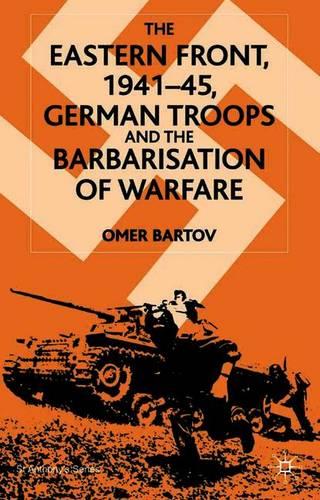
Based largely upon unpublished sources, Omer Bartov's study looks closely at the background of the German army on the Eastern Front during World War II. He describes the physical hardship, the discipline and morale at the front, and analyzes the social, educational and political background of the junior officers who formed the backbone of the German army. With these factors in mind, together with the knowledge of the extent of National Socialist indoctrination, this book begins to explain the criminal activities of the German army in Russia and the extent of involvement of the army in the execution of Hitler's brutal policies.
Full Product Details
Author: O. Bartov
Publisher: Palgrave Macmillan
Imprint: Palgrave Macmillan
Edition: 2nd ed. 2001
Dimensions:
Width: 14.00cm
, Height: 1.30cm
, Length: 21.60cm
Weight: 0.454kg
ISBN: 9780333949443
ISBN 10: 0333949447
Pages: 218
Publication Date: 31 July 2001
Audience:
College/higher education
,
Professional and scholarly
,
Undergraduate
,
Postgraduate, Research & Scholarly
Format: Paperback
Publisher's Status: Active
Availability: In Print

This item will be ordered in for you from one of our suppliers. Upon receipt, we will promptly dispatch it out to you. For in store availability, please contact us.
Reviews
'Omer Bartov's book is an extremely useful addition to the valuable Macmillan/St Antony's series of monographs on modern history and politics...Bartov is extremely good in recounting the nature and forms of, and responses to, the ideological instruction carried out in the armed forces during the war...' - John P. Fox, International Affairs Vol. 63 Nr 1 Winter 1986-87, pp. 123-4 'Omer Bartov's The Eastern Front...is...an original and flesh-creeping social history of German soldiers at the sharpest end of the Second World War which no serious student can afford to ignore.' - David Englander, British Book News 'excellently researched and well written...' - Geoffrey Jukes, Soviet Studies, vol. XXXIX 1987, pp. 158-159 'The merit of Bartov's book is that he investigates the barbarisation process at grass-roots level by looking through the microscope at the activities of three front-line divisions on the eastern front. Using material from divisional files Bartov draws a vivid picture of the appalling conditions and heavy casualties which subjected ordinary soldiers to intolerable stress and strain turning them into brute beasts indifferent to human values.' - W.Carr, History, Autumn 1987, pp.554-5 'after Bartov's book, it will be even more difficult than before to argue that only a small minority of the German army was involved in the extermination policy in the East.' - Christian Streit Mannheim, German Historical Institute London Bulletin
'Omer Bartov's book is an extremely useful addition to the valuable Macmillan/St Antony's series of monographs on modern history and politics...Bartov is extremely good in recounting the nature and forms of, and responses to, the ideological instruction carried out in the armed forces during the war...' - John P. Fox, International Affairs Vol. 63 Nr 1 Winter 1986-87, pp. 123-4 'Omer Bartov's The Eastern Front...is...an original and flesh-creeping social history of German soldiers at the sharpest end of the Second World War which no serious student can afford to ignore.' - David Englander, British Book News 'excellently researched and well written...' - Geoffrey Jukes, Soviet Studies, vol. XXXIX 1987, pp. 158-159 'The merit of Bartov's book is that he investigates the barbarisation process at grass-roots level by looking through the microscope at the activities of three front-line divisions on the eastern front. Using material from divisional files Bartov draws a vivid picture of the appalling conditions and heavy casualties which subjected ordinary soldiers to intolerable stress and strain turning them into brute beasts indifferent to human values.' - W.Carr, History, Autumn 1987, pp.554-5 'after Bartov's book, it will be even more difficult than before to argue that only a small minority of the German army was involved in the extermination policy in the East.' - Christian Streit Mannheim, German Historical Institute London Bulletin
'Omer Bartov's book is an extremely useful addition to the valuable Macmillan/St Antony's series of monographs on modern history and politics...Bartov is extremely good in recounting the nature and forms of, and responses to, the ideological instruction carried out in the armed forces during the war...' - John P. Fox, International Affairs Vol. 63 Nr 1 Winter 1986-87, pp. 123-4 'Omer Bartov's The Eastern Front...is...an original and flesh-creeping social history of German soldiers at the sharpest end of the Second World War which no serious student can afford to ignore.' - David Englander, British Book News 'excellently researched and well written...' - Geoffrey Jukes, Soviet Studies, vol. XXXIX 1987, pp. 158-159 'The merit of Bartov's book is that he investigates the barbarisation process at grass-roots level by looking through the microscope at the activities of three front-line divisions on the eastern front. Using material from divisional files Bartov draws a vivid picture of the appalling conditions and heavy casualties which subjected ordinary soldiers to intolerable stress and strain turning them into brute beasts indifferent to human values.' - W.Carr, History, Autumn 1987, pp.554-5 'after Bartov's book, it will be even more difficult than before to argue that only a small minority of the German army was involved in the extermination policy in the East.' - Christian Streit Mannheim, German Historical Institute London Bulletin
Author Information
OMAR BARTOV is John P. Birkelund Professor of European History at Brown University, USA.