Overview
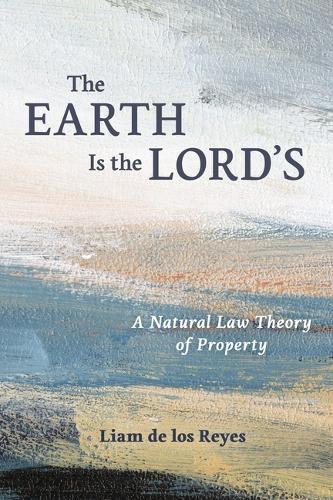
What does the Christian tradition have to say about property and ownership? The Earth Is the Lord's offers compelling answers to this question. In this timely and thought-provoking book, author Liam de los Reyes presents a counterpoint from within the Christian tradition to both Lockean and utilitarian theories of property. Combining strong textual evidence and clear reasoning, de los Reyes sets forth a natural law theory of property based on key patristic, scholastic, early modern, and contemporary theological sources. This theory posits that all things belong properly to God; that God has given human beings the power to use the things of the world for their own flourishing; and that property as a convention ought to govern and distribute the things of the world in accordance with this divine purpose. More specifically, de los Reyes argues that within the Christian tradition, property is a convention that gives expression to the political nature of humans by protecting certain principles of justice in how humans govern the material order, while leaving the determination of any one property regime open to a people's political reasoning that takes into account that people's historical, cultural, and environmental contexts. De los Reyes's theory is general enough to support a wide array of philosophical and theological theories of justice but also concrete enough to clarify many of the related critiques of capitalism and markets, making it of particular interest to scholars of ethics, religion, philosophy, law, and economics.
Full Product Details
Author: Liam de Los Reyes
Publisher: William B. Eerdmans Publishing Company
Imprint: William B. Eerdmans Publishing Company
Dimensions:
Width: 15.20cm
, Height: 1.80cm
, Length: 22.80cm
Weight: 0.259kg
ISBN: 9780802885203
ISBN 10: 0802885209
Pages: 260
Publication Date: 17 June 2025
Audience:
General/trade
,
General
Format: Paperback
Publisher's Status: Active
Availability: Available To Order

We have confirmation that this item is in stock with the supplier. It will be ordered in for you and dispatched immediately.
Reviews
""Amidst a lively theological literature examining capitalism and the economy, surprisingly little attention has been paid to the question of property. Liam de los Reyes's new book shows the vital importance of moving beyond the analysis of the market, consumption, and commodification, to ask whether adequate justification exists for the institution of private property. What emerges is a natural law theory of property capable of distinguishing legitimate from misguided critiques of markets and capitalism. A much-needed contribution!"" --Jennifer A. Herdt, Yale Divinity School ""In this groundbreaking book, Liam de los Reyes argues that the theory of property developed by scholastic jurists and theologians in the twelfth and thirteenth centuries offers a more satisfactory understanding of property rights than contemporary alternatives, above all the liberal theory defended by Locke and his followers. In sharp contrast to Locke, who defends a natural right to property, the scholastics hold that property rights are social constructs which are meant to promote the values of equality, subsistence, and freedom. This does not imply that property rights can just be set aside, but it does imply that these claims are to be interpreted in such a way as to give priority to those forms of distribution which promote wide access to shared resources. This book represents a major contribution to the growing field of economics and theology, and it will be essential reading for anyone concerned with building a more equitable and sustainable economic system."" --Jean Porter, University of Notre Dame
""Amidst a lively theological literature examining capitalism and the economy, surprisingly little attention has been paid to the question of property. Liam de los Reyes's new book shows the vital importance of moving beyond the analysis of the market, consumption, and commodification, to ask whether adequate justification exists for the institution of private property. What emerges is a natural law theory of property capable of distinguishing legitimate from misguided critiques of markets and capitalism. A much-needed contribution!"" --Jennifer A. Herdt, Yale Divinity School ""In this groundbreaking book, Liam de los Reyes argues that the theory of property developed by scholastic jurists and theologians in the twelfth and thirteenth centuries offers a more satisfactory understanding of property rights than contemporary alternatives, above all the liberal theory defended by Locke and his followers. In sharp contrast to Locke, who defends a natural right to property, the scholastics hold that property rights are social constructs which are meant to promote the values of equality, subsistence, and freedom. This does not imply that property rights can just be set aside, but it does imply that these claims are to be interpreted in such a way as to give priority to those forms of distribution which promote wide access to shared resources. This book represents a major contribution to the growing field of economics and theology, and it will be essential reading for anyone concerned with building a more equitable and sustainable economic system."" --Jean Porter, University of Notre Dame ""This deeply scholarly, original, and carefully crafted book fills an important gap in the literature in developing a coherent theory of property informed by philosophical analysis and Catholic social traditions. The author makes a convincing philosophical argument that theories of justice have so far lacked adequate reflection on theories of property. The book develops a case for property as a convention arising out of our social and creaturely nature. Importantly, it allows for equity, equality, sufficiency and liberty in divine intention becoming embedded in the establishment of property regimes. This is achieved primarily by drawing on scholastic theories of natural law which are grounded in humanity's earthed and rational nature. Such a theoretical grounding rules out the possibility of tyranny and interprets dominion over the earth as the right direction and ordering exercised by human reason. The book also engages in an interesting way with Catholic social teaching and more specifically the work of liberation theologian Ignacio Ellacuria. Scholars interested in theories of social justice and property rights, the development of Catholic social thought, and the application of natural law will find in this book a treasure trove of carefully argued critique, analysis and creative insight."" --Celia Deane-Drummond, University of Oxford
Author Information
Liam de los Reyes is associate professor of moral theology at Mount Angel Seminary in Saint Benedict, Oregon. His research interests include action theory, political theology and ethics, and Catholic social doctrine.