Overview
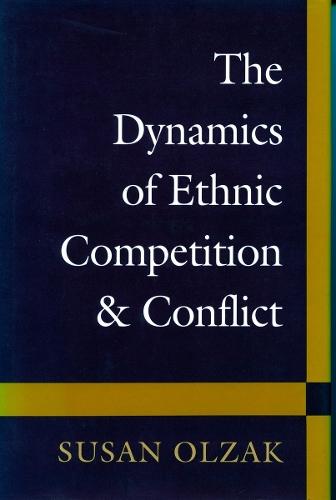
This study of ethnic violence in the United States from 1877 to 1914 reveals that not all ethnic groups were equally likely to be victims of violence; the author seeks the reasons for this historical record. Earlier theories of race and ethnic conflict often assumed that ethnic conflict is primarily a function of poverty or deprivation but Olzak suggests that conflict can equally arise during times of economic growth. She explains this by arguing that conflict erupts when racially ordered systems break down, in other words when different ethnic groups find themselves competing for key resources such as jobs and houses. 'This analysis of the causes of urban racial and ethnic strife in large American cities at the turn of the century is a tour de force. It is bound to become an important empirical and theoretical reference for social scientists and historians alike.' -William Julius Wilson, University of Chicago
Full Product Details
Author: Susan Olzak
Publisher: Stanford University Press
Imprint: Stanford University Press
Edition: New edition
Dimensions:
Width: 15.20cm
, Height: 2.30cm
, Length: 22.90cm
Weight: 0.600kg
ISBN: 9780804720281
ISBN 10: 0804720282
Pages: 288
Publication Date: 01 December 1992
Audience:
College/higher education
,
Professional and scholarly
,
Undergraduate
,
Postgraduate, Research & Scholarly
Format: Hardback
Publisher's Status: Active
Availability: In Print

This item will be ordered in for you from one of our suppliers. Upon receipt, we will promptly dispatch it out to you. For in store availability, please contact us.
Reviews
Susan Olzak promises a great deal in this book and delivers even more. She makes strong hypothetical claims derived from rich theoretical arguments, develops elegant empirical tests of them, and quite cautiously fashions conclusions out of the pattern of results. The book provides a remarkably coherent model for studying ethnic conflict... With this superb monograph Susan Olzak establishes a niche for herself among the best scholars of ethnic conflict and collective action. -- American Journal of Sociology
Susan Olzak promises a great deal in this book and delivers even more. She makes strong hypothetical claims derived from rich theoretical arguments, develops elegant empirical tests of them, and quite cautiously fashions conclusions out of the pattern of results. The book provides a remarkably coherent model for studying ethnic conflict... With this superb monograph Susan Olzak establishes a niche for herself among the best scholars of ethnic conflict and collective action. --American Journal of Sociology
"""Susan Olzak promises a great deal in this book and delivers even more. She makes strong hypothetical claims derived from rich theoretical arguments, develops elegant empirical tests of them, and quite cautiously fashions conclusions out of the pattern of results. The book provides a remarkably coherent model for studying ethnic conflict... With this superb monograph Susan Olzak establishes a niche for herself among the best scholars of ethnic conflict and collective action."" - American Journal of Sociology"
“Susan Olzak promises a great deal in this book and delivers even more. She makes strong hypothetical claims derived from rich theoretical arguments, develops elegant empirical tests of them, and quite cautiously fashions conclusions out of the pattern of results. The book provides a remarkably coherent model for studying ethnic conflict. . . . With this superb monograph Susan Olzak establishes a niche for herself among the best scholars of ethnic conflict and collective action.”— American Journal of Sociology
Susan Olzak promises a great deal in this book and delivers even more. She makes strong hypothetical claims derived from rich theoretical arguments, develops elegant empirical tests of them, and quite cautiously fashions conclusions out of the pattern of results. The book provides a remarkably coherent model for studying ethnic conflict. . . . With this superb monograph Susan Olzak establishes a niche for herself among the best scholars of ethnic conflict and collective action. -- American Journal of Sociology
Author Information
Susan Olzak is Professor of Sociology at Stanford University. She is the author of The Dynamics of Ethnic Competition and Conflict (Stanford University Press, 1992).