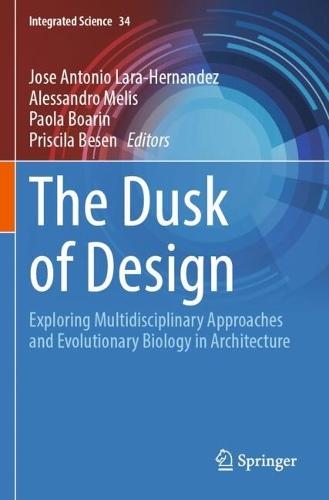
Full Product Details
Author: Jose Antonio Lara-Hernandez ,
Alessandro Melis ,
Paola Boarin ,
Priscila Besen
Publisher: Springer International Publishing AG
Imprint: Springer International Publishing AG
ISBN: 9783031768699
ISBN 10: 3031768698
Pages: 308
Publication Date: 14 January 2026
Audience:
Professional and scholarly
,
Professional & Vocational
Format: Paperback
Publisher's Status: Active
Availability: Manufactured on demand

We will order this item for you from a manufactured on demand supplier.
Author Information
Jose Antonio Lara-Hernandez PhD (Portsmouth), is a senior researcher at Auckland University of Technology. Previously postdoctoral researcher at the University of Porto. He was a member of the curatorial team of the Italian Pavilion at the Venice Biennale 2021. He has more than ten years’ experience as a registered architect and urban designer and a chartered member of the Colegio de Arquitectos de Merida (Mexico). In addition, he was a co-founder of the IMPLAN-Merida (Municipal Institute of Urban Planning in Merida City). His research and professional experience include works in Mexico, Italy, Switzerland, New Zealand and the United Kingdom. He focuses on research topics related to informality in the urban landscape, architectural exaptation, as well as studies on urban sustainability and resilience. Antonio has published several academic articles and books highlighting the impact of the transformation of the built environment at the streetscape level towards the diversity of temporary appropriation in cities. Alessandro Melis PhD (Florence) RIBA ARB AOU, is Full Professor of architecture innovation at the New York Institute of Technology. In 2019, he was appointed by the Italian Minister of Cultural Heritage as the curator of the Italian Pavilion at the Venice Biennale. Previously, at the University of Auckland, he was the head of the technology area and director of postgraduate engagement. In the period 2010-2013 he has been the Director of Brain City Lab at the university of Applied Arts Vienna, guest professor at the Anhalt University Dessau, and an honorary fellow at the Edinburgh School of Architecture. He has also been invited as a keynote speaker at the China Academy of Art, the MoMA New York, the University of Cambridge, TED, and the Italian Institute of Culture in London, and the UNESCO Headquarters in Paris. His work was the object of several publications, including the recent monograph (Rome, 2020) edited by Giuseppe Fallacara, titled “Alessandro Melis, Utopic Real World.” Paola Boarin PhD (Ferrara), is Associate Professor of Architectural Technology and Sustainability at Te Pare School of Architecture and Planning of the University of Auckland, New Zealand, where she is co-founder and Director of the Future Cities Research Centre. Paola’s research explores the intersections across architecture, technology and environment, focusing on sustainable and regenerative design, post-occupancy evaluation of buildings and neighbourhoods, and adaptive reuse. Paola is involved in transdisciplinary research groups and projects at national and international level focusing on the nexus across design, health and climate change impacts, and works closely with industry and governments. Paola is a member of the Executive and Steering Committees at the Association of Pacific Rim Universities’ Sustainable Cities and Landscapes Hub. Over her career, Paola has gained extensive international experience by collaborating closely on research and teaching activities in several universities in Europe, the USA and New Zealand, receiving two Young Researchers Awards from the University of Ferrara, the International Leadership Award from the U.S. Department of State, in addition to several recognitions for her teaching leadership at the University of Auckland. Priscila Besen PhD (Auckland), is a Lecturer in Sustainable and Regenerative Architecture at AUT's Huri Te Ao School of Future Environments. She leads the Architectural Ecologies stream and co-leads the Future Neighbourhoods Lab at AUT, focusing on creating healthy, resilient, and liveable built environments for a post-carbon future. With a Bachelor of Architecture and Urbanism from UFSC, Brazil, she has worked in multi-unit residential architecture, urban design, and building environmental certification across Brazil, the USA, and New Zealand. A certified Passive House Consultant and former Board member of Passive House Institute New Zealand, she is also part of the Future Cities Research Centre at the University of Auckland. She co-leads an international research project across Aotearoa NZ and Chile on co-designing collective housing with Indigenous communities. Her award-winning research and practice integrate technical and socio-cultural aspects, including life-cycle thinking, sustainable urban design, co-design, building energy performance, post-occupancy evaluation, adaptive reuse and retrofit.