Overview
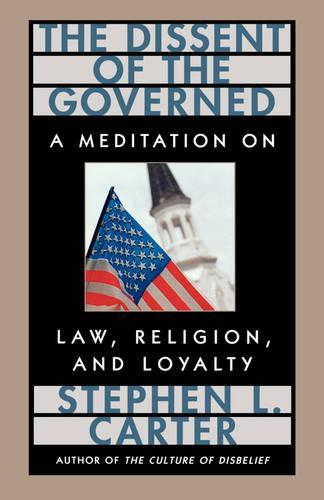
Between loyalty and disobedience; between recognition of the law's authority and realization that the law is not always right: In America, this conflict is historic, with results as glorious as the mass protests of the civil rights movement and as inglorious as the armed violence of the militia movement. In an impassioned defense of dissent, Stephen L. Carter argues for the dialogue that negotiates this conflict and keeps democracy alive. His book portrays an America dying from a refusal to engage in such a dialogue, a polity where everybody speaks, but nobody listens. The Dissent of the Governed is an eloquent diagnosis of what ails the American body politic--the unwillingness of people in power to hear disagreement unless forced to--and a prescription for a new process of response. Carter examines the divided American political character on dissent, with special reference to religion, identifying it in unexpected places, with an eye toward amending it before it destroys our democracy. At the heart of this work is a rereading of the Declaration of Independence that puts dissent, not consent, at the center of the question of the legitimacy of democratic government. Carter warns that our liberal constitutional ethos--the tendency to assume that the nation must everywhere be morally the same--pressures citizens to be other than themselves when being themselves would lead to disobedience. This tendency, he argues, is particularly hard on religious citizens, whose notion of community may be quite different from that of the sovereign majority of citizens. His book makes a powerful case for the autonomy of communities--especially but not exclusively religious--into which democratic citizens organize themselves as a condition for dissent, dialogue, and independence. With reference to a number of cases, Carter shows how disobedience is sometimes necessary to the heartbeat of our democracy--and how the distinction between challenging accepted norms and challenging the sovereign itself, a distinction crucial to the Declaration of Independence, must be kept alive if Americans are to progress and prosper as a nation.
Full Product Details
Author: Stephen L. Carter
Publisher: Harvard University Press
Imprint: Harvard University Press
Edition: New edition
Dimensions:
Width: 14.00cm
, Height: 0.90cm
, Length: 21.00cm
Weight: 0.259kg
ISBN: 9780674212664
ISBN 10: 0674212665
Pages: 167
Publication Date: 01 November 1999
Audience:
College/higher education
,
Professional and scholarly
,
Undergraduate
,
Postgraduate, Research & Scholarly
Format: Paperback
Publisher's Status: Active
Availability: Out of stock

The supplier is temporarily out of stock of this item. It will be ordered for you on backorder and shipped when it becomes available.
Reviews
In Dissent of the Governed , Stephen Carter points out that Americans do not believe in political trials. So, what is to be done with religious dissenters who protest the sovereign's understanding of the social contract? We cannot treat then as traitors and political subversives because that would come uncomfortably close to political trials. On the other hand, they cannot be regarded by analogy to the civil rights movement, because that would leave open the possibility that the sovereign is wrong...Carter correctly points out that when disaffected religious citizens are told to take their case on abortion, school prayer, family planning, or whatever to the public forum, the recommnedation is not sincere because liberal constitutionalism holds both in theory and practice that these things 'should be outside the realm of politics'...The question, then, is how the regime will treat the losers, and how the losers will comport themselves in their defeat. Carter is surprisingly--I think refreshingly--blunt in spelling out the problem. -- Russell Hittinger First Things
Interesting issues, disappointing book. In a series of three lectures Carter (Law/Yale) meditates on the challenge religious belief poses for political authority in American society. By reinterpreting the Declaration of Independence he first suggests that justice be measured in terms of government's response to dissenters. He then argues that the federal government's response to those who take religion seriously has been to cast them more as potential traitors whose religious faith implies a challenge to sovereignty rather than legitimate dissenters whose views deserve accommodation. For Carter a liberal constitutionalism has dominated American society, imposing an image of secular uniformity in the name of atomistic individual rights. By rushing to celebrate our own open-mindedness when embracing a seemingly neutral areligious polity, however, we overlook the way . . . a strongly secular bias can be . . . stultifying to people whose religious faith is at the center of their lives. Against the widely-accepted single-national-community ethos that requires legal uniformity Carter envisions a system of community autonomy in which believing families shape their lives around a shared faith; the goal is to allow religious believers the same political freedom to act on their beliefs as those who embrace a secular society. Unfortunately, even in local community government in accord with any set of beliefs, religious or secular, unavoidably involves leaving some people outside the favored order whenever society is not perfectly homogeneous. This would seem to be an obvious problem for Carter to address when considering practical issues, but he rushes to play the role of detached scholar in the presence of real policy questions. His apparent support for state aid to religious schools, for example, is quickly qualified by claiming that I am by no means advocating such aid, but merely arguing for its constitutionality. When addressing powerful topics, wishy-washy meditations are just not very satisfying. (Kirkus Reviews)
Author Information
Stephen L. Carter is William Nelson Cromwell Professor of Law at Yale Law School and the author of The Culture of Disbelief: How American Law and Politics Trivialize Religious Devotion.