|
|
|||
|
||||
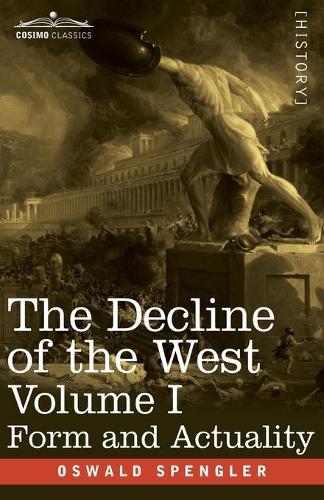
Overview"" ...the World-War was no longer a momentary constellation of casual facts due to national sentiments, personal influences, or economic tendencies, ...but the type of a historical change of phase occurring within a great historical organism of definable compass at the point preordained for it hundreds of years ago."" --Oswald Spengler, Decline of the West Vol. I, 1914 The Decline of the West, Volume I: Form and Actuality, by German historian Oswald Spengler, originally published in German as Der Untergang des Abendlandes (Vol. I in 1918), became an instant success in Germany after its defeat in World War I. Spengler's description of the end of the Western world and the implication that Germany was part of this larger historical process resonated with the German readers. He described great cultures following a cycle from inception to expansion followed by death. By understanding this cycle, one could reconstruct the past and predict the future. He specifically predicted that in the final stage of Western civilization, in the 20th century, Caesarism, a new and overpowering leadership would arise, replacing individualism, liberalism and democracy. Even though this book was criticized by scholars, it became a bestseller in the 1920s and laid the foundation for the social cycle theory, which states that stages of history generally repeat themselves in cycles. Full Product DetailsAuthor: Oswald SpenglerPublisher: Cosimo Classics Imprint: Cosimo Classics Volume: 1 Dimensions: Width: 14.00cm , Height: 2.60cm , Length: 21.60cm Weight: 0.585kg ISBN: 9781646791583ISBN 10: 1646791584 Pages: 464 Publication Date: 09 December 2020 Audience: General/trade , General Format: Paperback Publisher's Status: Active Availability: Available To Order We have confirmation that this item is in stock with the supplier. It will be ordered in for you and dispatched immediately. Table of ContentsReviewsAuthor InformationOSWALD SPENGLER (1880-1936) was a German historian and philosopher of history, whose book The Decline of the West became a major contribution to social theory. Spengler strongly influenced other modern thinkers, such as Arnold J. Toynbee, Samuel Huntington, Joseph Campbell, Camille Paglia and Henry Kissinger. Tab Content 6Author Website:Countries AvailableAll regions |
||||