Overview
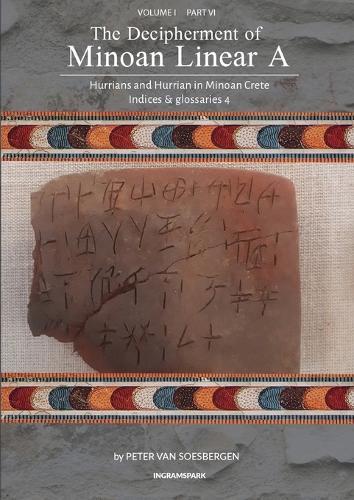
A photograph of Linear A tablet KH 5 from Xανιά / Khaniá is on the front-cover. KH 5.1-2: a-da-ki-si-ka , a-ra-u-da , KH 5.2: wi-sa-sa-ne HORD+E 2 VINb+9 2 KH 5.3: wi-na-du, OVIS+na 1 KH 5.3-4: ku-pa-do HORD [ ] 5 A FIC 2 JB Linear A a-da-ki-si-ka (KH 5.1) represents a Hurrian name, for it can be analysed as asd=a-kizzi=ḫḫ(i)=a, consisting of the a-stem asd=a 'woman' and the essive -a of kizzi=ḫ(ḫ)i 'jewel', so that it can be translated as 'The woman (is/shines) like a jewel' or more specifically 'The woman (is/shines) like a hairpin of precious metal', if we take into account that kizzi/uḫu at Qaṭna is the designation of a golden pin and that Linear A ja-ki-si-ki-nu (AK Zf 9) is written on a silver hairpin from Arkhanes, that can be analysed as ya-kizz=i=ḫḫi=nnu 'as it is a jewel'. The second sequence a-ra-u-da (KH 5.1-2) is a Hurrian 'one-word' name or a toponym Arau, with directive suffix -da 'to, for', or ablative suffix -dan 'from'. The name Arau (wr. A-ra-ú), analysis ar=av, 'I give (the boy)', is attested at Old Babylonian Sippar (Dekiere 6, 917 Beischrift). Linear A wi-sa-sa-ne (KH 5.2) may well consist of the name of the mountain Wisasa / Wisaisa + the alternative Hurrian ethnic suffix -n(n)i/e, 'The one of (Mount) Wisasa'. Linear A wi-na-du (KH 5.3) may be interpreted as the Hurrian sentence-name P/Win-asdu, analysed as p/win-azdu and be translated 'Lift (the child), oh woman !', 'Pick (the child) up, oh woman !'. Linear A ku-pa-do (KH 5.3) can be analysed as an Old Hurrian verbal 'one-word' name ḫub=ad=o=m, with root-extension -ad- of unknown meaning, 'He/She (a numen) destroyed (the deceased child)' or as an Old Hurrian imperative ḫub=ad=o 'Destroy (the deceased child) (oh numen) !'.
Full Product Details
Author: Peter George Van Soesbergen
Publisher: Peter G. Van Soesbergen
Imprint: Peter G. Van Soesbergen
Edition: 3rd Third Revised and Extended ed.
Volume: 6
Dimensions:
Width: 21.00cm
, Height: 2.70cm
, Length: 29.70cm
Weight: 1.238kg
ISBN: 9789083275451
ISBN 10: 9083275450
Pages: 522
Publication Date: 18 September 2022
Audience:
General/trade
,
General
Format: Paperback
Publisher's Status: Active
Availability: Available To Order

We have confirmation that this item is in stock with the supplier. It will be ordered in for you and dispatched immediately.
Reviews
Jacques Raison (Paris) wrote a review in the REVUE DES ÉTUDES GRECQUES, Tome XCVII, Nos 460-461, 1984, p. 87: ""Du même auteur (Peter G. van Soesbergen, BICS 28, 1981, p. 163, résume une conférence du 28-5-80 sur le même sujet 'The historical significance of onomastic data from Linear A and B texts' (texte complet fourni sur demande par la revue). .... Sans pousser jusqu'à l'hiéroglyphique, trop mal connu, Van Soesbergen, entre autres preuves, remonte aux origines du linéaire A, dont les traits 'agglutinants' et les caractéristiques orthographiques du syllabaire (inférées de celles du syllabaire B, son héritier), lui paraissent avoir été concues pour une langue comme celle du Mitanni. Rapprochement de mots du linéaire A et hourrites (assez intéressant, quand ils sont suffisamment longs); essai, finalement, point tellement loin d'une esquisse de déchiffrement partiel. Sous la même signature, bref retour, mais ferme, sur les traits 'hourrites' du linéaire A dans 'Progress in Linear A research', communication au congrès EIRENE de septembre-octobre 1982, à Prague (à paraître dans les actes de cette réunion). En préambule, résumé des acquis antérieurs concernant l'écriture évoquée: il est retenu, comme assuré, un peu de chacun et annoncé un livre sur ""The onomastics of the 'Minoan Linear A' and 'Linear B' documents and their historical significance"", ainsi qu'un ""Corpus of transliterated Linear A texts"".
Jacques Raison (Paris) wrote a review in the REVUE DES ETUDES GRECQUES, Tome XCVII, Nos 460-461, 1984, p. 87: Du meme auteur (Peter G. van Soesbergen, BICS 28, 1981, p. 163, resume une conference du 28-5-80 sur le meme sujet 'The historical significance of onomastic data from Linear A and B texts' (texte complet fourni sur demande par la revue). .... Sans pousser jusqu'a l'hieroglyphique, trop mal connu, Van Soesbergen, entre autres preuves, remonte aux origines du lineaire A, dont les traits 'agglutinants' et les caracteristiques orthographiques du syllabaire (inferees de celles du syllabaire B, son heritier), lui paraissent avoir ete concues pour une langue comme celle du Mitanni. Rapprochement de mots du lineaire A et hourrites (assez interessant, quand ils sont suffisamment longs); essai, finalement, point tellement loin d'une esquisse de dechiffrement partiel. Sous la meme signature, bref retour, mais ferme, sur les traits 'hourrites' du lineaire A dans 'Progress in Linear A research', communication au congres EIRENE de septembre-octobre 1982, a Prague (a paraitre dans les actes de cette reunion). En preambule, resume des acquis anterieurs concernant l'ecriture evoquee: il est retenu, comme assure, un peu de chacun et annonce un livre sur The onomastics of the 'Minoan Linear A' and 'Linear B' documents and their historical significance , ainsi qu'un Corpus of transliterated Linear A texts .
Author Information
Peter G. van Soesbergen (born in Amsterdam, 7th February 1945) studied Classics at the University of Amsterdam (Doctoral Examination cum laude). He pursued research on The archaeological context of Minoan Linear A for ""The Netherlands Organization for Pure Research"" (report of 400 pp.), published several articles and gave papers at international colloquia and congresses (Heraklion, Bucharest, Sheffield, Nottingham, Prague, Rome, Naples), a Mycenaean Seminar on ""The historical significance of onomastic data from Linear A and B texts"" (Institute of Classical Studies, University of London) and special papers on Linear A at Cambridge and Groningen. He pursued research as a Leverhulme European Visiting Fellow and Independent Research Worker at the University of Sheffield, where he received the degree of Doctor of Philosophy (PhD) on the thesis ""The onomastics of the 'Minoan Linear A' and 'Linear B' documents and their historical significance"". He taught Greek, Latin, Ancient History, Archaeology, Mycenology and Andrological examination. After his retirement he is still pursuing research.