Overview
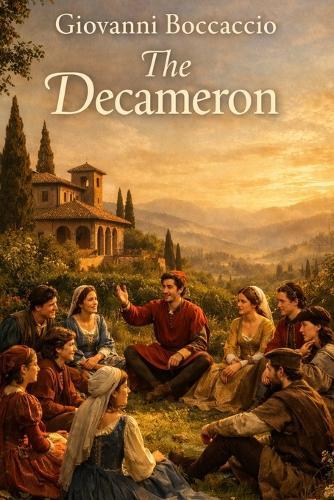
The Decameron[a] (Italian: Decameron[b] or Decamerone[c]), subtitled Prince Galehaut (Old Italian: Prencipe Galeotto[d]) and sometimes nicknamed l'Umana commedia (""the Human comedy"", as it was Boccaccio that dubbed Dante Alighieri's Comedy ""Divine""), is a collection of short stories by the 14th-century Italian author Giovanni Boccaccio (1313-1375). The book is structured as a frame story containing 100 tales told by a group of seven young women and three young men; they shelter in a secluded villa just outside Florence in order to escape the Black Death, which was afflicting the city. The epidemic is likely what Boccaccio used for the basis of the book which was thought to be written between 1348 and 1353. The various tales of love in The Decameron range from the erotic to the tragic. Tales of wit, practical jokes, and life lessons also contribute to the mosaic. In addition to its literary value and widespread influence (for example on Chaucer's The Canterbury Tales), it provides a document of life at the time. Written in the vernacular of the Florentine language, it is considered a masterpiece of early Italian prose.[1] Title The book's primary title exemplifies Boccaccio's fondness for Greek philology: Decameron combines Greek δέκα, déka (""ten"") and ἡμέρα, hēméra (""day"") to mean ""ten-day [event]"", [2] referring to the period in which the characters of the frame story tell their tales. Hexaemeron (Six Days, literally The Six-Day [Work]) was a familiar title in Boccaccio's day. It was commonly used for sermons and treatises commenting on the biblical story of the creation of the world, which took place in six days (and was therefore referred to as the Hexaemeron or Six-day work).[3] The tradition goes back to Patristic literature, notably Ambrose of Milan's Hexaemeron also known as Exameron (ca. 378 C.E.).[4] In thirteenth-century Italy Bonaventure still authored Collationes in Hexaemeron (1273, literally Talks on the Six Days) in the same tradition. Exploring the links between the Decameron and hexaemeral literature's exposition of creation usually structured in six chapters (one for each day), scholarship pointed out that Boccaccio's ten narrators intervene following a cataclysmic outbreak of plague as though they were metaphorically re-creating a world through their stories, day after day.[5] The mischievous critique of monastic culture contained in Boccaccio's book also led some to wonder whether the erudite title Decameron might not comprise a parodistic dimension.[6] Boccaccio's subtitle, Prencipe Galeotto, refers to Galehaut, a fictional knight sometimes called haut prince (high prince) in the 13th-century Lancelot-Grail. Galehaut was a close friend of Lancelot, but an enemy of King Arthur. When Galehaut learned that Lancelot loved Arthur's wife, Guinevere, he set aside his own ardor for Lancelot in order to arrange a meeting between his friend and Guinevere. At this meeting the Queen first kisses Lancelot, and so begins their love affair. Through this notorious episode, Galeotto had become the epitome of the romantic go-between in the Italian imagination - a Cupid able to bind two hearts. By subtitling his book Prencipe Galeotto, Boccaccio signals that he hopes his stories will bring young lovers together, providing them with an opportunity to use storytelling as a vehicle of flirtation (as the youths in the Decameron's frame story do) and ultimately fall in love.
Full Product Details
Author: Giovanni Boccaccio
Publisher: Les Prairies Numeriques
Imprint: Les Prairies Numeriques
Dimensions:
Width: 15.20cm
, Height: 5.90cm
, Length: 22.90cm
Weight: 1.361kg
ISBN: 9791043137181
Pages: 1040
Publication Date: 21 February 2026
Audience:
General/trade
,
General
Format: Paperback
Publisher's Status: Active
Availability: Available To Order

We have confirmation that this item is in stock with the supplier. It will be ordered in for you and dispatched immediately.