Overview
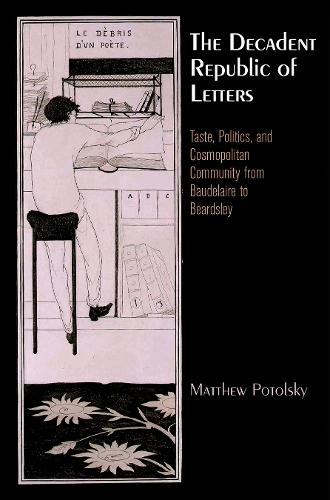
While scholars have long associated the group of nineteenth-century French and English writers and artists known as the decadents with alienation, escapism, and withdrawal from the social and political world, Matthew Potolsky offers an alternative reading of the movement. In The Decadent Republic of Letters, he treats the decadents as fundamentally international, defined by a radically cosmopolitan ideal of literary sociability rather than an inward turn toward private aesthetics and exotic sensation. The Decadent Republic of Letters looks at the way Charles Baudelaire, ThÉophile Gautier, and Algernon Charles Swinburne used the language of classical republican political theory to define beauty as a form of civic virtue. The libertines, an international underground united by subversive erudition, gave decadents a model of countercultural affiliation and a vocabulary for criticizing national canon formation and the increasing state control of education. Decadent figures such as Joris-Karl Huysmans, Walter Pater, Vernon Lee, Aubrey Beardsley, and Oscar Wilde envisioned communities formed through the circulation of art. Decadents lavishly praised their counterparts from other traditions, translated and imitated their works, and imagined the possibility of new associations forged through shared tastes and texts. Defined by artistic values rather than language, geography, or ethnic identity, these groups anticipated forms of attachment that are now familiar in youth countercultures and on social networking sites. Bold and sophisticated, The Decadent Republic of Letters unearths a pervasive decadent critique of nineteenth-century notions of political community and reveals the collective effort by the major figures of the movement to find alternatives to liberalism and nationalism.
Full Product Details
Author: Matthew Potolsky
Publisher: University of Pennsylvania Press
Imprint: University of Pennsylvania Press
Dimensions:
Width: 15.20cm
, Height: 2.00cm
, Length: 22.90cm
Weight: 0.458kg
ISBN: 9780812244496
ISBN 10: 0812244494
Pages: 240
Publication Date: 06 November 2012
Audience:
College/higher education
,
Tertiary & Higher Education
Format: Hardback
Publisher's Status: Active
Availability: In Print

This item will be ordered in for you from one of our suppliers. Upon receipt, we will promptly dispatch it out to you. For in store availability, please contact us.
Reviews
A new understanding, full of fresh detail and local insight, and it will take an important and indeed essential place in the growing body of scholarly work in this field. . . . A welcome contribution to the understanding of the cultural politics of late nineteenth-century decadence. * <i>Victorian Studies</i> * Potolsky offers a fresh and original contribution to the study of decadence and succeeds in showing how the movement is not a dusty relic of the nineteenth century, but a provocative and relevant intervention into contemporary issues. In true decadent manner, Potolsky approaches his subject perversely, arguing that we should look not at what decadence rejects but instead at what its proponents valorize. The result is a perspective that emphasizes engagement over withdrawal and renunciation. Decadence emerges from this analysis an exciting, revitalized ideology, one that suggests new ways of approaching contemporary debates. * Melanie Hawthorne, Texas A&M University *
A new understanding, full of fresh detail and local insight, and it will take an important and indeed essential place in the growing body of scholarly work in this field... A welcome contribution to the understanding of the cultural politics of late nineteenth-century decadence. -Victorian Studies Potolsky offers a fresh and original contribution to the study of decadence and succeeds in showing how the movement is not a dusty relic of the nineteenth century, but a provocative and relevant intervention into contemporary issues. In true decadent manner, Potolsky approaches his subject perversely, arguing that we should look not at what decadence rejects but instead at what its proponents valorize. The result is a perspective that emphasizes engagement over withdrawal and renunciation. Decadence emerges from this analysis an exciting, revitalized ideology, one that suggests new ways of approaching contemporary debates. -Melanie Hawthorne, Texas A&M University
...a new understanding, full of fresh detail and local insight, and it will take an important and indeed essential place in the growing body of scholarly work in this field. ...a welcome contribution to the understanding of the cultural politics of late nineteenth-century decadence. -Victorian Studies Potolsky offers a fresh and original contribution to the study of decadence and succeeds in showing how the movement is not a dusty relic of the nineteenth century, but a provocative and relevant intervention into contemporary issues. In true decadent manner, Potolsky approaches his subject perversely, arguing that we should look not at what decadence rejects but instead at what its proponents valorize. The result is a perspective that emphasizes engagement over withdrawal and renunciation. Decadence emerges from this analysis an exciting, revitalized ideology, one that suggests new ways of approaching contemporary debates. -Melanie Hawthorne, Texas A&M University
Potolsky offers a fresh and original contribution to the study of decadence and succeeds in showing how the movement is not a dusty relic of the nineteenth century, but a provocative and relevant intervention into contemporary issues. In true decadent manner, Potolsky approaches his subject perversely, arguing that we should look not at what decadence rejects but instead at what its proponents valorize. The result is a perspective that emphasizes engagement over withdrawal and renunciation. Decadence emerges from this analysis an exciting, revitalized ideology, one that suggests new ways of approaching contemporary debates. -Melanie Hawthorne, Texas A&M University A new understanding, full of fresh detail and local insight, and it will take an important and indeed essential place in the growing body of scholarly work in this field... A welcome contribution to the understanding of the cultural politics of late nineteenth-century decadence. -Victorian Studies
Potolsky offers a fresh and original contribution to the study of decadence and succeeds in showing how the movement is not a dusty relic of the nineteenth century, but a provocative and relevant intervention into contemporary issues. In true decadent manner, Potolsky approaches his subject perversely, arguing that we should look not at what decadence rejects but instead at what its proponents valorize. The result is a perspective that emphasizes engagement over withdrawal and renunciation. Decadence emerges from this analysis an exciting, revitalized ideology, one that suggests new ways of approaching contemporary debates. -Melanie Hawthorne, Texas A&M University
Author Information
Matthew Potolsky is Associate Professor of English at the University of Utah.