Overview
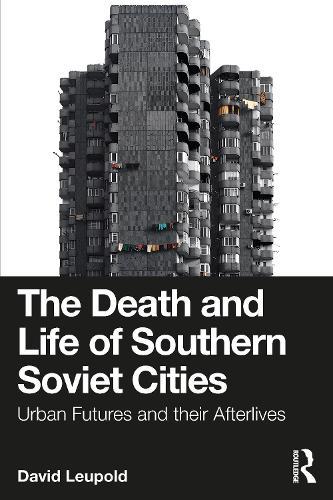
What does it mean, three decades after the demise of the USSR, to inhabit cities built for a future that has never arrived? In pursuit of the question – what is left of the socialist city? – this book aims not only to trace the material and mnemonic remains of the socialist city, but to show how the Soviet discourse of the city at times engendered radical ideas that challenged the narrow confines of state socialism itself. These ideas are, for instance, the efforts of Esperanto-speaking internationalists from Czechoslovakia to build the internationalist city from below in the Central Asian steppe, the quest of Armenian Futurists to root the architectural style of Soviet Armenia in the country’s Persianate heritage, or a Jewish-Kyrgyz philosopher's vision of turning a science town in the hinterland of Moscow into the first ecopolis of the USSR. In an effort to rethink the life and afterlife of the Soviet city from its geographical South, the book explores the material and immaterial legacies of socialist-era urbanization in Central Asia and the Southern Caucasus. To this end, it embarks on a historical and ethnographic journey to urban sites in Armenia and Kyrgyzstan. In a quest to reconstruct competing visions of urbanity that emerged from within the Soviet South, using varied empirical sources in Armenian, Czech, Kyrgyz, and Russian, the book outlines four urban visions: bottom-up urbanity, rooted urbanity, polycentric urbanity, and ecocentric urbanity. By understanding the social vision of a ""socialist city of the future"" beyond the political center in its trans-local independence, the book highlights the cultural and linguistic diversity of the Soviet South and its historical embeddedness within the regional dynamics of the Global South. As such, this book will be an important resource for students, instructors, and researchers in understanding and thinking through socialism, post-socialist transformation, and histories of the USSR. In it, David Leupold brings formidable historical imagination and ethnographic research to enliven the shape, contours, and textures of the ""socialist city"" and its afterlife beyond the demise of the Soviet Union.
Full Product Details
Author: David Leupold
Publisher: Taylor & Francis Ltd
Imprint: Routledge
ISBN: 9781032982847
ISBN 10: 1032982845
Pages: 280
Publication Date: 22 May 2026
Audience:
College/higher education
,
Professional and scholarly
,
Tertiary & Higher Education
,
Professional & Vocational
Format: Paperback
Publisher's Status: Forthcoming
Availability: Not yet available

This item is yet to be released. You can pre-order this item and we will dispatch it to you upon its release.
Reviews
“We are now far enough away from the end of the Soviet Union and its attendant internationalism that more nuanced and objective, less partisan and accusatory, accounts of Soviet history can be written. Leupold’s work presents to both a scholarly audience of historians, sociologists, political scientists, and urban researchers, as well as graduate students and a broader readership interested in the USSR and urban studies a unique way of rethinking Soviet history. This will be an extraordinarily important book.” -- Ronald G. Suny, William H. Sewell Jr Distinguished University Professor of History, University of Michigan “David Leupold delivers an original-because-richly comparative take on socialist experiment on the USSR’s peripheries. Offering a granular historical perspective that is complemented by extensive travel, he creatively leans on urban landscapes to show how contemporary citizens of Armenia, Kyrgyzstan, and beyond reflect on the entire socialist period. As Slovenian philosopher Slavoj Zizek has asked: now that socialism is over, does it all get jettisoned? David Leupold convinces us that in the world of urban planning, socialist legacies have something important to tell us.” -- Bruce Grant, Professor of Anthropology, New York University “The Death and Life of Southern Soviet Cities offers a compelling and valuable contribution to the study of urbanism, socialism, and post-socialist transformations, particularly in the context of Central Asia and the Southern Caucasus. By combining historical analysis with ethnographic research, the book provides a nuanced understanding of how socialist urban ideologies continue to impact these regions. This dual approach helps bridge gaps between theoretical frameworks and lived experiences, offering a more holistic view of urban transformation. The book's focus on four competing urban visions (bottom-up, rooted, polycentric, and ecocentric urbanity) promises to illuminate diverse conceptualizations of urbanism that emerged within the Soviet South. This approach highlights how different ideas about urban space and planning were envisioned and how they continue to influence contemporary urban landscapes.” -- Tamta Khalvashi, Professor of Anthropology and head of the PhD Program of Social and Cultural Anthropology, Ilia State University in Georgia
Author Information
David Leupold is an interdisciplinary social scientist, scholar of memory studies, and winner of the book award of the Central Eurasian Studies Society. Following his fellowship at the University of Michigan, he is currently pursuing his qualification for full professorship at the Humboldt-Universität zu Berlin.