Overview
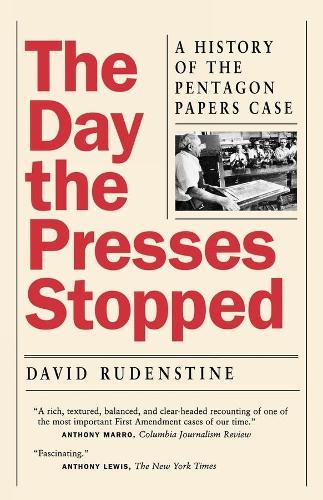
This bold account provides an original perspective on one of the most significant legal struggles in American history: the Nixon administration's efforts to prohibit the New York Times and the Washington Post from publishing the 7,000-page, top-secret Pentagon Papers, which traced U.S. involvement in Vietnam. In his gripping account of this highly charged case, Rudenstine examines new evidence, raises difficult questions, and challenges conventional views of a historic moment.
Full Product Details
Author: David Rudenstine
Publisher: University of California Press
Imprint: University of California Press
Dimensions:
Width: 14.30cm
, Height: 2.80cm
, Length: 22.20cm
Weight: 0.635kg
ISBN: 9780520213821
ISBN 10: 0520213823
Pages: 278
Publication Date: 07 July 1998
Audience:
General/trade
,
General
Format: Paperback
Publisher's Status: Active
Availability: Out of stock

The supplier is temporarily out of stock of this item. It will be ordered for you on backorder and shipped when it becomes available.
Reviews
""A masterful examination of the inside political tactics and journalistic decision-making process involved in the case.""--Bill Wallace, ""San Francisco Chronicle
Set to come out on the 25th anniversary of the New York Times's publication of the Pentagon Papers - the 7,000-page secret history of the government's Vietnam War decision-making commissioned by Robert S. McNamara in 1967 - Rudenstine's book is a remarkable achievement. Law professor Rudenstine (Benjamin N. Cardozo Law School) has mined the primary and secondary sources, interviewed three dozen important players, and unearthed new evidence. The result: a very readable political narrative with scholarly analysis of the landmark case. The excerpts and analyses of the papers that ran in the New York Times represented the largest unauthorized disclosure of classified documents in American history. The Nixon administration's effort to stop the Times (and later the Washington Post) marked the first time in American history that the government had sued to prevent newspapers from disclosing information for national security reasons. District Judge Murray Gurfein's order to cease publishing the material in question was the first time an American judge had taken such action against a newspaper. This substantive book's value lies in the breadth of the narrative, the sharpness of Rudenstine's analyses of the case's legal aspects, and the author's surprising but persuasively argued conclusion that the papers contained information that could have seriously harmed national security if disclosed. The government was unable to convince a majority of the US Supreme Court of that fact. And, as Rudenstine points out, the newspapers did not publish anything that had a negative impact on peace talks or that compromised diplomatic initiatives outside Vietnam. The Supreme Court chose to risk the dangers inherent in a freer press because the alternative resolution - enhancing government power to censor the press - was even more threatening to a stable and vital democracy. Nothing less than the definitive account of the Pentagon Papers case. (Kirkus Reviews)
With the benefit of hindsight it seems a storm in a teacup now. In 1971, when the Vietnam War still had three years to run, the New York Times, closely followed by the Washington Post, published extracts from a secret history of American involvement in Indochina that would become known as the Pentagon Papers. Though all the revelations concerned the Johnson administration, the Nixon government decided to issue an order preventing the publication of more revelations on the grounds that they would damage national security. In a landmark decision, the Supreme Court threw the case out, the papers continued to publish extracts, and no apparent harm was ever done to national security. At the time, however, it was a most important issue. No American government had ever before tried to use national security to muzzle the press, so the case established case law on issues of press freedom, especially in time of war. Moreover, it played to Nixon's sensibility that he was surrounded by enemies, and thus was a vital precursor to the Watergate affair that would shortly bring his government down. In this very readable history, Rudenstine, Professor of Constitutional Law at Yeshiva University, considers every aspect of the case, from the time the papers were written at the instigation of the then Secretary of Defence Robert McNamara, through their leaking by Daniel Ellsberg, to their final echoes in the Watergate affair, and finds the issue was not so clear cut as it appeared at the time. Though, in the end, he applauds the court's decision to throw out Nixon's suit, he uses newly discovered documents to show that Nixon's case was far more justifiable than many of Nixon's critics are prepared to admit even now. He also shows how the Pentagon Papers affair was more intimately connected to Watergate than many people have imagined. (Kirkus UK)
"""A masterful examination of the inside political tactics and journalistic decision-making process involved in the case.""--Bill Wallace, ""San Francisco Chronicle"
A masterful examination of the inside political tactics and journalistic decision-making process involved in the case. --Bill Wallace, San Francisco Chronicle
Author Information
David Rudenstine is the Dr. Herman George and Kate Kaiser Professor of Constitutional Law at the Benjamin N. Cardozo School of Law, Yeshiva University.