Overview
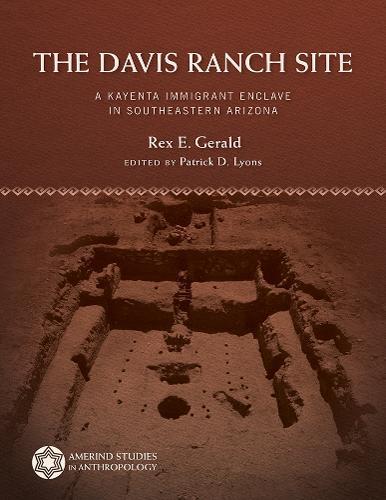
In this new volume, the results of Rex E. Gerald's 1957 excavations at the Davis Ranch Site in southeastern Arizona's San Pedro River Valley are reported in their entirety for the first time. Annotations to Gerald's original manuscript in the archives of the Amerind Museum and newly written material place Gerald's work in the context of what is currently known regarding the late thirteenth-century Kayenta diaspora and the relationship between Kayenta immigrants and the Salado phenomenon. Data presented by Gerald and other contributors identify the site as having been inhabited by people from the Kayenta region of northeastern Arizona and southeastern Utah. The results of Gerald's excavations and Archaeology Southwest's San Pedro Preservation Project (1990–2001) indicate that the people of the Davis Ranch Site were part of a network of dispersed immigrant enclaves responsible for the origin and spread of Roosevelt Red Ware pottery, the key material marker of the Salado phenomenon. A companion volume to Charles Di Peso's 1958 publication on the nearby Reeve Ruin, archaeologists working in the U.S. Southwest and other researchers interested in ancient population movements and their consequences will consider this work an essential case study.
Full Product Details
Author: Rex E. Gerald ,
Patrick D. Lyons
Publisher: University of Arizona Press
Imprint: University of Arizona Press
Dimensions:
Width: 22.00cm
, Height: 4.50cm
, Length: 28.10cm
Weight: 2.795kg
ISBN: 9780816538546
ISBN 10: 0816538549
Pages: 760
Publication Date: 30 May 2019
Audience:
Professional and scholarly
,
Professional & Vocational
Format: Hardback
Publisher's Status: Active
Availability: Available To Order

We have confirmation that this item is in stock with the supplier. It will be ordered in for you and dispatched immediately.
Reviews
Patrick D. Lyons masterfully presents Rex E. Gerald's work at the Davis Ranch site while adding new analysis and interpretation. This book presents important evidence about both the migration of Kayenta people to southern Arizona and the nature of the 1300s Kayenta diaspora. --James R. Allison, Department of Anthropology, Brigham Young University Patrick D. Lyons provides a comprehensive view of one of the most important sites of prehistoric migrations in the Americas--Davis Ranch--painstakingly weaving Rex E. Gerald's sixty-year-old notes and analyses together with modern understandings. Lyons also provides a stunning new study of Salado ceramics. --Catherine M. Cameron, Department of Archaeology, University of Colorado, Boulder
"Patrick D. Lyons masterfully presents Rex E. Gerald's work at the Davis Ranch site while adding new analysis and interpretation. This book presents important evidence about both the migration of Kayenta people to southern Arizona and the nature of the 1300s Kayenta diaspora."""" - James R. Allison, Department of Anthropology, Brigham Young University """"Patrick D. Lyons provides a comprehensive view of one of the most important sites of prehistoric migrations in the Americas—Davis Ranch—painstakingly weaving Rex E. Gerald's sixty-year-old notes and analyses together with modern understandings. Lyons also provides a stunning new study of Salado ceramics."""" - Catherine M. Cameron, Department of Archaeology, University of Colorado, Boulder"
Patrick D. Lyons masterfully presents Rex E. Gerald's work at the Davis Ranch site while adding new analysis and interpretation. This book presents important evidence about both the migration of Kayenta people to southern Arizona and the nature of the 1300s Kayenta diaspora. - James R. Allison, Department of Anthropology, Brigham Young University Patrick D. Lyons provides a comprehensive view of one of the most important sites of prehistoric migrations in the Americas-Davis Ranch-painstakingly weaving Rex E. Gerald's sixty-year-old notes and analyses together with modern understandings. Lyons also provides a stunning new study of Salado ceramics. - Catherine M. Cameron, Department of Archaeology, University of Colorado, Boulder
Author Information
Rex E. Gerald, who excavated the Davis Ranch Site as a predoctoral research fellow at the Amerind Foundation, was later director of the Centennial Museum and an associate professor of anthropology at the University of Texas at El Paso. Patrick D. Lyons is the director of the Arizona State Museum and an associate professor of anthropology at the University of Arizona. He is co-editor of Migrants and Mounds: Classic Period Archaeology of the Lower San Pedro Valley.