Overview
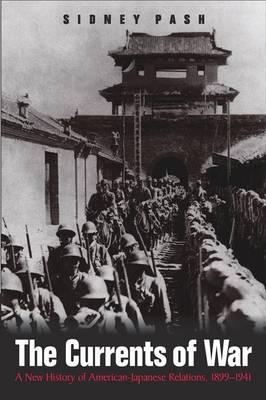
From 1899 until the American entry into World War II, U.S. presidents sought to preserve China's territorial integrity in order to guarantee American businesses access to Chinese markets -- a policy famously known as the ""open door."" Before the Russo-Japanese War in 1904, Americans saw Japan as the open door's champion; but by the end of 1905, Tokyo had replaced St. Petersburg as its greatest threat. For the next thirty-six years, successive U.S. administrations worked to safeguard China and contain Japanese expansion on the mainland. The Currents of War reexamines the relationship between the United States and Japan and the casus belli in the Pacific through a fresh analysis of America's central foreign policy strategy in Asia. In this ambitious and compelling work, Sidney Pash offers a cautionary tale of oft-repeated mistakes and miscalculations. He demonstrates how continuous economic competition in the Asia-Pacific region heightened tensions between Japan and the United States for decades, eventually leading to the attack on Pearl Harbor on December 7, 1941. Pash's study is the first full reassessment of pre--World War II American-Japanese diplomatic relations in nearly three decades. It examines not only the ways in which U.S. policies led to war in the Pacific but also how this conflict gave rise to later confrontations, particularly in Korea and Vietnam. Wide-ranging and meticulously researched, this book offers a new perspective on a significant international relationship and its enduring consequences.
Full Product Details
Author: Sidney L. Pash
Publisher: The University Press of Kentucky
Imprint: The University Press of Kentucky
Dimensions:
Width: 15.20cm
, Height: 3.00cm
, Length: 22.90cm
Weight: 0.653kg
ISBN: 9780813144238
ISBN 10: 081314423
Pages: 372
Publication Date: 28 January 2014
Audience:
General/trade
,
General
Format: Hardback
Publisher's Status: Active
Availability: Available To Order

We have confirmation that this item is in stock with the supplier. It will be ordered in for you and dispatched immediately.
Reviews
This sharply argued and well-researched book is quite timely. [...] Sidney Pash's detailed analysis of US-Japanese relations from 1899-1941 explores the conflicts and, more importantly, the principles that created those memories. </p>[...] This important contribution wraps an imaginative, detailed study of US-Japanese relations during an epoch within a broader analysis of both the global context and the series of broad US policy principles, or pillars. It is a major reformulation of a historic relationship that Asians and Americans now remember as ending in devastation. -- <i>Historian</i></p>
<p> Pash is not content to write traditional narrative diplomatic history in his ambitious and compelling study of U.S-Japanese relations from the late 19th Century to the outbreak of the Pacific War in 1941. Instead, he writes 'revisionist' history in the best sense of the word--as a cautionary tale of mistakes and lessons that should not be repeated but often are. -- J. Garry Clifford, University of Connecticut
Pash is not content to write traditional narrative diplomatic history in his ambitious and compelling study of U.S-Japanese relations from the late 19th Century to the outbreak of the Pacific War in 1941. Instead, he writes 'revisionist' history in the best sense of the word--as a cautionary tale of mistakes and lessons that should not be repeated but often are. -- J. Garry Clifford, University of Connecticut
This fascinating book gives insight into the competitive relationship between the United States and Japan from 1899--1941. -- The Lone Star Book Review
Author Information
Sidney Pash is associate professor of history at Fayetteville State University, USA. A former Fulbright Fellow in Tokyo, he is coeditor of The United States and the Second World War: New Perspectives on Diplomacy, War, and the Home Front.