Overview
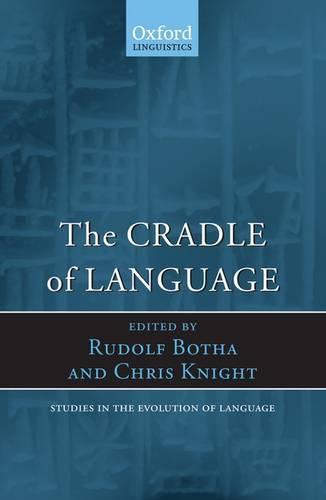
This book is the first to focus on the African origins of human language. It explores the origins of language and culture 250,000-150,000 years ago when modern humans evolved in Africa. Scholars from around the world address the fossil, genetic, and archaeological evidence and critically examine the ways it has been interpreted. The book also considers parallel developments among Europe's Neanderthals and the contrasting outcomes for the two species. Following an extensive introduction contextualizing and linking the book's topics and approaches, fifteen chapters bring together many of the most significant recent findings and developments in modern human origins research. The fields represented by the authors include genetics, biology, behavioural ecology, linguistics, archaeology, cognitive science, and anthropology.
Full Product Details
Author: Rudolf Botha (, University of Stellenbosch) , Chris Knight (, University of East London)
Publisher: Oxford University Press
Imprint: Oxford University Press
Volume: 12
Dimensions:
Width: 15.30cm
, Height: 2.30cm
, Length: 23.30cm
Weight: 0.636kg
ISBN: 9780199545865
ISBN 10: 0199545863
Pages: 408
Publication Date: 30 April 2009
Audience:
College/higher education
,
Undergraduate
,
Postgraduate, Research & Scholarly
Format: Paperback
Publisher's Status: Active
Availability: To order 
Stock availability from the supplier is unknown. We will order it for you and ship this item to you once it is received by us.
Table of Contents
1. Introduction: Perspectives on the Evolution of Language in Africa, Chris Knight 2. Earliest Personal Ornaments and Their Significance for the Origin of Language Debate, Francesco d'Errico and Marian Vanhaeren 3. Reading the Artefacts: Gleaning Language Skils From the Middle Stone Age in Southern Africa, Christopher Stuart Henshilwood and Benoit Dubreuil 4. Red Ochre, Body Painting, and Language: Interpreting the Blombos Ochre, Ian Watts 5. Theoretical Underpinnings of Inferences About Languae Evolution: The Syntax Used at Blombos Cave, Rudolf Botha 6. Fossil Cues to the Evolution of Speech, W. Tecumseh Fitch 7. Evidence Against a Genetic-Based Revolution in Language 50,000 Years Ago, Karl C. Diller and Rebecca L. Cann 8. A 'Language-Free' Explanation for Differences Between the European Middle and Upper Palaeolithic Record, Wil Roebroeks and Alexander Verpoorte 9. The Importance of Archaeological Evidence for Investigating the Evolutionary Emergence of Language, Iain Davidson 10. Diversity if Languages, Genes, and the Language Faculty, James R. Hurford and Dan Dediu 11. How Varied Typologically are the Languages of Africa?, Michael Cysouw and Bernard Comrie 12. What Click Languages Can and Can't Tell us About Language Origins, Bonny Sands and Tom Guldemann 13. Social Origins: Sharing, Exchange, Kinship, Alan Barnard 14. As Well as Words: Congo Pygmy Hunting, Mimicry, and Play, Jerome Lewis 15. Sexual Selection Models for the Emergence of Symbolic Communication: Why They Should be Reversed, Camilla Power 16. Language, Ochre, and the Rule of Law, Chris Knight References Index
Reviews
Author Information
Rudolf Botha is Emeritus Professor of General Linguistics at the University of Stellenbosch, Honorary Professor of Linguistics at Utrecht University, and a Fellow of the Netherlands Institute for Advanced Study (2001-02 & 2005-06). His books include Form and Meaning in Word Formation: A Study of Afrikaans Reduplication (CUP 1988), Challenging Chomsky: The Generative Garden Game (Blackwell 1989), and Unravelling the Evolution of Language (Elsevier 2003). Chris Knight is Professor of Anthropology at the University of East London. Best known for his 1991 book, 'Blood Relations: Menstruation and the origins of culture', he helped initiate the Evolution of Language (evolang) series of international conferences and has published widely on the evolutionary emergence of language and symbolic culture. His next book will be The Human Conspiracy: Speech, deception and the selfish gene.
Tab Content 6
Author Website:
Countries Available
All regions
|