Overview
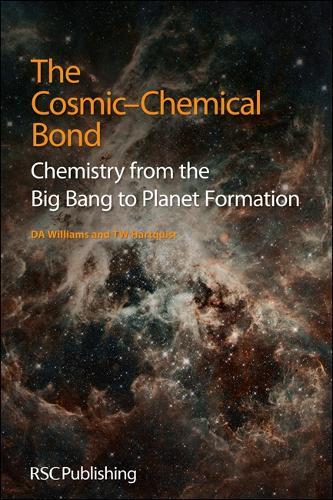
Introducing astrochemistry to a wide audience, this book describes how molecules formed in chemical reactions occur in a range of environments in interstellar and circumstellar space, from shortly after the Big Bang up to the present epoch. Stressing that chemistry in these environments needs to be driven, it helps identify these drivers and the various chemical networks that operate giving rise to signature molecules that enable the physics of the region to be better understood. The book emphasises, in a non-mathematical way, the chemistry of the Milky Way Galaxy and its planet-forming regions, describes how other galaxies may have rather different chemistries and shows how chemistry was important even in the Early Universe when most of the elements had yet to be formed. This book will appeal to anyone with a general interest in chemistry, from students to professional scientists working in interdisciplinary areas and non-scientists fascinated by the evolving and exciting story of chemistry in the cosmos.
Full Product Details
Author: David A Williams (University College London, UK) ,
Thomas W Hartquist (University of Leeds, UK)
Publisher: Royal Society of Chemistry
Imprint: Royal Society of Chemistry
Dimensions:
Width: 15.20cm
, Height: 1.30cm
, Length: 22.80cm
Weight: 0.356kg
ISBN: 9781849736091
ISBN 10: 184973609
Pages: 226
Publication Date: 10 May 2013
Audience:
College/higher education
,
Professional and scholarly
,
Tertiary & Higher Education
,
Professional & Vocational
Format: Paperback
Publisher's Status: Active
Availability: In Print

This item will be ordered in for you from one of our suppliers. Upon receipt, we will promptly dispatch it out to you. For in store availability, please contact us.
Reviews
UK academics Williams (Univ. College London) and Hartquist (Univ. of Leeds) present an authoritative though skimpily documented account of the universe's evolution, from the prechemical times--shortly after the big bang--of isolated elementary particles and hyperenergetic photons, through the formation of atoms, to more complex molecules and dust particles, and finally to stars, planets, and galaxies. The emphasis is heavily chemical, with relatively brief focus on the physical dynamics of stellar fNmation and energy. The text is also unsparingly technical, though nonmathematical. The authors stipulate that the intended audienc;e is ""anyone with a general interest in chemistry, from students to professional scientists."" However, students will need a good background in chemistry and physics to follow the text. The presentation is adorned with stl'ikingly good color illustrations of deep-space objects in the throes of processes described. Unfortunately, bibliographic aids are limited to brief ""Fwiher Reading"" lists, dominated by the authors' and their students' contributions. The relatively terse index largely references individual scientists. There is no discussion (perhaps wisely; no one really understands it) ofthe ""dark matter"" and ""dark energy"" that may or may not, depending on cosmologists, dominate the evolution of galaxies and the universe. Js there a ""dark chemistry""? Summing Up: Recommended. With reservations. Upper-division undergraduates through professionals. -- T R. Blackburn, former(v, American Chemical Society Petroleum Research Fund -- T R. Blackburn * CHOICE - Vol. 51 No. 08 *
UK academics Williams (Univ. College London) and Hartquist (Univ. of Leeds) present an authoritative though skimpily documented account of the universe's evolution, from the prechemical times--shortly after the big bang--of isolated elementary particles and hyperenergetic photons, through the formation of atoms, to more complex molecules and dust particles, and finally to stars, planets, and galaxies. The emphasis is heavily chemical, with relatively brief focus on the physical dynamics of stellar fNmation and energy. The text is also unsparingly technical, though nonmathematical. The authors stipulate that the intended audienc;e is anyone with a general interest in chemistry, from students to professional scientists. However, students will need a good background in chemistry and physics to follow the text. The presentation is adorned with stl'ikingly good color illustrations of deep-space objects in the throes of processes described. Unfortunately, bibliographic aids are limited to brief Fwiher Reading lists, dominated by the authors' and their students' contributions. The relatively terse index largely references individual scientists. There is no discussion (perhaps wisely; no one really understands it) ofthe dark matter and dark energy that may or may not, depending on cosmologists, dominate the evolution of galaxies and the universe. Js there a dark chemistry ? Summing Up: Recommended. With reservations. Upper-division undergraduates through professionals. -- T R. Blackburn, former(v, American Chemical Society Petroleum Research Fund -- T R. Blackburn * CHOICE - Vol. 51 No. 08 *
"UK academics Williams (Univ. College London) and Hartquist (Univ. of Leeds) present an authoritative though skimpily documented account of the universe's evolution, from the prechemical times--shortly after the big bang--of isolated elementary particles and hyperenergetic photons, through the formation of atoms, to more complex molecules and dust particles, and finally to stars, planets, and galaxies. The emphasis is heavily chemical, with relatively brief focus on the physical dynamics of stellar fNmation and energy. The text is also unsparingly technical, though nonmathematical. The authors stipulate that the intended audienc;e is ""anyone with a general interest in chemistry, from students to professional scientists."" However, students will need a good background in chemistry and physics to follow the text. The presentation is adorned with stl'ikingly good color illustrations of deep-space objects in the throes of processes described. Unfortunately, bibliographic aids are limited to brief ""Fwiher Reading"" lists, dominated by the authors' and their students' contributions. The relatively terse index largely references individual scientists. There is no discussion (perhaps wisely; no one really understands it) ofthe ""dark matter"" and ""dark energy"" that may or may not, depending on cosmologists, dominate the evolution of galaxies and the universe. Js there a ""dark chemistry""? Summing Up: Recommended. With reservations. Upper-division undergraduates through professionals. -- T R. Blackburn, former(v, American Chemical Society Petroleum Research Fund -- T R. Blackburn * CHOICE - Vol. 51 No. 08 *"
UK academics Williams (Univ. College London) and Hartquist (Univ. of Leeds) present an authoritative though skimpily documented account of the universe's evolution, from the prechemical times--shortly after the big bang--of isolated elementary particles and hyperenergetic photons, through the formation of atoms, to more complex molecules and dust particles, and finally to stars, planets, and galaxies. The emphasis is heavily chemical, with relatively brief focus on the physical dynamics of stellar fNmation and energy. The text is also unsparingly technical, though nonmathematical. The authors stipulate that the intended audienc;e is anyone with a general interest in chemistry, from students to professional scientists. However, students will need a good background in chemistry and physics to follow the text. The presentation is adorned with stl'ikingly good color illustrations of deep-space objects in the throes of processes described. Unfortunately, bibliographic aids are limited to brief Fwiher Reading lists, dominated by the authors' and their students' contributions. The relatively terse index largely references individual scientists. There is no discussion (perhaps wisely; no one really understands it) ofthe dark matter and dark energy that may or may not, depending on cosmologists, dominate the evolution of galaxies and the universe. Js there a dark chemistry ? Summing Up: Recommended. With reservations. Upper-division undergraduates through professionals. -- T R. Blackburn, former(v, American Chemical Society Petroleum Research Fund -- T R. Blackburn CHOICE - Vol. 51 No. 08