Awards
- Winner of Winner of the Haskins Medal, granted by the Medieval Academy of America 2023 (United States)
- Winner of Winner of the Otto Gründler Book Prize, granted by the Medieval Institute 2022 (United States)
Overview
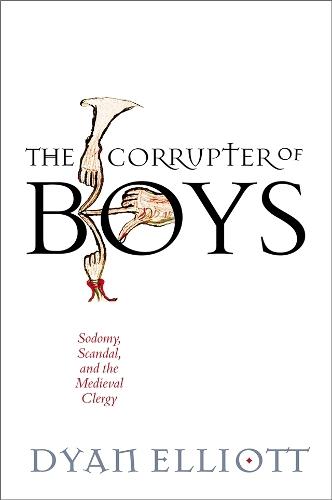
In the fourth century, clerics began to distinguish themselves from members of the laity by virtue of their augmented claims to holiness. Because clerical celibacy was key to this distinction, religious authorities of all stripes-patristic authors, popes, theologians, canonists, monastic founders, and commentators-became progressively sensitive to sexual scandals that involved the clergy and developed sophisticated tactics for concealing or dispelling embarrassing lapses. According to Dyan Elliott, the fear of scandal dictated certain lines of action and inaction, the consequences of which are painfully apparent today. In The Corrupter of Boys, she demonstrates how, in conjunction with the requirement of clerical celibacy, scandal-averse policies at every conceivable level of the ecclesiastical hierarchy have enabled the widespread sexual abuse of boys and male adolescents within the Church. Elliott examines more than a millennium's worth of doctrine and practice to uncover the origins of a culture of secrecy and concealment of sin. She charts the continuities and changes, from late antiquity into the high Middle Ages, in the use of boys as sexual objects before focusing on four specific milieus in which boys and adolescents would have been especially at risk in the high and later Middle Ages: the monastery, the choir, the schools, and the episcopal court. The Corrupter of Boys is a work of stunning breadth and discomforting resonance, as Elliott concludes that the same clerical prerogatives and privileges that were formulated in late antiquity and the medieval era-and the same strategies to cover up the abuses they enable-remain very much in place.
Full Product Details
Author: Dyan Elliott ,
Ruth Mazo Karras
Publisher: University of Pennsylvania Press
Imprint: University of Pennsylvania Press
ISBN: 9780812252521
ISBN 10: 0812252527
Pages: 448
Publication Date: 27 November 2020
Audience:
College/higher education
,
Tertiary & Higher Education
Format: Hardback
Publisher's Status: Active
Availability: In Print

This item will be ordered in for you from one of our suppliers. Upon receipt, we will promptly dispatch it out to you. For in store availability, please contact us.
Reviews
Dyan Elliott, an indefatigable medievalist-muckraker, argues that clerical child abuse is not just a modern issue. Here laid bare is the longue duree of an ecclesiastical culture anxious above all to preserve its power and reputation, rather than to confront its moral failings. Elliott's fearless take on the clergy's romance with pedophilia is certain to inspire both passionate controversy and exciting new research. -Barbara H. Rosenwein, Loyola University Chicago In my work as a court expert and consultant worldwide, I have been involved in more than one discussion with Church apologists who assert that the sexual violation of boys is a new phenomenon. Among the greatest failures of the hierarchical leadership of the Catholic Church has been the abysmal ignorance of the Church's own unrevised history, the unwillingness to entertain the validity of the events of the past when they are presented, and the inability to learn from that past. In The Corrupter of Boys Dyan Elliott shows us the evident parallels between the medieval and modern periods. It is a remarkable and invaluable book. -Thomas P. Doyle, J.C.D., C.A.D.C.
When the contemporary Catholic clergy sexual abuse crisis first broke in the 1980s, church officials in the United States and Rome pointed to the immorality of secular modernity as its cause. The Corrupter of Boys exposes once and for all the moral and intellectual emptiness of this claim. Elliott's deeply learned and unflinching account of the sexual privileges accorded priests and prelates from antiquity through the later middle ages-enshrined in theology and law and protected by secrets, silence, and lies-is an essential contribution towards a new history of Catholic sexuality. It is also a major step in the dismantling of the Catholic closet. -Robert A. Orsi, author of History and Presence Dyan Elliott, an indefatigable medievalist-muckraker, argues that clerical child abuse is not just a modern issue. Here laid bare is the longue duree of an ecclesiastical culture anxious above all to preserve its power and reputation, rather than to confront its moral failings. Elliott's fearless take on the clergy's romance with pedophilia is certain to inspire both passionate controversy and exciting new research. -Barbara H. Rosenwein, Loyola University Chicago In my work as a court expert and consultant worldwide, I have been involved in more than one discussion with Church apologists who assert that the sexual violation of boys is a new phenomenon. Among the greatest failures of the hierarchical leadership of the Catholic Church has been the abysmal ignorance of the Church's own unrevised history, the unwillingness to entertain the validity of the events of the past when they are presented, and the inability to learn from that past. In The Corrupter of Boys Dyan Elliott shows us the evident parallels between the medieval and modern periods. It is a remarkable and invaluable book. -Thomas P. Doyle, J.C.D., C.A.D.C. Dyan Elliott's bold book is unflinching in its examination of the long history of clerical pederasty and the ecclesiastical culture of silence about sexual predators. Her argument will provoke important reconsiderations of the history of sexualities, of medieval anti-clericalism, and of conceptions of childhood. -Martha Newman, University of Texas at Austin
Author Information
Dyan Elliott is the Peter B. Ritzma Professor in the Humanities and Professor of History at Northwestern University and a John Simon Guggenheim Memorial Foundation Fellow. She is author of The Bride of Christ Goes to Hell: Metaphor and Embodiment in the Lives of Pious Women, 200-1500 and Fallen Bodies: Pollution, Sexuality, and Demonology in the Middle Ages, both available from the University of Pennsylvania Press.