Overview
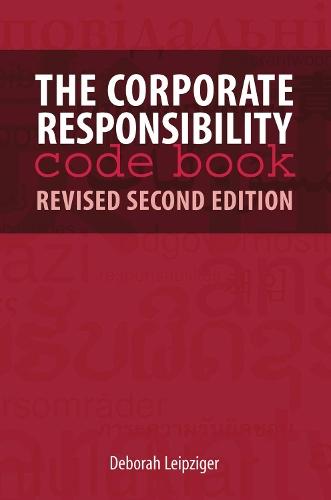
There is no single code or standard, no panacea that will lead to corporate responsibility (CR). Yet, now, more than ever before, corporations are waking up to the fact that they must adopt codes and implement standards to satisfy the growing demands of an ever-wider and ever-less-trustful spectrum of stakeholders. So, where do companies start? Information overload is nowhere more apparent than in the field of CR. There are millions of pages and web pages written on codes and standards, but most of it is spin: organizations punting to sell their code or standard. The reality is that CR is an emerging field, a new terrain for which maps are much needed, but often imprecise. Each company is different, each with its own challenges, corporate culture, unique set of stakeholders, and management systems. Corporate responsibility is a journey for which, today, there is no single map but a multitude of codes and standards that can be combined in new ways for different journeys. In her many lectures around the world, CSR consultant Deborah Leipziger has been asked the same question over and over again: ""What are the best standards for companies seeking to be socially responsible?"" Over the course of more than a decade, she has analysed hundreds of codes of conduct and standards to answer that question. This indispensable resource is the result. The field of corporate responsibility and sustainability has changed radically since the publication of the first edition of The Corporate Responsibility Code Book in late 2003. This second edition of the book reflects these changes, with the inclusion of a raft of new initiatives, revisions reflecting the improvements made to many others and the elimination of several initiatives that have been outgrown by developments. The second edition includes: New initiatives such as the UN Principles for Responsible Investment, the Equator Principles, ISO 26000, and the Extractive Industry Transparency Initiative; Updated versions of the UN Global Compact and the Global Reporting Initiative; The addition of codes and principles that have become more relevant, such as the ILO Code of Practice on HIV/Aids; The description of linkages between initiatives and the complex web of alliances that have grown in the field of CR as it has matured. The Corporate Responsibility Code Book is a guide for companies trying to understand the landscape of corporate responsibility and searching for their own, unique route towards satisfying diverse stakeholders. There is no one-size-fits-all approach. A company may face quite different challenges if it operates in more than one part of the world. And yet stakeholders, especially consumers and investors, are keen for some degree of comparability with which they can evaluate corporate performance. There are countervailing forces at work within corporate responsibility: on the one hand is the need for convergence in order to simplify the large numbers of codes and standards; and, on the other hand, the need to foster diversity and innovation. Many of the best codes of conduct and standards are not well known, while some CR instruments that are well disseminated are not terribly effective. Some comprehensive codes of conduct achieve nothing, while other quite vague codes of conduct become well embedded into the organisation and foster innovation and change. The book explains some of the best CR instruments available, and distils their most valuable elements. The goal of the book is to help companies select, develop and implement social and environmental codes of conduct. It demonstrates how the world's leading companies are implementing global codes of conduct, including the United Nations Global Compact, the OECD Guidelines for Multinational Enterprises, Social Accountability 8000 (SA 8000) and AccountAbility 1000 (AA 1000). The codes in this book cover a wide range of issues, including human rights, labour rights, environmental management, corruption, health and corporate governance. The book also includes how-to (or process) codes focusing on reporting, stakeholder engagement and assurance. This book is based on interviews with the standard-setters, the implementers of standards, academics, activists and other key stakeholders from around the world; and in many cases includes the full text of the code profiled. Each of the standards and codes described has been shared with the promulgators of the instrument to ensure that the information is as up to date as possible. The Corporate Responsibility Code Book will be an invaluable tool for companies developing their own code, but will also be a key tool for companies with a strong track record in CR, seeking to understand the interrelationships among codes and standards to create their own corporate vision. It will continue to be the key reference text on corporate codes of conduct for many years to come.
Full Product Details
Author: Deborah Leipziger
Publisher: Taylor & Francis Ltd
Imprint: Greenleaf Publishing
Edition: 2nd edition
Dimensions:
Width: 15.60cm
, Height: 3.60cm
, Length: 23.40cm
Weight: 0.920kg
ISBN: 9781906093396
ISBN 10: 1906093393
Pages: 536
Publication Date: 01 July 2010
Audience:
College/higher education
,
Professional and scholarly
,
Tertiary & Higher Education
,
Professional & Vocational
Replaced By: 9781907643941
Format: Hardback
Publisher's Status: Active
Availability: In Print

This item will be ordered in for you from one of our suppliers. Upon receipt, we will promptly dispatch it out to you. For in store availability, please contact us.
Reviews
Revised second edition of the key reference text on corporate codes of conduct. Occasionally, a book comes along and you know this is going to used again and again ... it is simply a great book of reference and will save us all buckets full of work. Social and Environmental Accounting Journal truly a masterpiece in the landscape of CSR and sustainability reference books Elaine Cohen
Author Information
DEBORAH LEIPZIGER advises companies around the world on human rights issues and played a key role in the development of several key standards, including Social Accountability 8000.