Overview
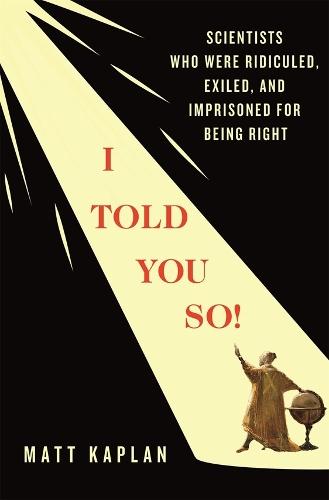
For two decades, Matt Kaplan has covered science for the Economist. He's seen breakthroughs often occur in spite of, rather than because of, the behavior of the research community, and how support can be withheld for those who don't conform or have the right connections. In this passionately argued and entertaining book, Kaplan narrates the history of the 19th century Hungarian physician Ignaz Semmelweis, who realized that Childbed fever-a devastating infection that only struck women who had recently given birth-was spread by doctors not washing their hands. Semmelweis was met with overwhelming hostility by those offended at the notion that doctors were at fault, and is a prime example of how the scientific community often fights new ideas, even when the facts are staring them in the face. In entertaining prose, Kaplan reveals scientific cases past and present to make his case. Some are familiar, like Galileo being threatened with torture and Nobel laureate Katalin Karikó being fired when on the brink of discovering how to wield mRNA-a finding that proved pivotal for the creation of the Covid-19 vaccine. Others less so, like researchers silenced for raising safety concerns about new drugs, and biologists ridiculed for revealing major flaws in the way rodent research is conducted. Kaplan shows how the scientific community can work faster and better by making reasonably small changes to the forces that shape it.
Full Product Details
Author: Matt Kaplan
Publisher: St Martin's Press
Imprint: St Martin's Press
Dimensions:
Width: 13.50cm
, Height: 0.70cm
, Length: 20.80cm
Weight: 0.380kg
ISBN: 9781250372277
ISBN 10: 1250372275
Pages: 288
Publication Date: 16 March 2026
Audience:
General/trade
,
General
Format: Hardback
Publisher's Status: Active
Availability: Not yet available

This item is yet to be released. You can pre-order this item and we will dispatch it to you upon its release.
Reviews
""Enlightening ... a timely and important call for change.""--Publishers Weekly, starred review ""Informative ... an eloquent plea for reforming research funding and reducing bias.""--Kirkus Reviews ""This engaging historical exploration of overlooked scientists and their discoveries is highly recommended.""--Library Journal ""Thoroughly absorbing and insightful!"" -Bill Bryson, author of The Body: A Guide for Occupants ""Matt Kaplan captured me from page one - and he deftly, often humorously, jumps between research past and present. The questions that he asks about the nature of research and how we go about it are of pivotal importance. You will never look at science the same way again!"" -- Siddhartha Mukherjee, author of Emperor of All Maladies ""An essential wake-up call for the scientific community. Through meticulously researched historical cases and contemporary examples, he exposes how ego, institutional politics, and flawed funding systems suppress breakthrough discoveries. From Semmelweis to Karikó, he reveals that science's greatest enemy is often scientists themselves. Every researcher, journal editor, and grant reviewer should read this book."" --Michelle Williams, ScD, Professor of Epidemiology and Population Health, Stanford University, School of Medicine ""A fascinating historical dissection of the ever-evolving history of science that will entice and inspire all who travel this illuminating literary journey! A must read for all."" --VADM (Ret) Richard Carmona, MD, MPH, FACS, 17th Surgeon General of The United States
""Enlightening ... a timely and important call for change."" --Publishers Weekly, starred review ""Informative ... an eloquent plea for reforming research funding and reducing bias."" --Kirkus Reviews ""Thoroughly absorbing and insightful!"" -Bill Bryson, author of The Body: A Guide for Occupants ""Matt Kaplan captured me from page one - and he deftly, often humorously, jumps between research past and present. The questions that he asks about the nature of research and how we go about it are of pivotal importance. You will never look at science the same way again!"" -- Siddhartha Mukherjee, author of Emperor of All Maladies ""An essential wake-up call for the scientific community. Through meticulously researched historical cases and contemporary examples, he exposes how ego, institutional politics, and flawed funding systems suppress breakthrough discoveries. From Semmelweis to Karikó, he reveals that science's greatest enemy is often scientists themselves. Every researcher, journal editor, and grant reviewer should read this book."" --Michelle Williams, ScD, Professor of Epidemiology and Population Health, Stanford University, School of Medicine ""A fascinating historical dissection of the ever-evolving history of science that will entice and inspire all who travel this illuminating literary journey! A must read for all."" --VADM (Ret) Richard Carmona, MD, MPH, FACS, 17th Surgeon General of The United States
""Informative ... an eloquent plea for reforming research funding and reducing bias."" --Kirkus Reviews ""Thoroughly absorbing and insightful!"" -Bill Bryson, author of The Body: A Guide for Occupants ""Matt Kaplan captured me from page one - and he deftly, often humorously, jumps between research past and present. The questions that he asks about the nature of research and how we go about it are of pivotal importance. You will never look at science the same way again!"" -- Siddhartha Mukherjee, author of Emperor of All Maladies ""An essential wake-up call for the scientific community. Through meticulously researched historical cases and contemporary examples, he exposes how ego, institutional politics, and flawed funding systems suppress breakthrough discoveries. From Semmelweis to Karikó, he reveals that science's greatest enemy is often scientists themselves. Every researcher, journal editor, and grant reviewer should read this book."" --Michelle Williams, ScD, Professor of Epidemiology and Population Health, Stanford University, School of Medicine ""A fascinating historical dissection of the ever-evolving history of science that will entice and inspire all who travel this illuminating literary journey! A must read for all."" --VADM (Ret) Richard Carmona, MD, MPH, FACS, 17th Surgeon General of The United States
Author Information
Matt Kaplan is a science correspondent at The Economist where he has written about everything from paleontology and parasites to virology and viticulture over the course of two decades. His writing has also appeared in National Geographic, New Scientist, Nature, and The New York Times. He is the author of The Science of Monsters and Science of the Magical, and co-author of David Attenborough's First Life: A Journey Through Time. He completed a thesis in Paleontology at Berkeley, and one in science journalism at Imperial College, London. In 2014 he was awarded a Knight Fellowship to study at MIT and Harvard. Born in California, he lives in England.