Overview
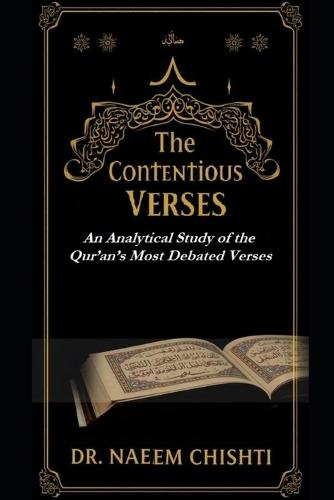
The Contentious Verses is a rigorous and balanced exploration of how a single sacred text has generated diverse, and at times deeply conflicting, interpretations across Islamic history. Revered by Muslims worldwide as divine revelation, the Qur'an has shaped theology, law, ethics, politics, and spirituality for more than fourteen centuries. Yet despite its unity as a text, disagreement over its meaning has been persistent and consequential. This book asks a fundamental question: how did interpretive divergence arise, and why have certain verses come to bear such an outsized burden of controversy? Focusing on approximately two hundred Qur'anic passages that have repeatedly surfaced in debates over belief, authority, law, gender, violence, salvation, and governance, this study examines not only what these verses say, but how they have been read, argued over, and institutionalized. These are the verses most frequently invoked in sectarian polemics, legal rulings, theological disputes, reformist critiques, and modern public controversies-both within Muslim societies and in their engagement with the wider world. Rather than advancing a new doctrine or privileging a particular sectarian position, this book adopts an analytical and interpretive approach. It maps the terrain of disagreement by situating contested verses within their linguistic, textual, and historical contexts, while tracing how competing readings emerged and gained authority. Classical tafsīr, juridical reasoning, theological argumentation, and modern interpretive trends are all engaged critically, without treating any single tradition as infallible or dismissing others as irrelevant. A central argument of the book is that disagreement did not arise despite the Qur'an's authority, but because of it. The Qur'an's language is concise, multivalent, and rhetorically layered; it addresses concrete historical situations while articulating universal moral principles. This dual character-situated yet transcendent-requires interpretation, and interpretation is inevitably shaped by human factors: language, context, ethical assumptions, institutional authority, and power. Over time, certain readings became embedded in law and doctrine, while others were marginalized or forgotten, not always because they were weaker, but because they were less useful to prevailing structures. The study is careful to acknowledge its own limitations. It does not claim to resolve every dispute it presents, nor does it attempt exhaustive historical coverage. Instead, it identifies recurring patterns of interpretation and highlights the methodological choices that underlie divergent conclusions. Special attention is given to linguistic polysemy, the problem of contextual distance from the moment of revelation, and the role of extra-Qur'anic frameworks-such as hadith, jurisprudence, and theology-in shaping meaning. Equally important is what this book is not. It is not a polemic against the Qur'an or the Islamic tradition, nor is it an argument for relativism or interpretive anarchy. It does not deny the authority of tradition, but insists on engaging that tradition critically and responsibly. Nor does it present disagreement as a failure of faith; rather, it treats interpretive plurality as a historical reality that must be understood, not obscured. In its concluding reflections, the book argues that the Qur'an provides enduring principles, while their application unfolds through human interpretation-an interpretive process that carries moral responsibility. If disagreement is inevitable, then clarity, honesty, humility, and restraint become ethical obligations for anyone who claims to speak in the name of the text. Written for scholars, students, and thoughtful readers alike, The book invites a slower, more reflective engagement with the Qur'an-one that resists sloganized readings and recovers the depth, complexity, and seriousness of the interpretive tradition.
Full Product Details
Author: Dr Naeem Chishti
Publisher: Independently Published
Imprint: Independently Published
Dimensions:
Width: 15.20cm
, Height: 1.90cm
, Length: 22.90cm
Weight: 0.485kg
ISBN: 9798247306542
Pages: 362
Publication Date: 07 February 2026
Audience:
General/trade
,
General
Format: Paperback
Publisher's Status: Active
Availability: Available To Order

We have confirmation that this item is in stock with the supplier. It will be ordered in for you and dispatched immediately.