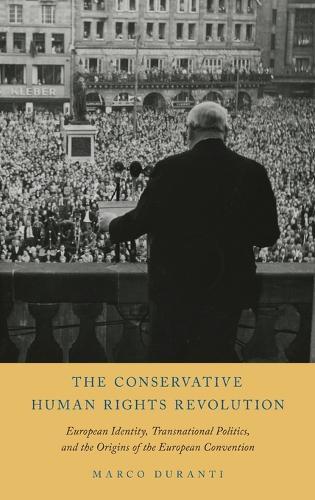
Full Product Details
Author: Marco Duranti (Lecturer in Modern European and International History, Lecturer in Modern European and International History, University of Sydney)
Publisher: Oxford University Press Inc
Imprint: Oxford University Press Inc
Dimensions:
Width: 23.60cm
, Height: 4.60cm
, Length: 15.50cm
Weight: 0.816kg
ISBN: 9780199811380
ISBN 10: 0199811385
Pages: 528
Publication Date: 23 February 2017
Audience:
College/higher education
,
Professional and scholarly
,
Tertiary & Higher Education
,
Professional & Vocational
Format: Hardback
Publisher's Status: Active
Availability: To order

Stock availability from the supplier is unknown. We will order it for you and ship this item to you once it is received by us.
Reviews
-Marco Duranti's immense contribution is to get us to see that human rights cannot hover forever above history. His story of the origins of our human rights culture is as convincing as it is surprising. In questioning our assumptions about the European Convention on Human Rights, he pulls off that rare feat of getting us to think about what we know in a wholly fresh way.---Conor Gearty, author of On Fantasy Island: Britain, Strasbourg, and Human Rights-Human rights history at its best. Duranti's well-written analysis of twentieth-century European internationalism is of lasting value. The insights into Euroskepticism that he provides could not be more timely. Necessary reading.---Lora Wildenthal, Rice University-Marco Duranti's enthralling and meditative study of the origins of the European Convention on Human Rights is not merely a lesson in historical imagination, restoring Winston Churchill's role as the project's prime mover and detailing the importance of a fateful alliance of religious conservatives and free-market defenders in its origins. For The Conservative Human Rights Revolution appears at a moment when it is even more instructive and ironic, with the Tories Duranti shows were instrumental in the beginning in full revolt against their own creation. Students of the past and observers of the present will welcome Duranti's own creation with gratitude.---Samuel Moyn, author of The Last Utopia: Human Rights in History-Required reading for anyone interested in the ideological foundations of the European Union.---Stefan-Ludwig Hoffmann, University of California, Berkeley-In this masterful--and timely--book, Marco Duranti plunges deep into rarely used archives to tell us the conservative origins of the European Convention on Human Rights. A magisterial and innovative piece of history that reshapes our understanding of human rights.---Patrick Weil, author of The Sovereign Citizen: Denaturalization and the Origins of the American Republic
Author Information
Marco Duranti is Senior Lecturer in Modern European and International History at the University of Sydney, where he directs the Nation Empire Globe Research Cluster. He has been a Fulbright Scholar at the European University Institute, a Fox Fellow at the Paris Institute of Political Studies, and a Postdoctoral Fellow in the Max Planck Research Group on History and Memory at the University of Konstanz.