Overview
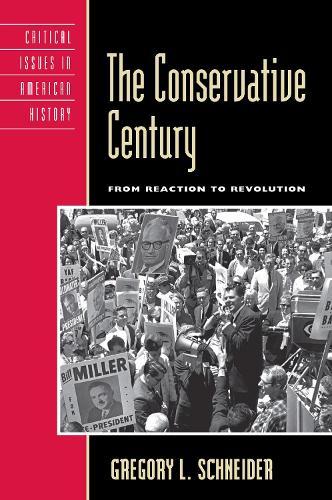
This concise history focuses on the development of American conservatism in the twentieth century up to the present. Gregory L. Schneider traces the course of a once-reactionary movement opposed to progressive reform and the New Deal and describes how it came to advance alternative policies and programs that revolutionized the shaping of domestic politics, foreign policy, and economic policy. Along the way he profiles such influential thinkers as William F. Buckley, Frank Meyer, Henry Regnery, and Barry Goldwater. He also details how the decline of liberalism after the 1960s helped conservatives gain political power, and how their energized activism and organization culminated in the election of Ronald Reagan in 1980. Schneider also describes how the years since the Reagan Revolution have been decidedly mixed for American conservatives.
Full Product Details
Author: Gregory L. Schneider
Publisher: Bloomsbury Publishing Plc
Imprint: Rowman & Littlefield
Dimensions:
Width: 15.50cm
, Height: 2.10cm
, Length: 23.30cm
Weight: 0.413kg
ISBN: 9780742542853
ISBN 10: 0742542858
Pages: 280
Publication Date: 16 November 2009
Audience:
General/trade
,
General
Format: Paperback
Publisher's Status: Active
Availability: Manufactured on demand

We will order this item for you from a manufactured on demand supplier.
Reviews
Gregory L. Schneider offers a thorough account in his new survey, The Conservative Century: From Reaction to Revolution. Schneider's copious account of the post-war conservative movement is superb. He offers good surveys of the few American conservative thinkers of the Progressive and New Deal eras such as Albert Jay Nock, Irving Babbitt, Paul Elmer More, Ralph Adams Cram, and the Southern Agrarians....--Steven Hayward Claremont Review Of Books
Gregory L. Schneider offers a thorough account in his new survey, The Conservative Century: From Reaction to Revolution. Schneider's copious account of the post-war conservative movement is superb. He offers good surveys of the few American conservative thinkers of the Progressive and New Deal eras such as Albert Jay Nock, Irving Babbitt, Paul Elmer More, Ralph Adams Cram, and the Southern Agrarians....--Steven Hayward Claremont Review Of Books, Winter 2009-10
Gregory L. Schneider has written an astute and absorbing contribution to the growing historical scholarship on American conservatism. In this well documented study, he demonstrates that modern conservatism has not been a static phenomenon but a supple, variegated, and resilient influence in American politics. -- George H. Nash, author of The Conservative Intellectual Movement in America Since 1945 Schneider takes a broad approach, considering conservatism a 'protean' movement that eludes easy definition, and succeeds in illustrating his assertion that this fluidity has allowed conservatism to flourish for an entire century. Students of political history will find a valuable perspective in this study. Publishers Weekly Schneider ... does a spirited job of walking through the standard post-Buckley history, but with a careful emphasis on what was new about its traditionalism, what was tossed away in its conservatism, what was statist in its supposed defenses of liberty. Reason Gregory L. Schneider offers a more thorough [account] in his new survey, The Conservative Century: From Reaction to Revolution precisely because it is limited to the 20th century... Schneider's copious account of the post-war conservative movement is superb. Claremont Review Of Books Gregory L. Schneider has already established a reputation as one of the preeminent historians of American conservatism. Steeped in a deep appreciation for the intellectual diversity of American conservatism and the long and arduous path that led conservatives from relative obscurity to political power, The Conservative Century will unquestionably assume a position next to George Nash's Conservative Intellectual Movement in America as one of the most insightful books on the subject. -- Marc A. Eisner, Henry Merritt Wriston Chair in Public Policy, Wesleyan University Dispassionate, systematic, and accessible, Schneider makes an important contribution that will be particularly useful as an introduction for students unfamiliar with one of the central story lines of twentieth-century American politics. Journal of American History
Author Information
Gregory L. Schneider is associate professor of history at Emporia State University.