Overview
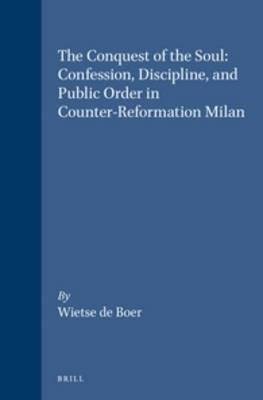
Carlo and Federico Borromeo achieved fame by turning Milan into the foremost laboratory of the Italian Counter-Reformation. This monograph interprets their programme of penitential discipline as a quest to reshape Lombard society by reaching into the souls of its inhabitants. This integration of the public and private spheres had vast implications- the transformation of the clergy into a professional body, a bureaucratic-juridical turn into sacramental practice, interventions into the ritual order (notably the introduction of the confessional), and new models of discipline and ""civilized"" behaviour. Catholic confessionalism thus conceived had decidedly mixed outcomes. While it transformed the religious landscape forever, its deepest ambitions foundered amidst political opposition, popular resistance, and a bureaucratic accommodation.
Full Product Details
Author: W. de Boer
Publisher: Brill
Imprint: Brill
Volume: 84
Dimensions:
Width: 15.50cm
, Height: 2.70cm
, Length: 23.50cm
Weight: 0.849kg
ISBN: 9789004117488
ISBN 10: 9004117482
Pages: 396
Publication Date: 28 November 2000
Audience:
College/higher education
,
Professional and scholarly
,
Undergraduate
,
Postgraduate, Research & Scholarly
Format: Leather / fine binding
Publisher's Status: Active
Availability: Out of stock

The supplier is temporarily out of stock of this item. It will be ordered for you on backorder and shipped when it becomes available.
Reviews
2001 Winner of the Howard R. Marraro Prize of the American Catholic Historical Association. <br>' This handsome volume is the latest in a truly distinguished series, the list of whose authors reads like a Who's Who of early modern historians. Wietse de Boer's book is eminently worthy of inclusion in such a series. He has made a great contribution to early modern Italian religious history...This erudite study [] is required reading for students of European society in the age of the Reformation.'<br>William V. Hudon, American Historical Review, 2002.<br>' a challenging and valuable contribution to our understanding of the place of Borromeo and his successors in the development of the Counter-Reformation and a healthy corrective to recent scholarship about the privatization of the sacrament of confession.'<br>Thomas Deutscher, Renaissance Quarterly, 2002.<br>' an excellent institutional historya convincing analysis of a particulary important region.'<br>R. Emmet McLaughlin, Sixteenth Century Journal, 2002.<br>
Author Information
Wietse de Boer, Ph.D. (1995) in History, Erasmus University Rotterdam, is Assistant Professor of History at Indiana University, Indianapolis. His recent publications focus particularly on the cultural aspects of the Italian Counter-Reformation.