Overview
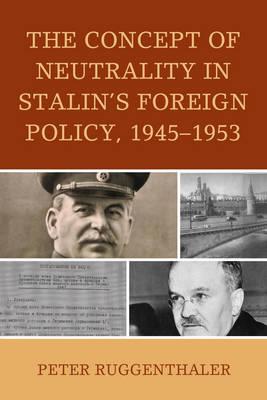
Drawing on recently declassified Soviet archival sources, this book sheds new light on how the division of Europe came about in the aftermath of World War II. The book contravenes the notion that a neutral zone of states, including Germany, could have been set up between East and West. The Soviet Union under Joseph Stalin was determined to preserve control over its own sphere of German territory. By tracing Stalin's attitude toward neutrality in international politics, the book provides important insights into the origins of the Cold War.
Full Product Details
Author: Peter Ruggenthaler
Publisher: Bloomsbury Publishing Plc
Imprint: Lexington Books
Dimensions:
Width: 15.30cm
, Height: 2.60cm
, Length: 23.30cm
Weight: 0.685kg
ISBN: 9781498517454
ISBN 10: 1498517455
Pages: 442
Publication Date: 14 April 2017
Audience:
College/higher education
,
Postgraduate, Research & Scholarly
Format: Paperback
Publisher's Status: Active
Availability: In Print

This item will be ordered in for you from one of our suppliers. Upon receipt, we will promptly dispatch it out to you. For in store availability, please contact us.
Reviews
Ruggenthaler has produced what is nothing less than one of the most important studies to date of Stalin's post-war foreign policy. There is little doubt that it brings us several leaps forward in our understanding of this troubled period. It should be essential reading for historians and area specialists, as well as students of foreign policy analysis. Scandinavian Journal of History Piercing the web of deception, cynicism, and intransigence characteristic of Soviet foreign policy, Ruggenthaler's authoritative explanation of Stalin's concept of neutrality from new sources in Russian archives is not only a breakthrough in our understanding of the early Cold War. His book is also timely reading for anyone seeking to understand the continuities in the Kremlin's conduct of foreign affairs that persist regardless of the passing of the Soviet empire. -- Vojtech Mastny, author of The Cold War and Soviet Insecurity: The Stalin Years On the basis of extensive archival research in Russia, the United States and other countries, Peter Ruggenthaler breaks new ground on Soviet foreign policy, particularly with regard to Austria and Scandinavia. Seeking maximum extension of power, Stalin was averse of neutrality but understood that, if there was major countervailing interest, he might better accept some kind of neutral status. This was the case with Finland and Austria but not with Germany which was to open the road to Western Europe. This monograph is a solid study which adds considerably to our knowledge of history after World War II. -- Gerhard Wettig, author of Stalin and the Cold War in Europe: The Emergence and Development of East-West Conflict, 1939-1953
Author Information
Peter Ruggenthaler is senior research fellow at the Ludwig Boltzmann Institute for Research on War´s Consequences and lecturer at the University of Graz.