Overview
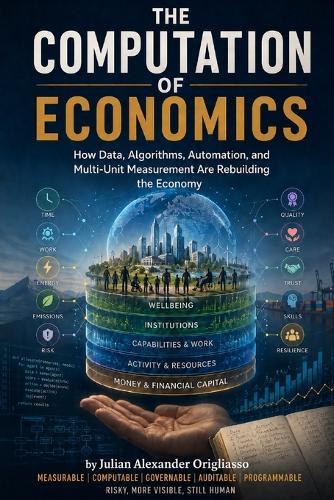
What happens when the economy becomes computable? For centuries, economics has been measured through money, prices, markets, accounting records, financial statements, and GDP. These tools remain essential, but they no longer describe the full reality of modern economic life. Today, the economy is increasingly shaped by data, algorithms, artificial intelligence, automation, platforms, sensors, software systems, digital infrastructure, and real-time records. Work is tracked through digital workflows. Capital can move through automated finance. Governments administer services through digital systems. Platforms allocate visibility, labour, opportunity, and trust. AI is changing knowledge work. Robotics and sensors are bringing computation into the physical economy. The Computation of Economics argues that the economy is entering a new measurement era. Money remains important, but it is now one measurement layer inside a much larger system. The real economy also includes time, work, quality, capability, energy, emissions, care, trust, risk, resilience, institutional performance, and human wellbeing. This book does not argue that computation will solve economics. It argues something more serious: computation can make more of the economy visible, but visibility is not the same as wisdom. Across money, prices, accounting, GDP, platforms, algorithms, AI, robotics, digital government, automated finance, economic simulation, and multi-unit measurement, Julian Alexander Origliasso presents a new framework for understanding how the real economy is being rebuilt through computation. This is a book for readers interested in economics, accounting, AI, automation, public policy, systems thinking, governance, digital platforms, the future of work, and the future of economic measurement. At its centre is one question: How does a real economy become measurable, computable, governable, and still human? The answer is not more technology for its own sake. The answer is better measurement, better accountability, better institutions, and better human judgement. The economy should not be computed so people can be controlled more efficiently. It should be computed so reality can be seen more clearly, responsibility can be assigned more fairly, and human life can be improved more deliberately.
Full Product Details
Author: Julian Alexander Origliasso
Publisher: Independently Published
Imprint: Independently Published
Dimensions:
Width: 15.20cm
, Height: 1.70cm
, Length: 22.90cm
Weight: 0.435kg
ISBN: 9798259035591
Pages: 324
Publication Date: 27 April 2026
Audience:
General/trade
,
General
Format: Paperback
Publisher's Status: Active
Availability: Available To Order

We have confirmation that this item is in stock with the supplier. It will be ordered in for you and dispatched immediately.