Overview
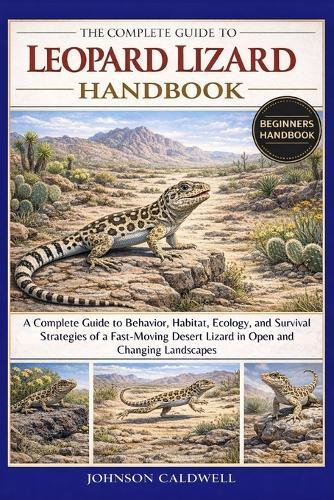
Introduction to the Leopard LizardA Desert Lizard Built for Exposure, Speed, and PrecisionThe leopard lizard is the kind of reptile that makes sense the moment you see it in its natural setting. It does not hide in dense vegetation or creep quietly through thick ground cover. Instead, it lives in open country-wide, sun-washed spaces where the ground is pale and dry, the shadows are sharp, and the horizon feels close. In that exposed world, survival depends on the ability to read heat, terrain, and movement with accuracy. The leopard lizard meets those demands with a body designed for sprinting, a temperament shaped by caution, and a lifestyle that balances boldness with instant retreat. The name ""leopard lizard"" comes from its striking spotted pattern, which can look almost too decorative for such a harsh landscape. Yet those markings are not simply ornamental. In many habitats, the mixture of light soil, broken shadows, scattered stones, and patchy vegetation creates a visually complex background. Spots and bars break up the lizard's outline, making it harder for predators to lock onto its shape when it freezes. The leopard lizard is not a creature that relies on one trick; its success comes from switching seamlessly between camouflage, speed, and shelter-depending on what the moment demands. Where It Fits in the Living Desert Leopard lizards are most strongly associated with arid and semi-arid regions, where plant cover is low and the ground heats quickly. These landscapes can look empty to people, but they are full of movement at small scales: insects shifting in the dust, small mammals cutting across open ground, birds watching from above, and other reptiles using rocks and burrows as thermal refuges. Within that active network, the leopard lizard sits in an important middle position. It is a predator of smaller animals, yet it is also prey for larger hunters. That dual role shapes everything about its behavior. In practical terms, a leopard lizard must behave like an efficient hunter without becoming a visible target. It must feed enough to maintain body condition, grow, and reproduce, but it must also avoid drawing attention while doing so. This is why its daily routine is rarely chaotic. Instead, it is structured, repetitive, and highly responsive to micro-changes in temperature and risk. A Life Directed by Heat and Ground-Level Reality If there is one key to understanding the leopard lizard, it is this: body temperature controls life quality. When the lizard is too cool, it cannot move well, cannot strike accurately, and cannot escape quickly. When it is too hot, it risks dehydration, overheating, and reduced coordination. The leopard lizard solves this by treating the environment like a map of thermal options. Sunlit soil, shaded shrubs, burrow entrances, and rock edges each represent different temperatures. The lizard moves through that thermal map throughout the day, using posture and location to keep its body within a workable range. This is why leopard lizards are so often seen in transitional zones-near burrow openings, along the edges of low shrubs, or on slightly elevated ground where they can bask but still retreat. Their presence is rarely random. If you see a leopard lizard sitting still, it is not wasting time. It is making a choice that balances warmth, visibility, and escape distance.
Full Product Details
Author: Johnson Caldwell
Publisher: Independently Published
Imprint: Independently Published
Dimensions:
Width: 15.20cm
, Height: 0.70cm
, Length: 22.90cm
Weight: 0.177kg
ISBN: 9798245023540
Pages: 126
Publication Date: 26 January 2026
Audience:
General/trade
,
General
Format: Paperback
Publisher's Status: Active
Availability: Available To Order

We have confirmation that this item is in stock with the supplier. It will be ordered in for you and dispatched immediately.