|
|
|||
|
||||
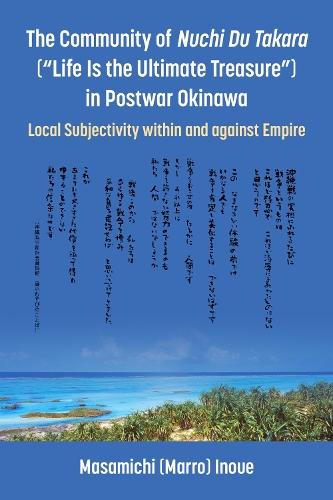
OverviewAgainst the background of the prolonged US military presence in post–World War II Okinawa, The Community of Nuchi Du Takara (“Life Is the Ultimate Treasure”) in Postwar Okinawa explores the conflict between Okinawa and the US-Japan alliance. Developing the local notion of nuchi du takara into an analytical concept, Inoue examines how Okinawan activists, artists, writers, and other social actors have resisted US military presence, particularly the planned construction of a new military facility in northern Okinawa. The concept of nuchi du takara also helps Inoue explore complex negotiations Okinawa has had with Washington and Tokyo beyond resistance and protest, a process that involves developing a local communal capacity to embrace diverse and often contradictory attitudes toward the US military. Inoue’s grounded investigation underscores the possibility of small yet significant, incremental social changes from below, a possibility that ultimately points toward the World Republic—an international politics built upon peace, democracy, and shared affluence—against the sovereignty of global capitalism. Full Product DetailsAuthor: Masamichi (Marro) InouePublisher: The University of Michigan Press Imprint: The University of Michigan Press Weight: 0.454kg ISBN: 9780472077144ISBN 10: 0472077147 Pages: 456 Publication Date: 10 February 2025 Audience: College/higher education , Postgraduate, Research & Scholarly Format: Hardback Publisher's Status: Active Availability: Available To Order We have confirmation that this item is in stock with the supplier. It will be ordered in for you and dispatched immediately. Table of ContentsIntroduction Part I. Anti-base Struggles in Henoko and the Formation of the Community of Nuchi Du Takara by the Okinawan Multitude Introduction to Part I Chapter 1: Anti-base Struggles in Henoko, 2004-2023 Chapter 2: Protest as a Life-Form of the Okinawan Multitude: Internal Workings of the Community of Nuchi Du Takara Conclusion to Part 1 Part II . Money and Taboo: Okinawan Subjectivity as “a Changing Same” and the Construction of the Community of Nuchi Du Takara Introduction to Part II Chapter 3: Ambivalence toward the U.S. Military: Formation of the Androcentric Community by the Okinawan “People” (1945-1972) Chapter 4: Money and the Development of Okinawan Citizenship in Post-Reversion Okinawa (1970s-1990s) Conclusion to Part II Part III. Empire in the Asia-Pacific Region: Between American/Global and Japanese/National Introduction to Part III Chapter 5: American/Global/Postmodern Tendencies of Empire: Five Historical Moments of Its Formation and Transformation Chapter 6: Dojin and Okinawa: Official Nationalism v.1, v.2, and v.3 Conclusion to Part III Part IV. A Paradigm beyond Self and Other: The Okinawan Multitude within and against Empire in the Asia-Pacific Region Introduction to Part IV Chapter 7: The Mimetic Production of the Okinawan Multitude in the Planetary Time-SpaceChapter 8: Conclusion: Collective Security from an Okinawan Perspective ReferencesReviews""This scholarly work does a good job of indicating the nuances and the conflict between Okinawa and the U.S.-Japan alliance. Recommended for graduate students and readers interested in modern East Asia.""-- ""Joshua Wallace, Library Journal"" Author InformationMasamichi (Marro) Inoue is Professor of Japan Studies in the Department of Modern and Classical Languages, Literatures and Cultures at the University of Kentucky. Tab Content 6Author Website:Countries AvailableAll regions |
||||