Full Product Details
Author: Keith Stewart Thomson ,
Linda Price Thomson
Publisher: Yale University Press
Imprint: Yale University Press
Edition: New edition
Dimensions:
Width: 15.90cm
, Height: 0.20cm
, Length: 24.10cm
Weight: 0.299kg
ISBN: 9780300066548
ISBN 10: 0300066546
Pages: 200
Publication Date: 04 March 1996
Audience:
General/trade
,
General
Format: Paperback
Publisher's Status: Active
Availability: Manufactured on demand

We will order this item for you from a manufactured on demand supplier.
Reviews
“Thomson loves biology and literature with equal passion. . . . Writing with rare eloquence, he mourns the current death of literary merit in scientific literature, drawing a parallel between the demise of cogent expression and the fate of the loons on his favorite New Hampshire lake.”—Charles Solomon, Los Angeles Times “A wonderful exploration of some of the most interesting nooks and crannies of evolutionary science.”—Paul R. Ehrlich, Stanford University
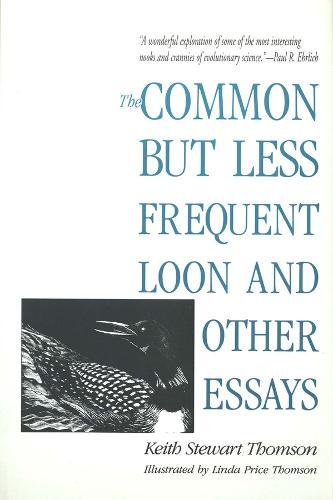
Twenty-four shapely essays, most drawn from American Scientist, by paleoichthyologist Thomson (Living Fossil, 1991), president of the Academy of Natural Sciences. Thomson divides his pieces into three groups. The first assemblage, The Uses of Diversity, devoted to natural history, includes the title essay on the loons that haunt New Hampshire lakes where Thomson vacations each summer. Other pieces ponder, in a benign, literate voice, the lost Benjamin Franklin tree, an extremely rare plant extinct in the wild; the degradation of the modern urban landscape and the roots of this despoiling in the farming techniques of the first European settlers; studies of horsemanship, shark locomotion, and the neural crest (a developmental feature in embryonic vertebrates); and a celebration of that delightful, neglected 18th-century British natural historian, writer, and country parson, Gilbert White. Part Two, On Becoming a Scientist, digs deeper: Here, Thomson not only shares charming autobiographical reminiscences of boyish scientific enthusiasms but pushes hard for better scientific publishing (urging everyone to write fewer and more significant works ). The final section, The Future of Evolution, explores the multiple meanings of that overworked term; sings a paean to university research museums; puzzles over why paleontology (dinosaurs excepted) has fallen out of favor; and gingerly pushes the idea that variations in evolution may be directed rather than strictly random. Suffused with the sense of wonder that unites the wide-eyed child and the white-haired Nobel laureate: an uncommonly good collection. (Kirkus Reviews)
Author Information
Keith Stewart Thomson (1938–2025) was a distinguished evolutionary biologist, historian, and writer. He was emeritus professor of natural history at the University of Oxford and had served as director of the Oxford Museum of Natural History, the Academy of Natural Sciences in Philadelphia, and the Peabody Museum at Yale University, where he was also a professor and dean. He wrote many books and essays on history, history of science, evolution, and paleontology, including Before Darwin: Reconciling God and Nature; The Young Charles Darwin; The Legacy of the Mastodon: The Golden Age of Fossils in America; and Jefferson’s Shadow: The Story of His Science.